- Animals
- ›Chordates
- ›Vertebrates
- ›Birds
- ›Swifts and Hummingbirds
- ›Hummingbirds
- ›Bee Hummingbirds, Emeralds, Mountain-gems, and Allies
- ›Emerald Hummingbirds and Allies
- ›Chlorestes
On eBird ↗
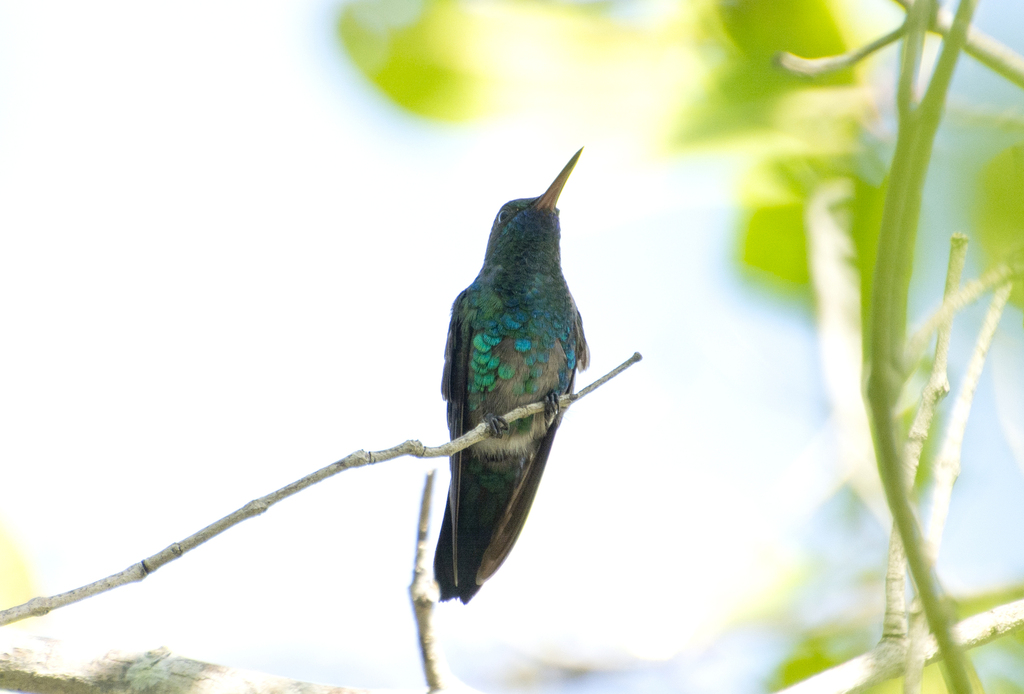
Blue-chinned Sapphire
Live sightings near you, the range map, bar charts of when it is seen, and Macaulay Library photos and recordings.
Blue-chinned Sapphire
Chlorestes notata
The blue-chinned sapphire or blue-chinned emerald (Chlorestes notata) is a hummingbird that ranges from Colombia south and east to the Guianas, Trinidad and Tobago, Peru, and Brazil. There have been occasional records from Tobago. For Brazil, the species' range is along the main Amazon River Basin, as well as the Atlantic Forest, both in the northeast, as well as far south on the southeast coastal strip, (an entire coastal strip, north-east-south of about 3,000 km (1,900 mi)). It is sometimes placed in the genus Chlorostilbon.
It is a bird of forests and sometimes cultivated areas with large trees. The female lays her eggs in a deep cup nest, made of lichen and other fine plant material and placed on a horizontal tree branch. Incubation is 16 days with a further 18–19 days to fledging.
From the article Blue-chinned sapphire on Wikipedia (CC BY-SA), quoted section by section
Description
The blue-chinned sapphire is 8.9 cm (3.5 in) long and weighs 3.8 g (1⁄8 oz). The bill is fairly straight, with the upper mandible black and the lower reddish. The male has mainly green plumage, darker above, with white thighs, a forked metallic blue tail and blue upper throat. The female differs from the male in that she has green-spotted white underparts.
Listen
Looking for field recordings…
Where it lives
Recorded sightings
—
geo-referenced records in GBIF, from museums, herbaria and field observers.
Drag the globe to turn it. Dots are where records exist, not a range map; darker means more records.
In the stacks
Searching the stacks…
Every page naming Chlorestes notata in the Biodiversity Heritage Library →
This page is assembled live from iNaturalist, GBIF, Wikipedia, the Source Library and the Internet Archive. It is not yet part of the hand-edited codex. iNaturalist taxon 72661.