- Animals
- ›Chordates
- ›Vertebrates
- ›Birds
- ›Swifts and Hummingbirds
- ›Hummingbirds
- ›Bee Hummingbirds, Emeralds, Mountain-gems, and Allies
- ›Bee Hummingbirds and Allies
- ›Calothorax
On eBird ↗
Beautiful Hummingbird
Live sightings near you, the range map, bar charts of when it is seen, and Macaulay Library photos and recordings.
Beautiful Hummingbird
Calothorax pulcher
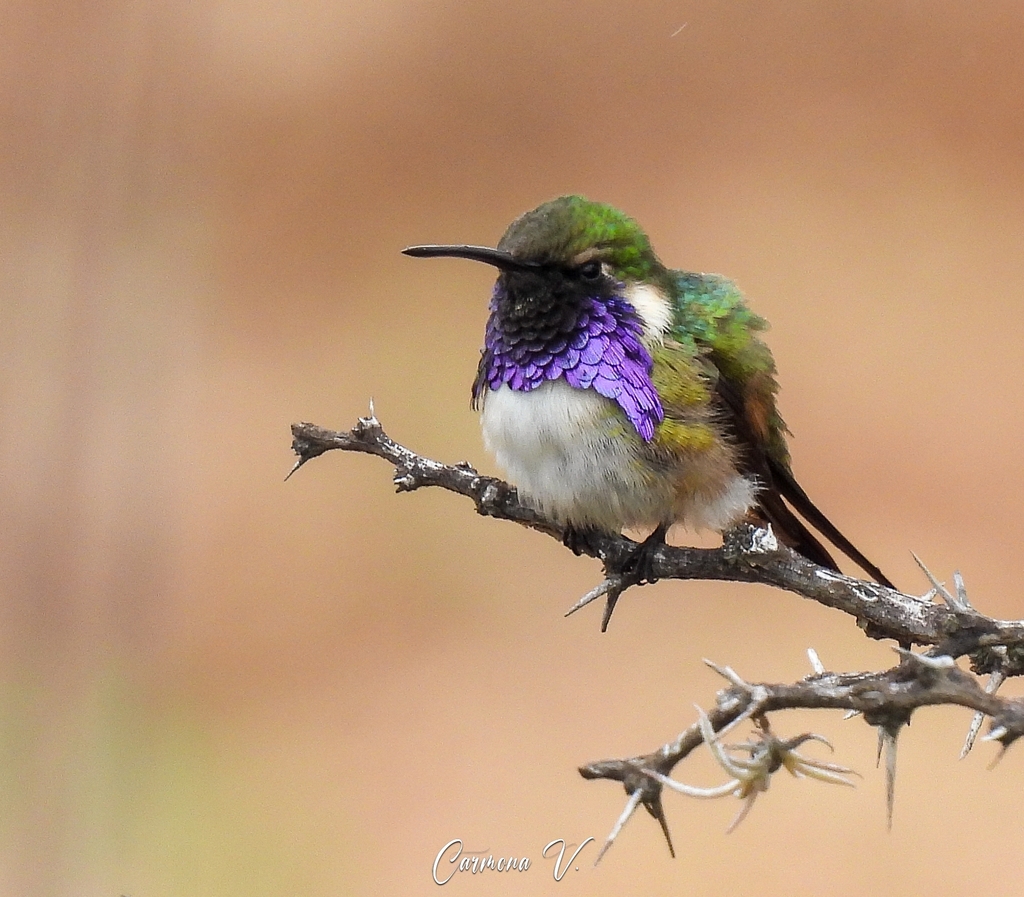
The beautiful sheartail or beautiful hummingbird (Calothorax pulcher) is a species of hummingbird in the family Trochilidae. It is found in southern-central Mexico. Its natural habitat is subtropical or tropical high-altitude shrubland.
From the article Beautiful sheartail on Wikipedia (CC BY-SA), quoted section by section
Description
The beautiful sheartail is 7.7 to 9 cm (3.0 to 3.5 in) long and weighs about 2.2 to 3 g (0.078 to 0.11 oz). Both sexes have a long, slightly decurved, black bill. Males have metallic bronze green upperparts and a white stripe behind the eye. Their gorget is metallic magenta purple that is more violet and blue to the rear; the rear feathers are elongated. The breast is grayish white, the flanks metallic bronze green, and the undertail coverts white. The tail is long and forked. The central two pairs of feathers are metallic bronze green and the other three pairs bronzy black. The female's upperparts are also metallic bronze green that is duller on the crown. The underparts are pale grayish buff with cinnamon buff flanks. The tail is shorter than the male's and rounded. Its central two pairs of feathers are bright bronze green. The three outer pairs have light cinnamon rufous bases and the balance is black but for white tips on the outer two pairs.
Range & habitat
The beautiful sheartail is found only in south central Mexico, from central Guerrero and southern Puebla south to Oaxaca. It inhabits arid and semiarid scrublands, semi-open areas with trees and shrubs, and gallery forest, mostly within interior valleys. In elevation it ranges between 1,000 and 2,200 m (3,300 and 7,200 ft).
Wikipedia: “Distribution and habitat”
What it does
The beautiful sheartail mostly forages close to the ground but will feed at any height vegetation. It takes nectar from a wide variety of plants though details are lacking. Its close relative the Lucifer hummingbird defends patches of flowers. In addition to feeding on nectar, the beautiful sheartail takes small insects by hawking from a perch.
Wikipedia: “Feeding”
Listen
Looking for field recordings…
Where it lives
Recorded sightings
—
geo-referenced records in GBIF, from museums, herbaria and field observers.
Drag the globe to turn it. Dots are where records exist, not a range map; darker means more records.
In the stacks
Searching the stacks…
Every page naming Calothorax pulcher in the Biodiversity Heritage Library →
This page is assembled live from iNaturalist, GBIF, Wikipedia, the Source Library and the Internet Archive. It is not yet part of the hand-edited codex. iNaturalist taxon 72595.