On eBird ↗
Brown Hornbill
Live sightings near you, the range map, bar charts of when it is seen, and Macaulay Library photos and recordings.
Brown Hornbill
Anorrhinus austeni
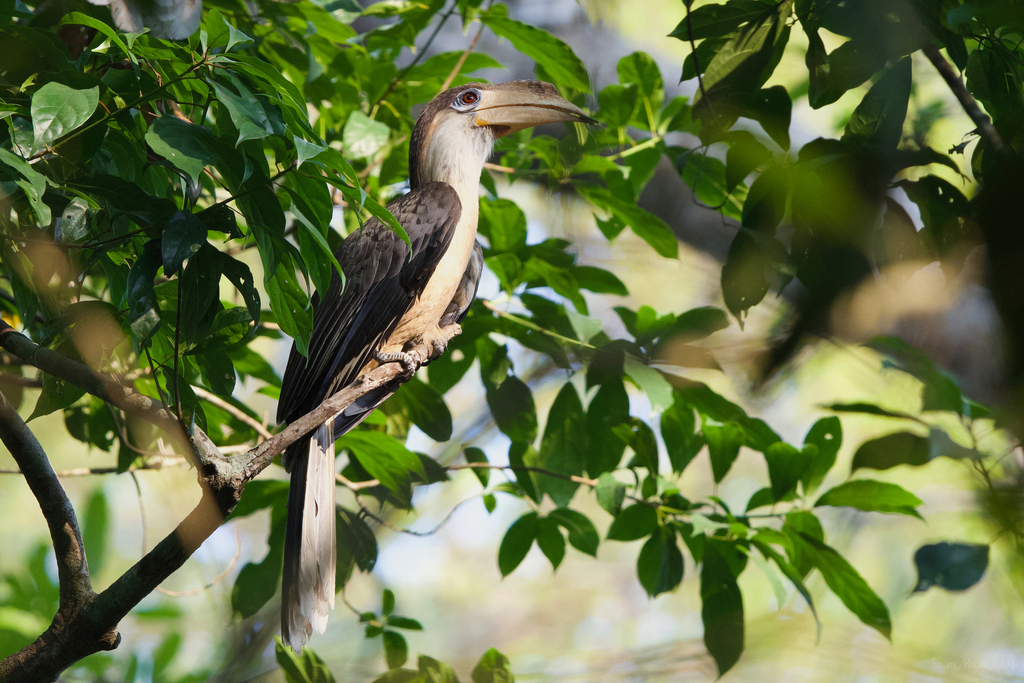
Austen's brown hornbill (Anorrhinus austeni), also known as the white-throated brown hornbill or brown hornbill, is a medium-sized species of hornbill found in forests from northeastern India to Vietnam and northern Thailand. It is rare throughout its range and is threatened by habitat loss and fragmentation.
From the article Austen's brown hornbill on Wikipedia (CC BY-SA), quoted section by section
Description
Austen's brown hornbill has dark brown upperparts (back, wings, and tail) with a lighter-coloured belly, cheeks, and throat. It has a white-tipped tail and wings and has blue-coloured bare skin around the eyes. The species is sexually dimorphic. The bill and casque are ivory white in females and cream-coloured in males. Females have a grey-brown throat, belly, and cheeks, whereas males have a whitish throat and cheeks with a reddish belly. The female also has a yellow wash below the eye. Juveniles look similar to adult males but have a short yellow bill, orange skin around the eye, and pale-brown feather tips. The male weighs 710–900 g (25–32 oz) and is 73–80 cm (29–31 in) long. The female is smaller.
Range & habitat
Austen's brown hornbill is found in northeastern India, central and northern Thailand, Myanmar, Laos, Vietnam, Cambodia, and historically China but there have been no recent reports. It is rare in most of its range and found mainly in national parks and sanctuaries where forests are protected such as the Patkai Wildlife Sanctuary and Namdapha Tiger Reserve. It is common in Laos but the population is declining. It lives mainly in dense evergreen forests in lowlands and foothills, and is less commonly found in deciduous forests. It has been observed up to 1,000 m (3,300 ft) in India, 1,500 m (4,900 ft) in Southeast Asia, and 1,800 m (5,900 ft) in Tibet. It moves through the forest at or below canopy level, but uses all canopy layers equally.
Wikipedia: “Distribution and habitat”
What it does
Austen's brown hornbill eats fruits and small animals. The percentage of animal matter in its diet ranges from 40–79% and includes arthropods, molluscs, earthworms, reptiles, bats, and bird eggs and chicks. The percentage of fruit matter ranges from 20–60% with a large portion of that being figs. Compared to other hornbill species, Austen's brown hornbill is an animal specialist and spends more time hunting animals below the canopy. The proportion of various food items and amount of food consumed overall changes throughout the phases of the breeding season.
Wikipedia: “Diet”
Listen
Looking for field recordings…
Where it lives
Recorded sightings
—
geo-referenced records in GBIF, from museums, herbaria and field observers.
Drag the globe to turn it. Dots are where records exist, not a range map; darker means more records.
In the stacks
Searching the stacks…
Every page naming Anorrhinus austeni in the Biodiversity Heritage Library →
This page is assembled live from iNaturalist, GBIF, Wikipedia, the Source Library and the Internet Archive. It is not yet part of the hand-edited codex. iNaturalist taxon 72505.