- Animals
- ›Chordates
- ›Vertebrates
- ›Birds
- ›Swifts and Hummingbirds
- ›Hummingbirds
- ›Brilliants, Coquettes, and Allies
- ›Coquettes and Allies
- ›Aglaiocercus
On eBird ↗
Venezuelan Sylph
Live sightings near you, the range map, bar charts of when it is seen, and Macaulay Library photos and recordings.
Venezuelan Sylph
Aglaiocercus berlepschi
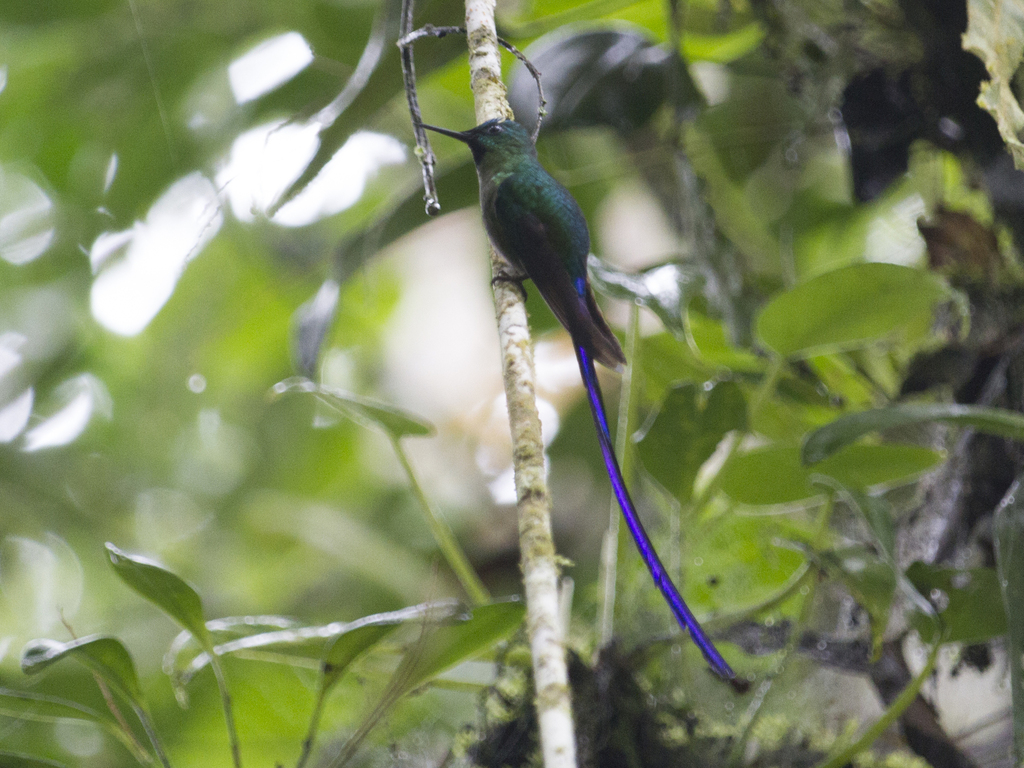
The Venezuelan sylph (Aglaiocercus berlepschi) is a small bird in the hummingbird family, Trochilidae. It is restricted to the eastern Venezuelan Coastal Range and is classed as an endangered species by BirdLife International. It is sometimes considered to be a subspecies of the long-tailed sylph (A. kingi).
From the article Venezuelan sylph on Wikipedia (CC BY-SA), quoted section by section
Description
The male Venezuelan sylph is 22 cm (8.7 in) long including the 14 to 15 cm (5.5 to 5.9 in) outer tail feathers and weighs 5.5 g (0.19 oz). Females are 9.5 to 11 cm (3.7 to 4.3 in) long and weigh 4.5 g (0.16 oz). Both sexes have a short black bill. Males have a dark glittering green crown and a shining green back. They have a glittering blue gorget and bronzy green underparts with puffy white thighs. The inner tail feathers are short and blue-green; the outer ones are very long and deep violet at the base becoming blue at the end. Females have a glittering blue crown; otherwise their upperparts are similar to the male's. Their throat, breast, and belly are white with green spots. Their tail is short and slightly forked, blue-green with white tips on the outer feathers. Immatures resemble adult females with buffy fringes on the head feathers.
Range & habitat
The Venezuelan sylph occurs where Sucre, Monagas, and Anzoátegui states meet. It is found in two ranges of the Turimiquire Massif, the eastern Cordillera de Caripe and the western Serranía de Turimiquire. It inhabits subtropical forest and scrubland on coastal mountain slopes between 1,450 and 1,800 m (4,800 and 5,900 ft) of elevation.
Wikipedia: “Distribution and habitat”
What it does
The Venezuelan sylph feeds on nectar from flowering vines, shrubs, and trees, especially those of genus Inga. It uses trap-lining around a circuit of flowering plants but also will defend specific feeding territories. It also catches insects by hawking from a perch. It typically forages alone or in pairs but sometimes several will feed at a flowering tree.
Wikipedia: “Feeding”
Listen
Looking for field recordings…
Where it lives
Recorded sightings
—
geo-referenced records in GBIF, from museums, herbaria and field observers.
Drag the globe to turn it. Dots are where records exist, not a range map; darker means more records.
In the stacks
Searching the stacks…
Every page naming Aglaiocercus berlepschi in the Biodiversity Heritage Library →
This page is assembled live from iNaturalist, GBIF, Wikipedia, the Source Library and the Internet Archive. It is not yet part of the hand-edited codex. iNaturalist taxon 72473.