- Animals
- ›Arthropods
- ›Hexapods
- ›Insects
- ›Winged and Once-winged Insects
- ›Flies
- ›Brachyceran Flies
- ›Orthorrhaphan Flies
- ›Asiloidea
- ›Mydas Flies
- ›Mydinae
- ›Mydini
- ›Gauromydas
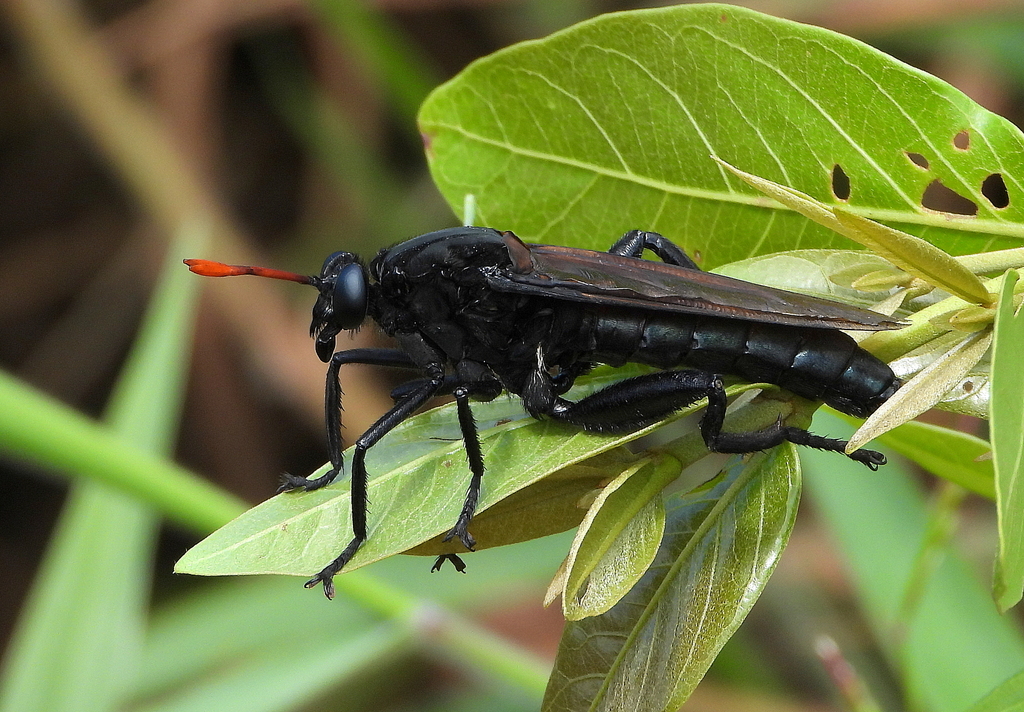
Gauromydas heros
The Mydidae (sometimes misspelled as "Mydaidae"), or Mydas flies, are a cosmopolitan family of flies. It is a small family, with about 471 species described. They are generally large in size, including the largest known fly, Gauromydas heros (syn. Mydas heros). Many of the species, in addition to their large size, are mimics of stinging hymenopterans, especially wasps.
Most mydids are found in arid and semiarid regions of the world, but they are also found in other habitats. Mydidae are most diverse in southern Africa, but many species have also been described from North America, Chile, and Australia.
From the article Mydas fly on Wikipedia (CC BY-SA), quoted section by section
Description
Mydids are medium-sized to very large flies (9–60 mm in body length). The abdomen is long and cylindrical in section. It is slightly tapered apically in the male, and usually widest at segment four in the female. The second segment of the antenna forms a club. Mydids are sparsely pilose, and lack bristles except on the legs. The hind leg is much longer and stronger than both the middle leg and the fore leg and the hind femur is usually swollen and bears ventral spines. The hind tibia has an apical spur or bristles. The wings are long, and narrow to wide. Most of the veins end in the upper margin before the apex.
In human culture
The oldest known member of the family is Cretomydas from the Early Cretaceous (Aptian) Crato Formation of Brazil. The genus appears to have close affinites to the subfamily Diochlistinae, suggesting a Cretaceous diversification for the family.
Wikipedia: “Evolutionary history”
Listen
Looking for field recordings…
Where it lives
Recorded sightings
—
geo-referenced records in GBIF, from museums, herbaria and field observers.
Drag the globe to turn it. Dots are where records exist, not a range map; darker means more records.
In the stacks
Searching the stacks…
Every page naming Gauromydas heros in the Biodiversity Heritage Library →
This page is assembled live from iNaturalist, GBIF, Wikipedia, the Source Library and the Internet Archive. It is not yet part of the hand-edited codex. iNaturalist taxon 712497.