- Animals
- ›Arthropods
- ›Hexapods
- ›Insects
- ›Winged and Once-winged Insects
- ›Flies
- ›Brachyceran Flies
- ›Cyclorrhaphan Flies
- ›Schizophoran Flies
- ›Calyptrate Flies
- ›Bot Flies, Blow Flies, and Allies
- ›Blow Flies
- ›Chrysomyinae
- ›Compsomyiops
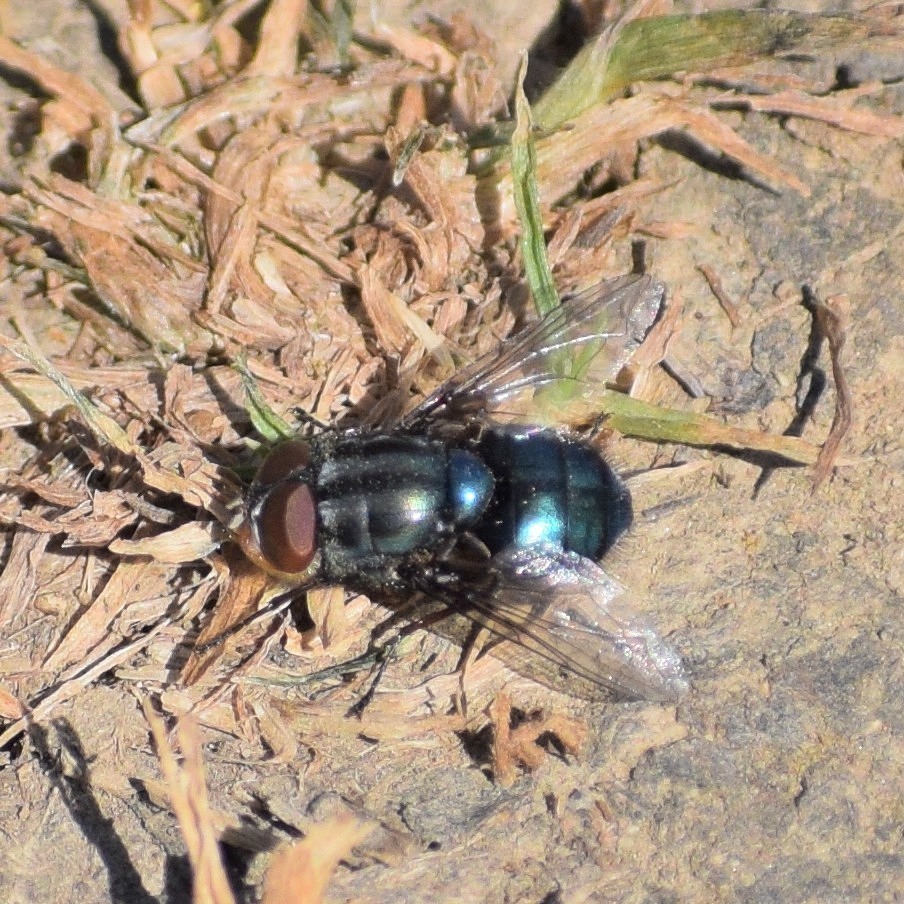
Compsomyiops callipes
Compsomyiops callipes, previously known as Paraluclia wheeleri, is a member of the blowfly family Calliphoridae. It is a warm weather fly that can be found in southwestern parts of the United States and parts of South America. This species can be identified by its chaetotaxy, metallic blue color, club-shaped palp, and brown calypters.
Compsomyiops callipes serves an important role in the field of medicocriminal entomology, a subfield of forensic entomology, by determining post mortem intervals (PMI). This species is attracted to carrion and has been involved in case studies in California where it has been the primary fly found on human remains.
From the article Compsomyiops callipes on Wikipedia (CC BY-SA), quoted section by section
Description
Compsomyiops callipes is a member of the order Diptera meaning two wings. Diptera are characterized by having two forewings and halteres. Since it is a member of the family Calliphoridae, it has bristles on the meron, its antennae have plumose arista, and it has two to three notopleural bristles. The subfamily Chrysomyinae is characterized by a setose stem vein on the wings. Compsomyiops callipes is a relatively large fly with a length of about 6–12 mm. Its abdomen and thorax are a metallic blue color. It has a bright yellow gena and four longitudinal lines on its pronotum. The setae on the posterior margin of the hind coxa are long and dark. Its palp, which is an appendage near its mouth used for sensation, movement and feeding, is clavate meaning club-shaped. Its anterior spiracle and calypters are brown. Compsomyiops callipes is very similar in appearance to flies belonging to the genus Cochliomyia but can be distinguished by its palp, calypters, and chaetotaxy, which is the study of the arrangement of setae.
What it does
Compsomyiops callipes is attracted to carrion. In accordance with other blow-flies, it can smell carrion from up to 10 miles away. Flowers like the American pawpaw and Dead Horse Arum produce these smells of death to attract the flies thereby spreading their pollen. Nectar from these flowers can be used to generate energy for flight. Compsomyiops callipes were found on rat carrion in a Venezuelan study. Larvae from Compsomyiops callipes are commonly found on dead bodies providing time of death estimations.
Wikipedia: “Feeding”
Listen
Looking for field recordings…
Where it lives
Recorded sightings
—
geo-referenced records in GBIF, from museums, herbaria and field observers.
Drag the globe to turn it. Dots are where records exist, not a range map; darker means more records.
In the stacks
Searching the stacks…
Every page naming Compsomyiops callipes in the Biodiversity Heritage Library →
This page is assembled live from iNaturalist, GBIF, Wikipedia, the Source Library and the Internet Archive. It is not yet part of the hand-edited codex. iNaturalist taxon 704084.