- Animals
- ›Arthropods
- ›Hexapods
- ›Insects
- ›Winged and Once-winged Insects
- ›Flies
- ›Brachyceran Flies
- ›Orthorrhaphan Flies
- ›Snipe Flies and Allies
- ›Horse and Deer Flies
- ›Horse Flies
- ›Haematopotini
- ›Haematopota
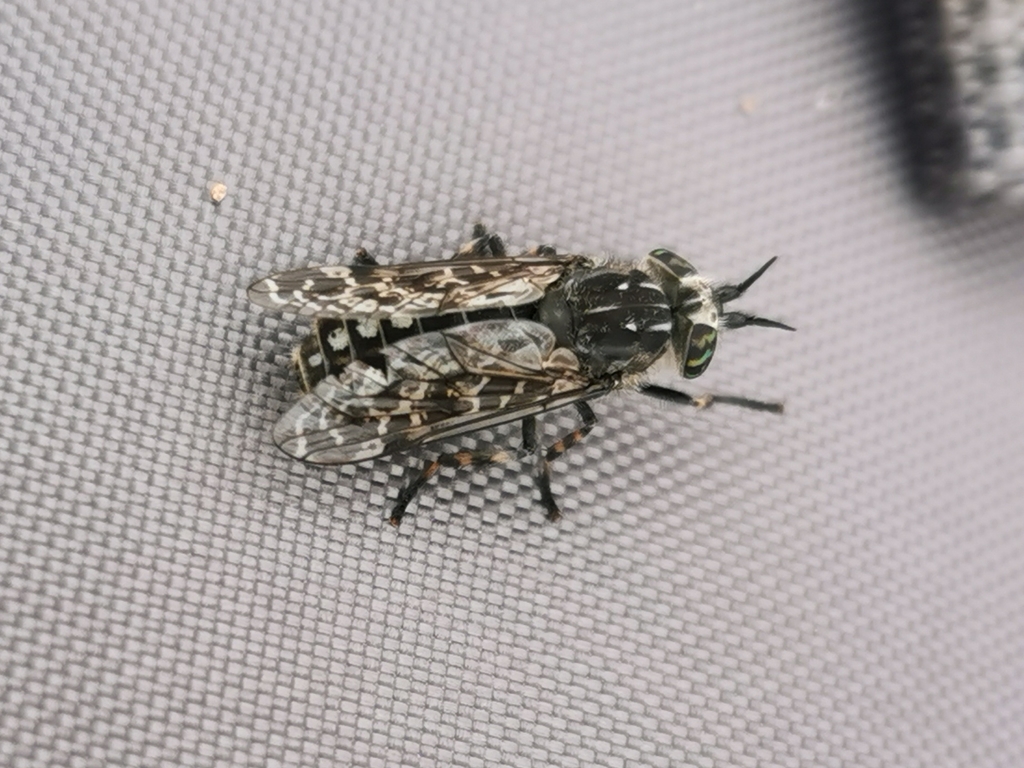
Black-horned Cleg
Haematopota crassicornis
Haematopota crassicornis, the Black-horned Cleg is a species in the horse-fly family, Tabanidae.
From the article Haematopota crassicornis on Wikipedia (CC BY-SA), quoted section by section
Description
Haematopota crassicornis typically measures 7.5–11.5 millimetres (0.30–0.45 in) in length. It is generally dark in colour, and like most species of Haematopota it has three narrow, lighter longitudinal stripes mainly on its pro- and mesonotum. The abdomen is greyish. The antennae are black.
Range & habitat
Haematopota crassicornis occurs widely throughout most of Europe, having been reported from the Iberian Peninsula in the west, to Russia in the east, Italy in the South, and much of Scandinavia and the British Isles in the north.
Wikipedia: “Distribution”
What it does
The males of Haematopota crassicornis visit flowers for nectar. The females suck blood from various mammals, particularly from large species such as cattle and humans. The larvae live in moist soil, largely preying on small invertebrates such as other insects. The adults are most active from May to August but they still may be seen through September.
Wikipedia: “Ecology”
Listen
Looking for field recordings…
Where it lives
Recorded sightings
—
geo-referenced records in GBIF, from museums, herbaria and field observers.
Drag the globe to turn it. Dots are where records exist, not a range map; darker means more records.
In the stacks
Searching the stacks…
Every page naming Haematopota crassicornis in the Biodiversity Heritage Library →
This page is assembled live from iNaturalist, GBIF, Wikipedia, the Source Library and the Internet Archive. It is not yet part of the hand-edited codex. iNaturalist taxon 70188.