- Animals
- ›Arthropods
- ›Hexapods
- ›Insects
- ›Winged and Once-winged Insects
- ›Butterflies and Moths
- ›Butterflies
- ›Brush-footed Butterflies
- ›Checkerspots, Anglewings, Peacocks, and Allies
- ›Checkerspots
- ›Chlosyne
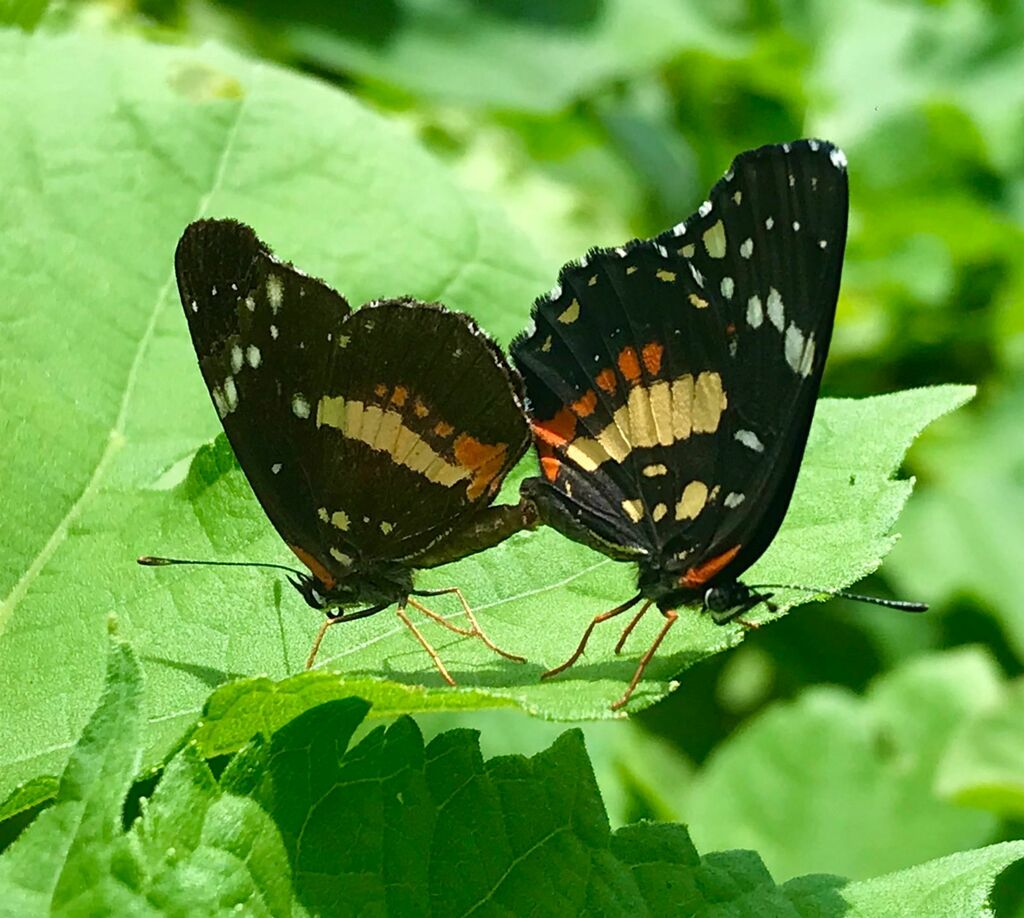
Bordered Patch
Chlosyne lacinia
Chlosyne lacinia, the bordered patch or sunflower patch, is a North and South American butterfly in the family Nymphalidae.
From the article Chlosyne lacinia on Wikipedia (CC BY-SA), quoted section by section
Description
The bordered patch is an extremely variable butterfly. The upperside of the wings is mainly black with the forewing having rows of white and/or yellow-orange spots of varying sizes. There is usually one whitish spot in the forewing cell. The hindwing has many color variations. Those variations can be: almost completely black to having some red postmedian spots to having a few rows of white postmedian spots to having an all red-orange discal area to having a yellow-orange postmedian band of varying width. The underside of the wings is just as variable as the upperside. It varies from having a few rows of white and red spots to having a yellow-white hindwing median band of varying width to the underside being mostly golden yellow with large yellow-orange spots and a thick golden-yellow median band. All of these variations have a red spot near the hindwing tornus. Its wingspan ranges from 1+1⁄4 to 1+7⁄8 inches (32 to 48 mm).
Range & habitat
The bordered patch may be encountered in habitats such as desert hills, mesquite woodlands, pinyon woodlands, and oak woodlands in the United States. In the US, this species prefers to inhabit agricultural areas and weedy wastelands where the preferred host plant Helianthus annuus occurs. In Belize, Costa Rica, Panama and other regions in Central America, this species as well as others in the genus, are often found in roadside verges, in the unmowed rows between citrus plantations, and other areas of disturbed ground where both nectar resources and larval hosts are provided by plant species in the Asteracae, Acanthaceae, and Amaranthaceae families.
Wikipedia: “Habitat”
What it does
Males will find females by awaiting them on hilltops. Females will lay their eggs in clusters of about 100 or more on the underside of host plant leaves. The eggs are pale yellow green but later turn a reddish color. The young larvae feed together and but do not make a nest. They will become solitary when older. The larva is as variable as the adult. It ranges from mostly orange with black spines and stripes to black with a red-orange mid-dorsal stripe to almost all black. All variations have a red-orange head. The chrysalis varies from almost all white to white with black markings to nearly all black. The third instar larva hibernates and also estivates. The bordered patch has three or four broods per year.
Wikipedia: “Life cycle”
Listen
Looking for field recordings…
Where it lives
Recorded sightings
—
geo-referenced records in GBIF, from museums, herbaria and field observers.
Drag the globe to turn it. Dots are where records exist, not a range map; darker means more records.
In the stacks
Searching the stacks…
Every page naming Chlosyne lacinia in the Biodiversity Heritage Library →
This page is assembled live from iNaturalist, GBIF, Wikipedia, the Source Library and the Internet Archive. It is not yet part of the hand-edited codex. iNaturalist taxon 68240.