- Animals
- ›Arthropods
- ›Hexapods
- ›Insects
- ›Winged and Once-winged Insects
- ›Dragonflies and Damselflies
- ›Dragonflies
- ›Libelluloidea
- ›Skimmers
- ›Sympetrum
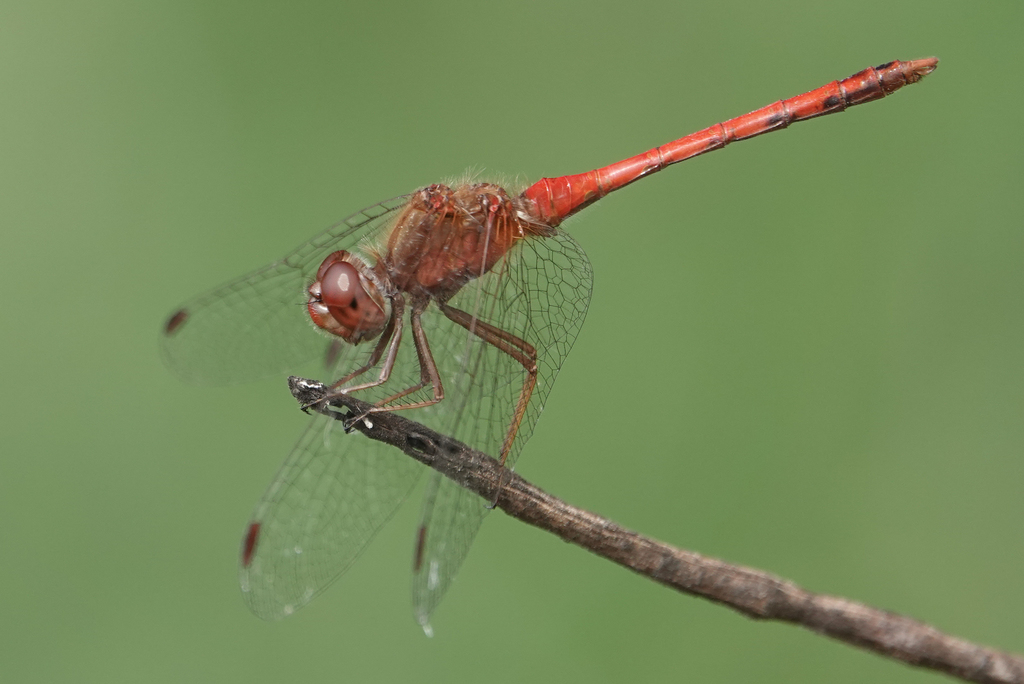
Autumn Meadowhawk
Sympetrum vicinum
Sympetrum vicinum, the Yellow-Legged Meadowhawk, is one of some fifteen North American species of autumn meadowhawk, which are dragonflies in the Libellulidae family. It grows to 26–35 mm long.
From the article Sympetrum vicinum on Wikipedia (CC BY-SA), quoted section by section
Range & habitat
This dragonfly is found in and around marshes, ponds and slow-moving streams throughout the eastern United States, southern Canada, the Great Plains, and the west coast of North America. This species has two separate populations in North America. One is found from Ontario east to Nova Scotia, extending south into the U.S. to Texas and Florida. The other population occurs in British Columbia, Washington, Oregon and Idaho.
Wikipedia: “Range and habitat”
What it does
The naiads live in the debris of the bottoms of lakes and ponds. They do not actively pursue prey but wait for it to pass by, a strategy which affords them protection from other predators. The naiads emerge from the water to make the transition to adult dragonflies at night. Adults fly from early August through October. This species flies later in the fall than any other species in the Northwest, with observations as late as October 29 in Idaho and into November in Washington. The adults of this species hunt flying insects from perches on rocks or bare branches. The Latin name for this genus, Sympetrum, means "with rock" and refers to their habit of basking on rocks to absorb heat early in the day. This dragonfly is abundant where it occurs, with large numbers of pairs flying and laying eggs in tandem.
Wikipedia: “Ecology”
Listen
Looking for field recordings…
Where it lives
Recorded sightings
—
geo-referenced records in GBIF, from museums, herbaria and field observers.
Drag the globe to turn it. Dots are where records exist, not a range map; darker means more records.
In the stacks
Searching the stacks…
Every page naming Sympetrum vicinum in the Biodiversity Heritage Library →
This page is assembled live from iNaturalist, GBIF, Wikipedia, the Source Library and the Internet Archive. It is not yet part of the hand-edited codex. iNaturalist taxon 68139.