- Animals
- ›Arthropods
- ›Hexapods
- ›Insects
- ›Winged and Once-winged Insects
- ›Flies
- ›Brachyceran Flies
- ›Cyclorrhaphan Flies
- ›Schizophoran Flies
- ›Acalyptrate Flies
- ›Ephydroidea
- ›Vinegar and Fruit Flies
- ›Drosophilinae
- ›Drosophila
- ›Sophophora
- ›Drosophila melanogaster
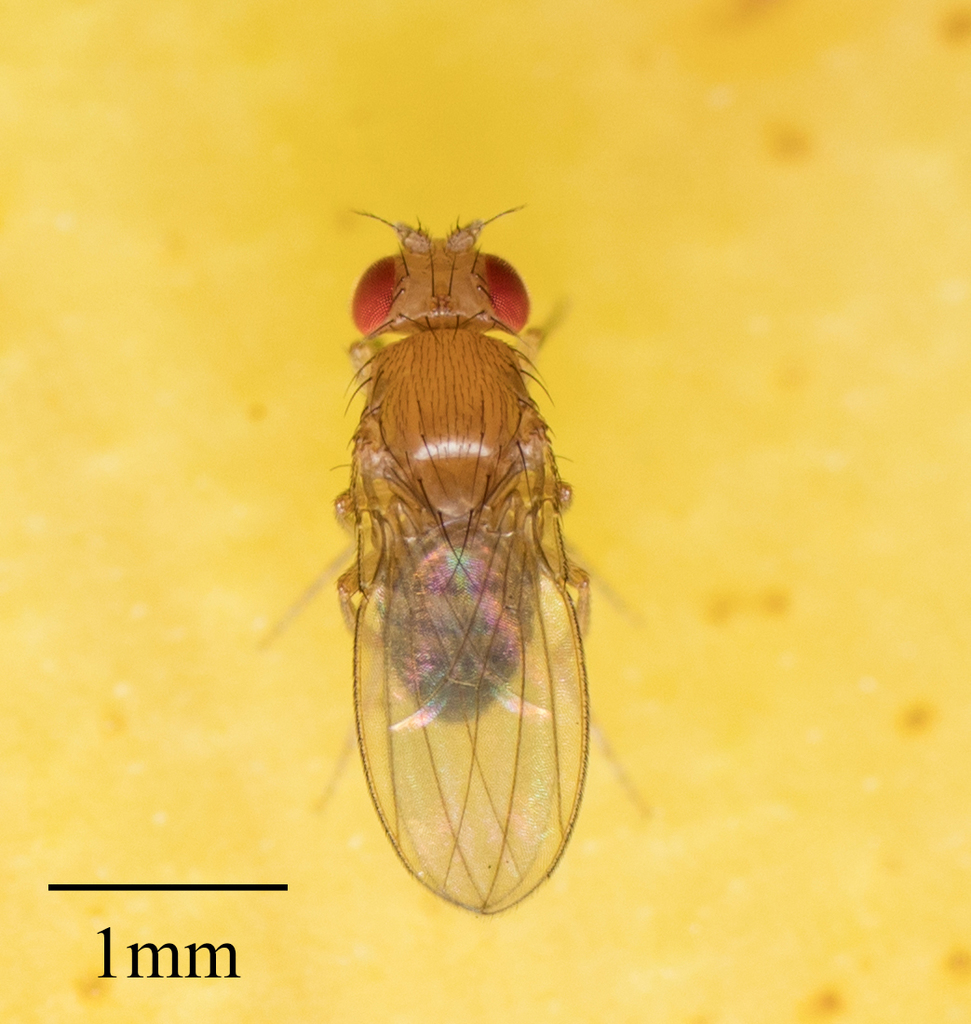
Common Fruit Fly
Drosophila melanogaster
Drosophila melanogaster is a species of fly (an insect of the order Diptera) in the family Drosophilidae. The species is often referred to as the fruit fly or lesser fruit fly, or less commonly the "vinegar fly", "pomace fly", or "banana fly". D. melanogaster is attracted to rotting fruit and fermenting beverages and is often found in orchards, kitchens, and pubs.
Starting with Charles W. Woodworth's 1901 proposal of the use of this species as a model organism, D. melanogaster continues to be widely used for biological research in genetics, physiology, microbial pathogenesis, and life history evolution. In 1947 D. melanogaster was the first animal to be launched into space. As of 2017, six Nobel Prizes have been awarded to drosophilists for their work using the insect.
From the article Drosophila melanogaster on Wikipedia (CC BY-SA), quoted section by section
What it does
Under optimal growth conditions at 25 °C (77 °F), the D. melanogaster lifespan is about 50 days from egg to death. The developmental period for D. melanogaster varies with temperature, as with many ectothermic species. The shortest development time (egg to adult), seven days, is achieved at 28 °C (82 °F). Development times increase at higher temperatures (11 days at 30 °C or 86 °F) due to heat stress. Under ideal conditions, the development time at 25 °C (77 °F) is 8+1⁄2 days, at 18 °C (64 °F) it takes 19 days and at 12 °C (54 °F) it takes over 50 days. Under crowded conditions, development time increases, while the emerging flies are smaller. Females lay some 400 eggs (embryos), about five at a time, into rotting fruit or other suitable material such as decaying mushrooms and sap fluxes. Drosophila melanogaster is a holometabolous insect, so it undergoes a full metamorphosis. Their life cycle is broken down into four stages: embryo, larva, pupa, adult. The eggs, which are about 0.5 mm long, hatch after 12–15 hours (at 25 °C or 77 °F). The resulting larvae grow for about four days (at 25 °C) while molting twice (into second- and third-instar larvae), at about 24 and 48 hours after hatching. During this time, they feed on the microorganisms that decompose the fruit, as well as on the sugar of the fruit itself. …
Wikipedia: “Lifecycle and reproduction”
In human culture
The term "Drosophila", meaning "dew-loving", is a modern scientific Latin adaptation from Greek words δρόσος, drósos, "dew", and φίλος, philos, "loving". The term "melanogaster", meaning "black belly", comes from Ancient Greek μέλας, mélas, "black", and γᾰστήρ, gastḗr, "belly".
Wikipedia: “Etymology”
Listen
Looking for field recordings…
Where it lives
Recorded sightings
—
geo-referenced records in GBIF, from museums, herbaria and field observers.
Drag the globe to turn it. Dots are where records exist, not a range map; darker means more records.
In the stacks
Searching the stacks…
Every page naming Drosophila melanogaster in the Biodiversity Heritage Library →
This page is assembled live from iNaturalist, GBIF, Wikipedia, the Source Library and the Internet Archive. It is not yet part of the hand-edited codex. iNaturalist taxon 67743.