- Animals
- ›Chordates
- ›Vertebrates
- ›Birds
- ›Swifts and Hummingbirds
- ›Hummingbirds
- ›Bee Hummingbirds, Emeralds, Mountain-gems, and Allies
- ›Emerald Hummingbirds and Allies
- ›Leucochloris
On eBird ↗
White-throated Hummingbird
Live sightings near you, the range map, bar charts of when it is seen, and Macaulay Library photos and recordings.
White-throated Hummingbird
Leucochloris albicollis
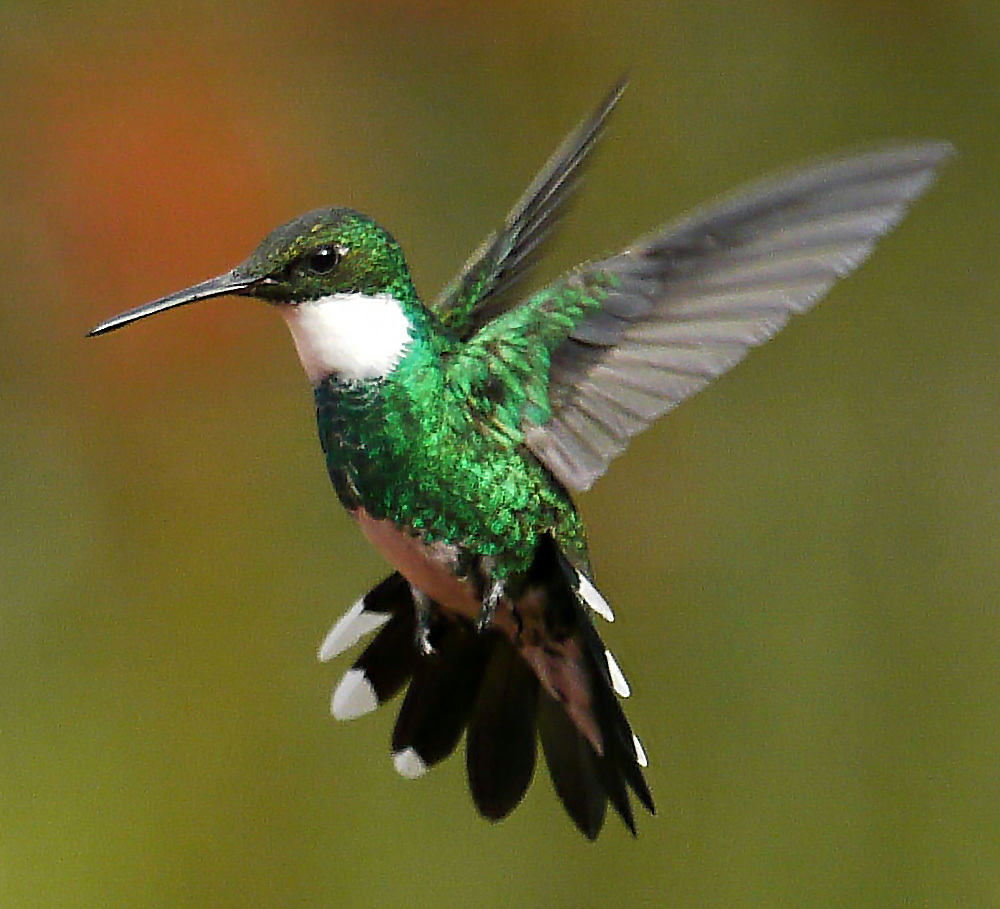
The white-throated hummingbird (Leucochloris albicollis) is a species of hummingbird in the Trochilidae family. It is the only member of the genus Leucochloris. It is found in north-eastern Argentina, south-eastern Brazil, Paraguay, and Uruguay. It is found in forest, woodland, parks and gardens. It is generally common, and therefore considered to be of least concern by BirdLife International.
From the article White-throated hummingbird on Wikipedia (CC BY-SA), quoted section by section
Description
The white-throated hummingbird is 10 to 11.5 cm (3.9 to 4.5 in) long. Males weigh 5 to 8 g (0.18 to 0.28 oz) and females about 4.5 g (0.16 oz). Adults have a medium length, straight, bill with a blackish maxilla and red mandible with a black tip. Adult males have golden- to bronze-green upperparts. Their uppertail coverts and inner tail feathers are golden-green to brilliant green and the outer tail feathers blackish green with white bands near the end. Their chin feathers are brilliant green with white edges, their throat white, and their cheeks and breast brilliant green to golden-green. The center of their belly is white with golden- to bronze-green sides and flanks. Their undertail coverts are white with some bronze-green to brownish inclusions. Adult females are very similar but duller, less glittery, overall. Juveniles have grayish brown underparts with less white and brownish tips to the tail feathers.
Range & habitat
The white-throated hummingbird is found in eastern Paraguay, southeastern Brazil from Minas Gerais and Espírito Santo south, Uruguay, and northeastern Argentina. It inhabits semi-open to open landscapes such as the edges of mature forest, marshes, scrublands, parks, and gardens. In elevation it is generally found from near sea level to 1,000 m (3,300 ft) but there are occasional records higher with one at 2,100 m (6,900 ft).
Wikipedia: “Distribution and habitat”
What it does
The white-throated hummingbird forages for nectar at a very wide variety of native and introduced plants. Species from at least 10 families have been documented as sources. Bromeliaceae seem especially favored; examples include Quesnelia testudo and Tillandsia aeranthos. It is known to pollinate Siphocampylus sulfureus. In addition to nectar it feeds on insects captured by hawking from a perch.
Wikipedia: “Feeding”
Listen
Looking for field recordings…
Where it lives
Recorded sightings
—
geo-referenced records in GBIF, from museums, herbaria and field observers.
Drag the globe to turn it. Dots are where records exist, not a range map; darker means more records.
In the stacks
Searching the stacks…
Every page naming Leucochloris albicollis in the Biodiversity Heritage Library →
This page is assembled live from iNaturalist, GBIF, Wikipedia, the Source Library and the Internet Archive. It is not yet part of the hand-edited codex. iNaturalist taxon 6521.