- Animals
- ›Chordates
- ›Vertebrates
- ›Birds
- ›Swifts and Hummingbirds
- ›Hummingbirds
- ›Bee Hummingbirds, Emeralds, Mountain-gems, and Allies
- ›Bee Hummingbirds and Allies
- ›Doricha
On eBird ↗
Slender Sheartail
Live sightings near you, the range map, bar charts of when it is seen, and Macaulay Library photos and recordings.
Slender Sheartail
Doricha enicura
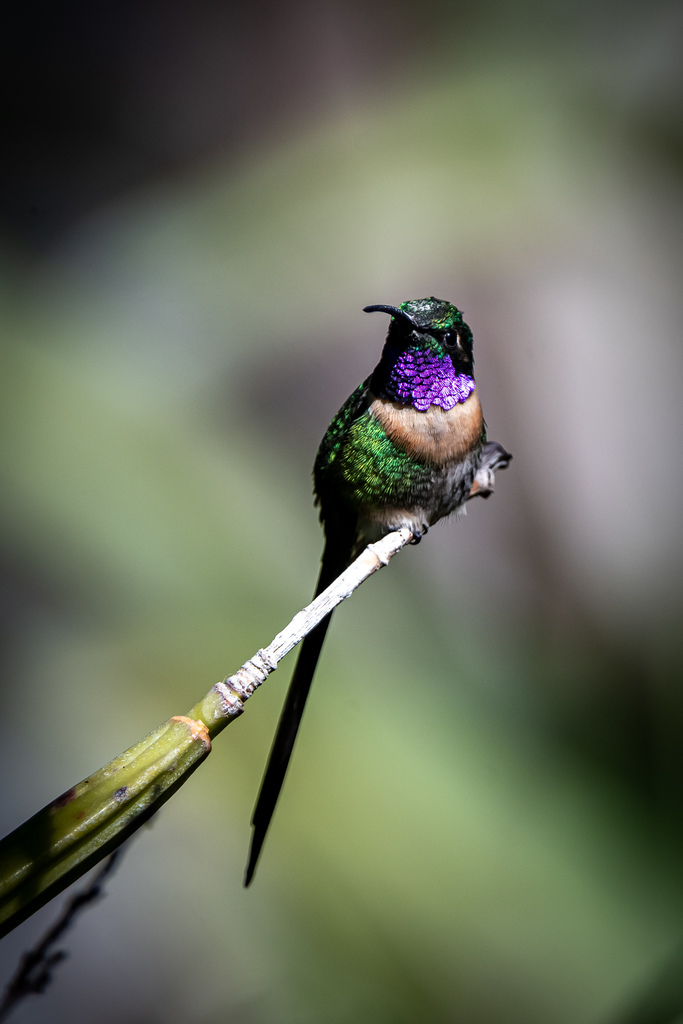
The slender sheartail (Doricha enicura) is a species of hummingbird in the family Trochilidae. It is found in El Salvador, Guatemala, Honduras, and Mexico. Its natural habitats are subtropical or tropical moist montane forests and heavily degraded former forest.
From the article Slender sheartail on Wikipedia (CC BY-SA), quoted section by section
Description
The male slender sheartail is 11 to 12.5 cm (4.3 to 4.9 in) long and weighs about 2.3 g (0.081 oz). Females are 8 to 9 cm (3.1 to 3.5 in) long and weigh about 2.6 g (0.092 oz). Both sexes have a long, decurved, black bill and a white spot behind the eye. The male's head, upperparts, and sides of the belly are green. Its gorget is pinkish purple and the chest and center of the belly white. The very long tail is deeply forked. The central pair of feathers are green and the others blackish. The female's upperparts are green and the underparts cinnamon-buff. It has a blackish stripe through the eye. Its tail is much shorter and less forked than the male's; its central pair of feathers are green and the others cinnamon with a wide black band near the tip and white tips.
Range & habitat
The slender sheartail is found in mountains and their interior valleys from Chiapas in southern Mexico through Guatemala and northeastern El Salvador into Honduras. It inhabits semi-open landscapes such as forest openings, woodland, secondary forest, and scrublands. In elevation it ranges between 1,000 and 3,000 m (3,300 and 9,800 ft).
Wikipedia: “Distribution and habitat”
What it does
The slender sheartail forages for nectar and small arthropods from ground level to the middle strata of the vegetation. While feeding on nectar, males hold their tails nearly vertical while females wag and open and close theirs.
Wikipedia: “Feeding”
Listen
Looking for field recordings…
Where it lives
Recorded sightings
—
geo-referenced records in GBIF, from museums, herbaria and field observers.
Drag the globe to turn it. Dots are where records exist, not a range map; darker means more records.
In the stacks
Searching the stacks…
Every page naming Doricha enicura in the Biodiversity Heritage Library →
This page is assembled live from iNaturalist, GBIF, Wikipedia, the Source Library and the Internet Archive. It is not yet part of the hand-edited codex. iNaturalist taxon 6519.