- Animals
- ›Chordates
- ›Vertebrates
- ›Birds
- ›Swifts and Hummingbirds
- ›Hummingbirds
- ›Brilliants, Coquettes, and Allies
- ›Coquettes and Allies
- ›Oreonympha
On eBird ↗
Bearded Mountaineer
Live sightings near you, the range map, bar charts of when it is seen, and Macaulay Library photos and recordings.
Bearded Mountaineer
Oreonympha nobilis
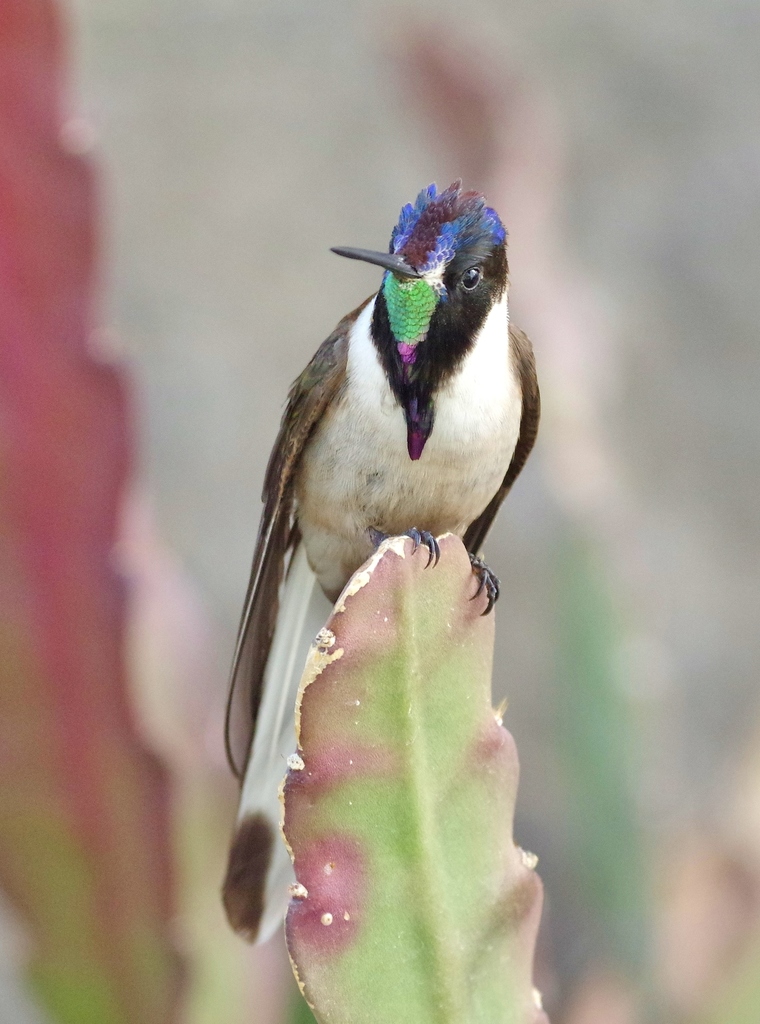
The bearded mountaineer (Oreonympha nobilis) is a species of hummingbird in the family Trochilidae. It is found only in Peru. Its natural habitat is subtropical or tropical high-altitude shrubland.
From the article Bearded mountaineer on Wikipedia (CC BY-SA), quoted section by section
Description
The bearded mountaineer is 14 to 16.5 cm (5.5 to 6.5 in) long including the approximately 2.3 cm (0.91 in) long bill. It weighs about 7 to 9 g (0.25 to 0.32 oz). Adult males of the nominate subspecies have a deep purplish blue forecrown and crown with a narrow black stripe in the middle. The face is bronzy black with a narrow white band at the back. Its gorget is long and narrow, emerald green under the chin and the rest purplish with a bluish tip. The nape, back, and rump are bronzy to bronzy brown. The tail is long and deeply forked; the feathers are bronzy with increasing amounts of white from the innermost to outermost. The center of the breast is white, the sides of the breast and flanks brownish, and the undertail coverts are bronzy brown. The adult female is similar to the male but duller overall and dingier underneath. Its gorget is smaller and mostly white and the tail less deeply forked. Both sexes have black bills and legs. Juveniles are duller than the adults, with a scaly green crown, a dull brown throat, and a yellow mandible. Males of subspecies O. n. albolimbata has white bands on either side of the crown and its tail is much more coppery. The female has white extending from the same white bands of the crown through the lores to the gorget.
Range & habitat
The "eastern" nominate subspecies of bearded mountaineer is found in the departments of Apurímac and Cuzco of south-central Peru, in the drainages of the Urubamba and upper Apurímac rivers. The "western" subspecies O. n. albolimbata is found in Peru's departments of Huancavelica, Ayacucho, and Apurímac, in the drainages of the Mantaro, Pampas, and Chalhuanca rivers. The species inhabits dry Andean valleys characterized by rocky and scrubby hillsides and open woodland. It occurs in a variety of native plant communities but also is regularly found in tree tobacco (Nicotiana) and Eucalyptus even along roads and in towns. In elevation it ranges from 2,500 to 3,900 m (8,200 to 12,800 ft).
Wikipedia: “Distribution and habitat”
What it does
The bearded mountaineer feeds on nectar, primarily that of Agave, cacti, Nicotiana, and Eucalyptus. It feeds both by hovering with an almost vertical stance and tail flicking, but also clings to flowers with open wings. It also eats small arthropods. It is submissive to most other hummingbirds.
Wikipedia: “Feeding”
Listen
Looking for field recordings…
Where it lives
Recorded sightings
—
geo-referenced records in GBIF, from museums, herbaria and field observers.
Drag the globe to turn it. Dots are where records exist, not a range map; darker means more records.
In the stacks
Searching the stacks…
Every page naming Oreonympha nobilis in the Biodiversity Heritage Library →
This page is assembled live from iNaturalist, GBIF, Wikipedia, the Source Library and the Internet Archive. It is not yet part of the hand-edited codex. iNaturalist taxon 6510.