- Animals
- ›Chordates
- ›Vertebrates
- ›Birds
- ›Swifts and Hummingbirds
- ›Hummingbirds
- ›Mango Hummingbirds and Allies
- ›Chrysolampis
On eBird ↗
Ruby-topaz Hummingbird
Live sightings near you, the range map, bar charts of when it is seen, and Macaulay Library photos and recordings.
Ruby-topaz Hummingbird
Chrysolampis mosquitus
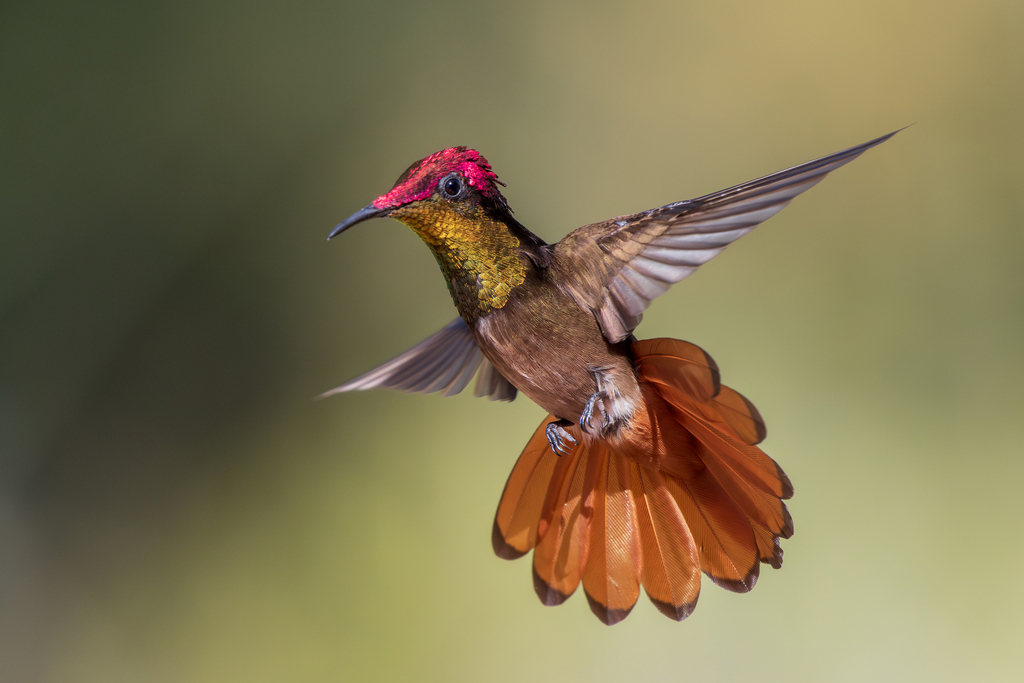
The ruby-topaz hummingbird (Chrysolampis mosquitus), commonly referred to simply as the ruby topaz, is a small bird that breeds in the Lesser Antilles and tropical northern South America from Colombia, Venezuela and the Guyanas, south to central Brazil and northern Bolivia; also from Colombia into southern Panama. It is the only member of the genus Chrysolampis. It is a seasonal migrant, although its movements are not well understood.
From the article Ruby-topaz hummingbird on Wikipedia (CC BY-SA), quoted section by section
Description
The ruby-topaz hummingbird is 8 to 9.5 cm (3.1 to 3.7 in) long and weighs 2.5 to 5 g (0.09 to 0.18 oz). Its almost straight, black bill is relatively short compared to those of most other hummingbirds. The male has dark brown upperparts with an olive gloss. Its crown and nape are glossy ruby red, and the throat and breast are usually iridescent golden though sometimes emerald green. The rest of the underparts are brown and the chestnut tail is tipped black. The female ruby-topaz hummingbird has bronze-green upperparts and pale grey underparts. The tail is mostly chestnut with a dark subterminal band and a white tip; the central feathers are olive green. Females on Trinidad and Tobago sometimes have a greenish throat-streak (it may appear dark). Juvenile females are similar to adult females, but with a white-tipped dusky-brown tail. Juvenile males resemble the juvenile female, but with a variable amount of iridescent orange to the throat.
Range & habitat
The ruby-topaz hummingbird is found from eastern Panama east through northern Colombia, Venezuela, and the Guianas into northeastern Brazil. From there it is found through central and eastern Brazil as far south as Mato Grosso and westward into eastern Bolivia. In Colombia its range extends southward between the three Andes ranges, and it is also found in the ABC Islands and Trinidad and Tobago. It has been recorded as a vagrant in Argentina and Peru and there is at least one unconfirmed sight record in Paraguay. The ruby-topaz hummingbird inhabits the interior and edges of open savanna-like landscapes and shrubby arid hillsides; it is found in gardens and cultivated areas as well. It mostly occurs below 500 m (1,600 ft) of elevation but is found as high as 1,700 m (5,600 ft).
Wikipedia: “Distribution and habitat”
What it does
The ruby-topaz hummingbird feeds on nectar from a wide variety of flowering shrubs, trees, epiphytes, cacti, and crops. However, they prefer the flowers of the samaan tree and the Ixora plant since these flowers have a high sugar content. Males defend feeding territories. The species also catches small insects and spiders on the wing and sometimes gleans them from within foliage.
Wikipedia: “Feeding”
Listen
Looking for field recordings…
Where it lives
Recorded sightings
—
geo-referenced records in GBIF, from museums, herbaria and field observers.
Drag the globe to turn it. Dots are where records exist, not a range map; darker means more records.
In the old herbals & bestiaries

Jean Baptiste Audebert — Histoire naturelle des colibris (1802)
Jean Baptiste Audebert · 1802 · p.135

Jean Baptiste Audebert — Histoire naturelle des colibris (1802)
Jean Baptiste Audebert · 1802 · p.139

Jean Baptiste Audebert — Histoire naturelle des colibris (1802)
Jean Baptiste Audebert · 1802 · p.228

Jean Baptiste Audebert — Histoire naturelle des colibris (1802)
Jean Baptiste Audebert · 1802 · p.231
In the stacks
Searching the stacks…
Every page naming Chrysolampis mosquitus in the Biodiversity Heritage Library →
This page is assembled live from iNaturalist, GBIF, Wikipedia, the Source Library and the Internet Archive. It is not yet part of the hand-edited codex. iNaturalist taxon 6462.