- Animals
- ›Chordates
- ›Vertebrates
- ›Reptiles
- ›Snakes and Lizards
- ›Snakes
- ›Colubrid Snakes
- ›Natricine Snakes
- ›Natrix
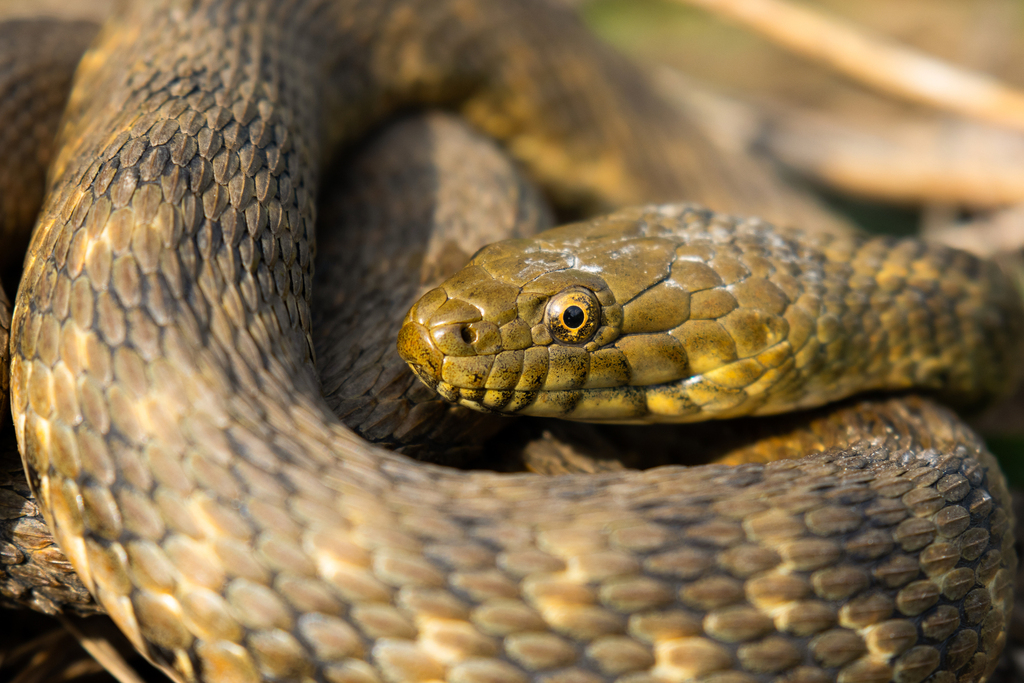
Tessellated Water Snake
Natrix tessellata
The dice snake (Natrix tessellata) or water snake is a Eurasian nonvenomous snake in the family Colubridae, subfamily Natricinae. Its average length is 1.0–1.3 m (39–51 in). Body color may vary from greyish green to brownish or almost black, with dark spots on the back. The belly is sometimes vividly coloured in yellow or orange, with black spots, very similar to dice, hence the name.
From the article Dice snake on Wikipedia (CC BY-SA), quoted section by section
Range & habitat
The dice snake is found throughout much of central and eastern Eurasia, from Italy and Czechia in the west to Kyrgyzstan in the east, and from Ukraine in the north to Iran in the south.
Wikipedia: “Distribution”
What it does
Living mainly near rivers, streams and lakes, it frequently feeds on fish. Sometimes, it feeds also on amphibians such as frogs, toads, and tadpoles. In one instance, a dice snake was even observed trying to feed on an olm (Proteus anguinus) that had been flushed from a cave in Bosnia and Herzegovina following heavy rains. However, the snake was far too small to be able to consume the olm. While considered nonvenomous, N. tessellata produces a potent antihemorrhagin in its serum. As a defence, it spreads a very bad-smelling secretion from its cloaca. Another defence mechanism is thanatosis, playing dead. During the mating season (March–May), they congregate in large groups. Egg-laying is usually in July, and one clutch consists of 10–30 eggs. The young snakes hatch in early September. Dice snakes hibernate from October to April in dry holes near the water.
Wikipedia: “Ecology”
Where it lives
Recorded sightings
—
geo-referenced records in GBIF, from museums, herbaria and field observers.
Drag the globe to turn it. Dots are where records exist, not a range map; darker means more records.
In the stacks
Searching the stacks…
Every page naming Natrix tessellata in the Biodiversity Heritage Library →
This page is assembled live from iNaturalist, GBIF, Wikipedia, the Source Library and the Internet Archive. It is not yet part of the hand-edited codex. iNaturalist taxon 64346.