- Animals
- ›Chordates
- ›Vertebrates
- ›Birds
- ›Swifts and Hummingbirds
- ›Hummingbirds
- ›Bee Hummingbirds, Emeralds, Mountain-gems, and Allies
- ›Bee Hummingbirds and Allies
- ›Archilochus
On eBird ↗
Black-chinned Hummingbird
Live sightings near you, the range map, bar charts of when it is seen, and Macaulay Library photos and recordings.
Black-chinned Hummingbird
Archilochus alexandri
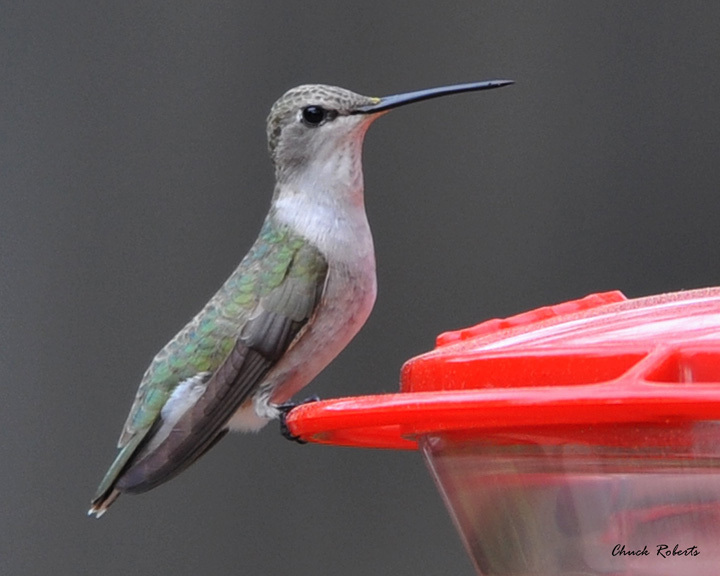
The black-chinned hummingbird (Archilochus alexandri) is an apodiforme bird in the trochilidae family. These birds are found in numerous habitats, including deserts, mountain forests, and some urban areas. The black-chinned hummingbird ranges from southern British Columbia, western United States, and northern Mexico, with most of the northern lying bird migrating down to southern regions after breeding season is over. Male black-chinned hummingbirds are recognizable by the faint iridescent purple gorget on their neck which is only visible in certain lighting. Females have similar features to the ruby-throated hummingbird, making it difficult to tell the two species apart, but often female black-chinned humming birds are larger. When hovering, black-chinned hummingbirds produce a faint low pitched humming sound, but when the male mating dance is displayed, the sounds produced by tail and wing feathers is a higher pitched trill.
From the article Black-chinned hummingbird on Wikipedia (CC BY-SA), quoted section by section
Description
The black-chinned hummingbird is 8.25 cm (3.25 in) long. Adults are metallic green above and white-gray below with green flanks. Their bill is long, straight and slender. The adult male has a black face and chin, a glossy purple gorget (when accurately exposed to sunlight) and a dark forked tail. The female has a dark rounded tail with white tips and no throat patch. Juvenile plumage is similar to that of adult females, but with buff margins on the dorsal feathers. Juvenile males may also possess purple feathers on their throats. Juveniles do not have a forked tail like adults. Young are born almost featherless, but grow a complete set of feathers within three weeks of hatching. Juveniles begin replacing their feathers in November after migrating for the winter. They have a completely new set of feathers before their first year of age. Similar species to the black-chinned hummingbird include broad-tailed hummingbird, rufous hummingbird, calliope hummingbird, Allen's hummingbird, lucifer hummingbird, Anna's hummingbird, and Costa's hummingbird.
Status. This species has been labeled as a least-concern species because of its broad range (236,000 km2 (91,120 sq mi)), considerable population size and growth (14.6% increase per decade). …
Range & habitat
Black-chinned hummingbirds are found in most of the western United States, reaching north into British Columbia, east to Oklahoma, and as far south as Mexico. They can be found in mountains, woodlands, orchards, meadows, chaparral habitats, and in urban environments. Their breeding habitat is open, semiarid areas, usually near water in the western United States, northern Mexico, and southern British Columbia. They may inhabit moist environments like orchards, shaded canyons, and riparian woods. The males and females of this species use different habitats from one another for breeding territories.
Wikipedia: “Distribution and habitat”
What it does
Black-chinned hummingbirds are important pollinators to the regions they occupy. They commonly feed on nectar producing plants, as well as spiders and smaller insects. These hummingbirds can be found feeding on flowers anywhere between the ground level and up in trees, and insects are caught by flying through swarms of bugs or by taking prey off spider webs. Black-chinned hummingbirds are able to get nectar from their tongue to their mouth through capillary action. The tongue is equipped with small grooves that allow the nectar to travel into it's bill when retracting the tongue.
Wikipedia: “Feeding”
Listen
Looking for field recordings…
Where it lives
Recorded sightings
—
geo-referenced records in GBIF, from museums, herbaria and field observers.
Drag the globe to turn it. Dots are where records exist, not a range map; darker means more records.
In the stacks
Searching the stacks…
Every page naming Archilochus alexandri in the Biodiversity Heritage Library →
This page is assembled live from iNaturalist, GBIF, Wikipedia, the Source Library and the Internet Archive. It is not yet part of the hand-edited codex. iNaturalist taxon 6433.