- Animals
- ›Chordates
- ›Vertebrates
- ›Birds
- ›Swifts and Hummingbirds
- ›Hummingbirds
- ›Mango Hummingbirds and Allies
- ›Eulampis
On eBird ↗
Purple-throated Carib
Live sightings near you, the range map, bar charts of when it is seen, and Macaulay Library photos and recordings.
Purple-throated Carib
Eulampis jugularis
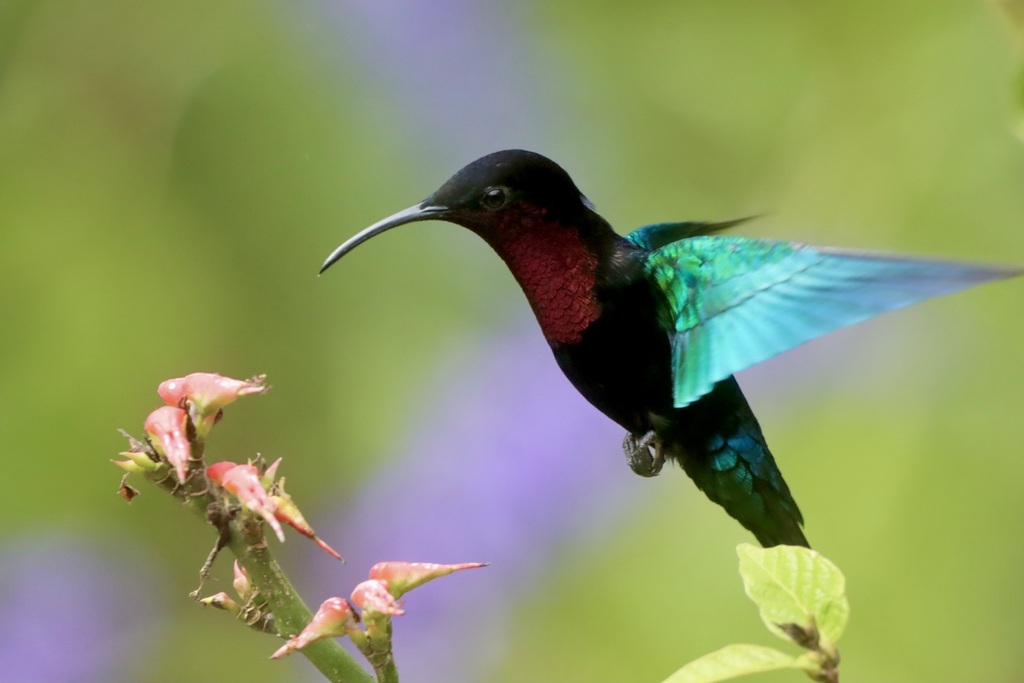
The purple-throated carib (Eulampis jugularis) is a species of hummingbird in the subfamily Polytminae. It is resident on most of the islands of the Lesser Antilles and has occurred as a vagrant both further north and south.
From the article Purple-throated carib on Wikipedia (CC BY-SA), quoted section by section
Description
The purple-throated carib is 11 to 12 cm (4.3 to 4.7 in) long. Males weigh 9 to 12 g (0.32 to 0.42 oz) and females 7 to 10 g (0.25 to 0.35 oz); specimens of unrecorded sex weighed 6.7 to 10.8 g (0.24 to 0.38 oz). The adult male and female have the same plumage. Their crown and back are velvety black, the throat and chest fiery purplish red, the wings bright golden green, and the tail and its upper and lower coverts metallic greenish blue. The male has a medium length slightly decurved bill; the female's is longer and more strongly curved. Immatures have an orange throat and chest with red speckles.
Range & habitat
The purple-throated carib is resident on Antigua, Dominica, Guadeloupe, Martinique, Montserrat, Saba, Saint Kitts and Nevis, Saint Lucia, Saint Vincent and Sint Eustatius. It has occurred as a vagrant in Barbados, Barbuda, Grenada and the Greater Antilles. It inhabits the interior and edges of primary and secondary forest, mostly at elevations between 800 and 1,200 m (2,600 and 3,900 ft).
Wikipedia: “Distribution and habitat”
What it does
The purple-throated carib feeds primarily on nectar of flowering trees from the middle levels to the treetops. Males defend flower-centered feeding territories year round and females during the non-breeding season. The species also feeds on small arthropods, catching them on the wing and gleaning them from leaves, flowers, and spider webs.
Wikipedia: “Feeding”
Listen
Looking for field recordings…
Where it lives
Recorded sightings
—
geo-referenced records in GBIF, from museums, herbaria and field observers.
Drag the globe to turn it. Dots are where records exist, not a range map; darker means more records.
In the stacks
Searching the stacks…
Every page naming Eulampis jugularis in the Biodiversity Heritage Library →
This page is assembled live from iNaturalist, GBIF, Wikipedia, the Source Library and the Internet Archive. It is not yet part of the hand-edited codex. iNaturalist taxon 6430.