 NL·0132
Herbarium of the Nature Library
- Name
- Triticum aestivum
- Family
- Poaceae
- Native to
- Of cultivated origin in the Fertile Crescent and south-west of the Caspian (Transcaucasia/northern Iran); grown on every continent except Antarctica
- Habitat
- Temperate grassland (as cropland), Mediterranean and semi-arid farmland
Bread wheat
Triticum aestivum
Also calledGehun (Hindi/Urdu) · Qamḥ / Ḥinṭa (Arabic) · Gandom (Persian) · Xiǎomài (Chinese) · Buğday (Turkish) · Trigo (Spanish/Portuguese) · Ngano (Swahili)
Bread wheat is a hexaploid hybrid of three wild grasses, formed when cultivated emmer crossed with goatgrass near the Caspian about 9,000 years ago. Grown on more land than any other crop, it supplies about a fifth of all calories humans eat.
Common wheat, also known as bread wheat, is a cultivated wheat species. It originated around 8,000 years ago, from the hybridization of an already existing domesticated variety of wheat and the wild goatgrass in the South Caucasus or southwestern Caspian area. About 95% of wheat produced worldwide is this species; it is the most widely grown of all crops and the cereal with the highest monetary yield. Wikipedia
What it can do
- iHexaploid: carries three complete genomes (A, B and D) from three ancestral species
- iiGluten proteins form an elastic network that traps gas, letting dough rise
- iiiDomestic wheat lost the 'shattering' trait, so ripe grain stays on the ear until harvested
- ivWinter wheat needs cold vernalisation before it will flower
At the table
Eatengrain (flour, bulgur, semolina, freekeh) · young shoots (wheatgrass) · germ and bran
Grain is a staple. Gluten triggers coeliac disease in about 1% of people; wheat is also a common allergen. Grain infected with ergot fungus is toxic.
In the medicine cabinet
| Tradition | Use |
|---|---|
| Unani | Wheat porridges for convalescents and bran poultices |
| Modern medicine | Wheat bran as a bulk-forming laxative with good trial evidence for constipation |
Weight of evidence
Strong. An approved drug, or consistent results in well-run clinical trials.
Active compounds
gluten (gliadins, glutenins), starch, arabinoxylan fibre, alkylresorcinols
Fruit & seed
Fruit
Caryopsis (grain)
Ripens: Early to midsummer (winter wheat); late summer (spring wheat)
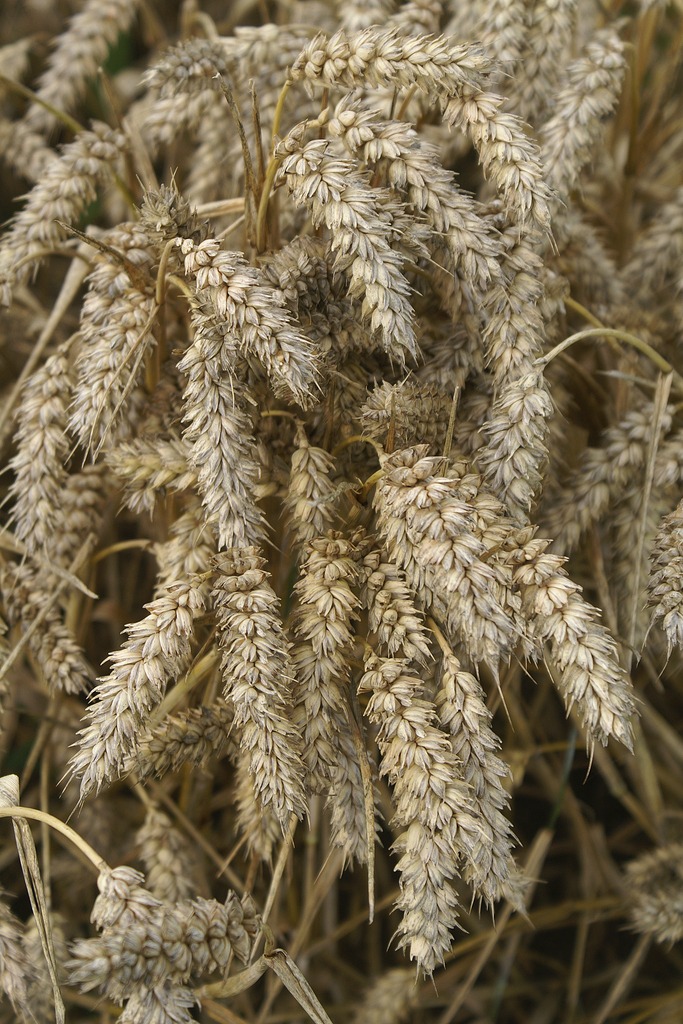
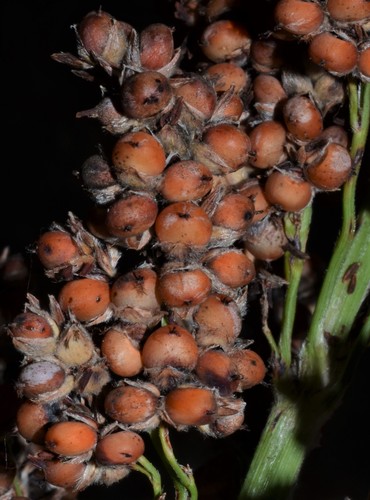
Dense ear (spike) of 30–60 grains arranged in spikelets, golden when ripe, awned or awnless.


Seed
5–7 mm
Oval to egg-shaped grain 5–7 mm, with a deep crease along one side and a tuft of fine hairs at the tip; red-brown, amber or white, hard and glassy or soft and floury
- Dispersal
- Humans (domesticated; does not shatter)
- Germination
- Sow 2.5–4 cm deep at 4–25 °C; emerges in 5–10 days. Winter varieties need weeks of cold to flower
Photographs from Wikimedia Commons under open licences; hover for the photographer, click for the file.
How to grow it
Hardiness (USDA zones)
Annual crop: winter wheat in USDA 3–8; spring wheat in short-summer regions. Survives winters down to about -40 °C.
- Light
- Full sun
- Water
- Moderate (300–900 mm over the season)
- Soil
- Well-drained loam or clay loam, pH 6–7.5
- Propagation
- Seed
- To harvest
- Winter wheat 8–10 months; spring wheat 90–120 days
- Climates
- Temperate, Continental, Mediterranean, Semi-arid, Subtropical (winter crop)
- 1Prepare a fine, firm seedbed; sow winter wheat in autumn or spring wheat as early as the soil can be worked, about 2.5–4 cm deep in rows 15–20 cm apart (or broadcast and rake in).
- 2Keep weeds down in the first weeks; a small plot can be hoed between rows.
- 3Feed with nitrogen (compost or fertiliser) in early spring as the plants begin to stretch.
- 4Harvest when the straw is golden and a grain dented with a thumbnail is hard; cut and bundle stems into sheaves to dry for a week.
- 5Thresh by beating sheaves in a sack or on a tarp, then winnow in a breeze to blow away the chaff.
Can it grow where you are?
Where it lives
Recorded sightings
—
geo-referenced records in GBIF, from museums, herbaria and field observers.
Native range
Of cultivated origin in the Fertile Crescent and south-west of the Caspian (Transcaucasia/northern Iran); grown on every continent except Antarctica
Drag the globe to turn it. Dots are where records exist, not a range map; darker means more records.
In Gerard's Herball, 1597

First Booke · Chap. 40 · p. 58 · read the page →
Of Corne.
John Gerard, The Herball, or Generall Historie of Plantes, London, 1597. What England's best-known herbal said of bread wheat, in its own spelling.
- The vertues
- Rawe Wheate saith Dioscorides, being eaten, breedeth woormes in the belly: being chewed and applied doth cure the biting of madde dogs. The flower of Wheate being boiled with hony and water, or with oyle and water, taketh away all inflammations or hot swellings. The bran of Wheate boiled in strong vineger, clenseth away scurffe and dry scales, and dissolueth the beginning of all hot swellings, if it be laid vnto them. And boiled with the decoction of Rue, it slaketh the swellings in womens brests. The graines of white Wheat, as Pliny writeth in his 22. booke, & 7. chap. being dried browne, but not burnt, & the powder thereof mixed with white wine, is good for watering eies, if it be laid therto. The dried powder of red Wheate, boiled with vineger, helpeth the shrinking of sinews. The meale of Wheate, mingled with the iuice of Henbane, and plaisterwise applied, appeaseth inflammations, as Ignis sacer, or S. Anthonies fire, and such like: staying the fluxe of humors from the ioints, which the Grecians call Rheumismata.
- The place
- Wheate groweth almost in all the countries of the world that are inhabited and manured, and requireth a fruitfull and fat soile, and rather sunnie and drie, than waterie grounds and shadowy: for in a drie ground as Columella reporteth, it groweth harder, and better compact: in a moist & darke soile, it degenerateth somtime to be of another kinde.
- The time
- They are most commonly sowen in the fall of the leafe or Autumne: sometime in the spring. It is sowen in Autumne or the fall of the leafe, and oftentimes in the spring, and for that cause hath been called Trimestre or three months graine, it bringeth…
- The temperature
- The kindes of Wheate according to their naturall qualities, are hot and moist in the first degree, and drie in the middle of the second. Wheate saith Galen is very much vsed of men, and with greatest profit.
- The names
- Wheate is called of the Grecians πυρὸς: of the Latines Triticum. Triticum doth generally signifie any kind of corne, which is threshed forth of the eares, & made cleane by fanning, or such ordinary meanes. The Germaines call it Weitsen: in low Dutch Tarwe: in Italian Grano: the Spaniards Trigo: the French men Bled, ou Fourment: in England we call the first white Wheate, and Flaxen Wheate.
Gerard wrote within Galenic humoral medicine, and his opinions, including about the peoples of the Americas and their crops, are those of 1590s London. His “vertues” are history, not advice. Transcription: Source Library (CC BY-SA 4.0). The whole chapter in the Herball Room.
In the old herbals & bestiaries
Woodcuts and engravings matched from the Source Library’s scanned books by name. Plates marked “relative” show a close kin rather than this exact species. Click a plate to read the page it came from, with translation.

On the Names of Plants
Hieronymus Bock (Tragus) · 1552 · p.706

Zhiwu Mingshi Tukao (Vol. 1)
吳其濬 · 1848 · p.43

Illustrated Herbal Primer
Chen Jiamo (陳嘉謨) · 1628 · p.222

Ortus sanitatis
1491 · p.418

Ortus sanitatis
1491 · p.458

Garden of Health
1507 · p.337

Notable Commentaries on the History of Plants
Leonhart Fuchs · 1542 · p.682

Notable Commentaries on the History of Plants
Leonhart Fuchs · 1549 · p.680

Notable Commentaries on the History of Plants
Leonhart Fuchs · 1549 · p.315

On Medical Materials in Six Books
Dioscorides · 1550 · p.241
In the stacks
Searching the stacks…
Every page naming Triticum aestivum in the Biodiversity Heritage Library →
Marginalia
Wheat was one of the 'founder crops' of Neolithic agriculture at sites like Abu Hureyra and Göbekli Tepe's region, and Egyptian tombs held bread loaves for the afterlife. In the Lord's Prayer and the Eucharist, wheaten bread became the central Christian symbol of sustenance.
Curiosity
The bread-wheat genome is about five times larger than the human genome.
Kinship


Fact-checked: 1 correction made to this sheet. Photographs: iNaturalist contributors under the licences shown. Records: GBIF.org. Historical plates: Source Library (CC BY-SA 4.0; originals public domain). Summary text: Nature Library editors and Wikipedia (CC BY-SA). Medicinal and edibility notes are historical and educational, not advice. iNaturalist taxon 64161.