 NL·0128
Herbarium of the Nature Library
- Name
- Oryza sativa
- Family
- Poaceae
- Native to
- Domesticated in the Yangtze valley of China (japonica) and later hybridised in South Asia (indica); grown in tropical and warm-temperate regions worldwide
- Habitat
- Freshwater wetlands (as paddy), Tropical uplands, River deltas
Asian rice
Oryza sativa
Also calledChawal / Dhan (Hindi/Urdu) · Vrīhi (Sanskrit) · Dàmǐ / Dàogǔ (Chinese) · Kome / Ine (Japanese) · Beras / Padi (Malay) · Arroz (Spanish/Portuguese) · Ruzz / Aruzz (Arabic) · Mchele (Swahili)
The grain that feeds more than half of humanity, domesticated from wild Oryza rufipogon in the Yangtze valley about 9,000 years ago. Rice can grow in standing water because hollow channels in its stems pipe air down to its roots.
Oryza sativa, having the common name Asian cultivated rice, is the much more common of the two rice species cultivated as a cereal, the other species being O. glaberrima, African rice. It was first domesticated in the Yangtze River basin in China 13,500 to 8,200 years ago. Wikipedia
What it can do
- iAerenchyma tissue carries oxygen from leaves to roots in flooded soil
- iiSome varieties carry the Sub1 gene, letting them survive two weeks fully underwater
- iiiPaddy fields support fish, frogs and ducks in traditional integrated systems
- ivThe International Rice Genebank in the Philippines holds over 130,000 rice accessions
At the table
Eatengrain (white, brown, red, black, glutinous) · rice bran oil · fermented into wine, vinegar and sake
Cooked grain is safe. Rice can accumulate inorganic arsenic from soil and water; rinsing and cooking in excess water reduces it. Cooked rice left warm can grow Bacillus cereus.
In the medicine cabinet
| Tradition | Use |
|---|---|
| Traditional Chinese Medicine | Rice congee as a gentle food to strengthen digestion; red yeast rice (fermented with Monascus) for blood circulation |
| WHO oral rehydration | Rice-based oral rehydration solutions for diarrhoea |
| Ayurveda | Navara rice used in Kerala's 'Njavarakizhi' massage therapy |
Weight of evidence
Strong. An approved drug, or consistent results in well-run clinical trials.
Active compounds
starch (amylose, amylopectin), γ-oryzanol (bran), monacolin K (red yeast rice)
Fruit & seed
Fruit
Caryopsis (grain)
Ripens: Late summer to autumn in temperate zones; multiple crops a year in the tropics
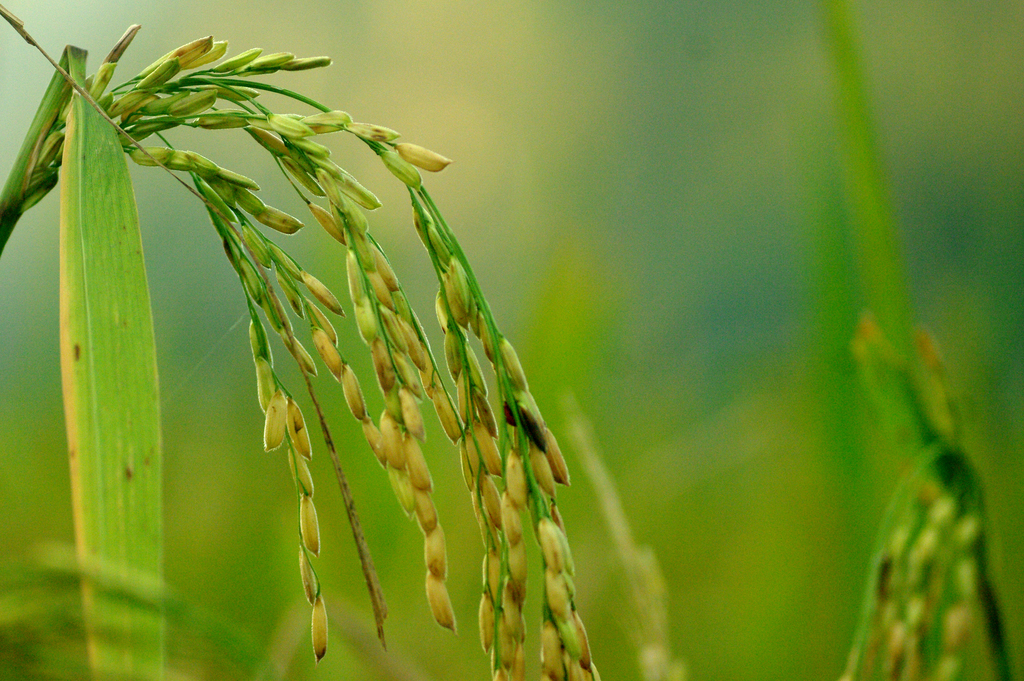
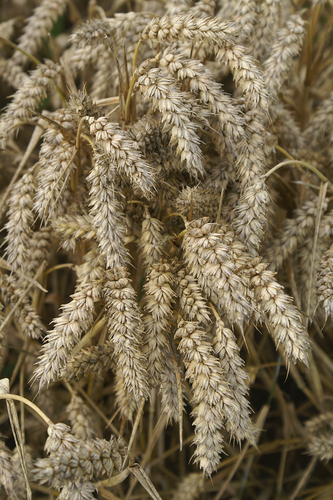
Drooping panicle of 50–500 spikelets, each enclosing a single grain in a tough, ridged, straw-coloured husk (hull).
Seed
5–10 mm (long-grain to short-grain)
Paddy grain is oblong, 5–10 mm, enclosed in a golden, ridged, sometimes awned hull; dehulled brown rice is smooth, slim to round and tan, red or black, with a white starchy interior
- Dispersal
- Humans; wild relatives shatter and float on water
- Germination
- Soak 24 hours, keep moist and warm (25–35 °C); sprouts in 2–4 days
How to grow it
Hardiness (USDA zones)
Annual warm-season crop; needs 3–6 frost-free months above about 20 °C. Survives winters down to about -40 °C.
- Light
- Full sun
- Water
- Very high (paddy) or high rainfall (upland rice)
- Soil
- Heavy clay or silt that holds water; pH 5–7
- Propagation
- Seed, direct-sown or transplanted as seedlings
- To harvest
- 100–180 days depending on variety
- Climates
- Tropical, Monsoon, Humid subtropical, Warm temperate
- 1Soak seed for a day and sow thickly in a moist nursery bed or trays.
- 2After 3–4 weeks, transplant seedlings in clumps of 2–3, about 20 cm apart, into a levelled, puddled (muddy) bed or tub.
- 3Keep 5–10 cm of standing water over the soil through growth to suppress weeds; drain briefly mid-season to strengthen roots.
- 4Drain the field 2–3 weeks before harvest, when panicles droop and grains turn golden.
- 5Cut, dry the sheaves, thresh, then dry grain to about 14% moisture before hulling.
Can it grow where you are?
Where it lives
Recorded sightings
—
geo-referenced records in GBIF, from museums, herbaria and field observers.
Native range
Domesticated in the Yangtze valley of China (japonica) and later hybridised in South Asia (indica); grown in tropical and warm-temperate regions worldwide
Drag the globe to turn it. Dots are where records exist, not a range map; darker means more records.
In Gerard's Herball, 1597

First Booke · Chap. 52 · p. 72 · read the page →
Of Rice.
John Gerard, The Herball, or Generall Historie of Plantes, London, 1597. What England's best-known herbal said of asian rice, in its own spelling.
- The vertues
- Galen faith, that all men vfe to ftaie the belly with this graine, being boiled after the fame maner that Chondrus is. In England we vfe to make with milke and Rife, a certaine food, or pottage which doth both meanely binde the belly, and alfo nourifh. Many other good kinds of foode is made with this graine, as thofe that are skilfull in cookerie can tell.
- The place
- It groweth in the territories of the Bactrians, in Babilon, in Sufium, & in the lower part of Syria. It groweth in thefe daies, not onely in thefe countries before named, but alfo in the fortunate Ilands, and in Spaine, from whence it is brought vnto vs, purged and prepared, as we fee after the maner of French barly. It profpereth beft in fenny and waterifh places.
- The time
- It is fowen in the fpring in India, as Eratosthenes witneffeth, when it is moiftened with fommer flowers.
- The names
- The Grecians call it $\text{ὄρυζα}$, or as Theophrastus faith $\text{ὄρυζον}$: the Latines keepe the Greeke worde Oryza: in French it is called Riz: in the Germaine toong Rifz, and Rys: in Englifh Rife.
Gerard wrote within Galenic humoral medicine, and his opinions, including about the peoples of the Americas and their crops, are those of 1590s London. His “vertues” are history, not advice. Transcription: Source Library (CC BY-SA 4.0). The whole chapter in the Herball Room.
In the old herbals & bestiaries
Woodcuts and engravings matched from the Source Library’s scanned books by name. Plates marked “relative” show a close kin rather than this exact species. Click a plate to read the page it came from, with translation.

Ortus sanitatis
1491 · p.365

Garden of Health
Jacob Meydenbach · 1491 · p.365

Six Groups of the History of Plants
Rembert Dodoens · 1583 · p.521

Elements of Botany
Joseph Pitton de Tournefort · 1719 · p.47

Zhiwu Mingshi Tukao (Vol. 1)
吳其濬 · 1848 · p.69

飲膳正要(三) (vol 3)
(元)忽思慧撰 · n.d. · p.2

Commentaries on the Six Books of Dioscorides
Pietro Andrea Mattioli · 1560 · p.373

Commentaries on the Six Books of Dioscorides on Medical Matter
Pietro Andrea Mattioli · 1563 · p.358

Commentaries on the Six Books of Pedanius Dioscorides on Medical Matter
Pietro Andrea Mattioli · 1565 · p.573

Sancai Tuhui (Vol. 105)
王圻, 王思義 · 1609 · p.76
In the stacks
Searching the stacks…
Every page naming Oryza sativa in the Biodiversity Heritage Library →
Marginalia
In Japan, the emperor ritually plants and harvests rice in the palace paddies, and Shinto's Inari is the god of rice. The Ifugao rice terraces of the Philippines, a UNESCO World Heritage site, are popularly said to be 2,000 years old, though radiocarbon studies suggest many were built in the last 400 years or so.
Curiosity
The 1966 'miracle rice' IR8 from the International Rice Research Institute roughly doubled yields across Asia and averted predicted famines.
Kinship


Fact-checked: 1 correction made to this sheet. Photographs: iNaturalist contributors under the licences shown. Records: GBIF.org. Historical plates: Source Library (CC BY-SA 4.0; originals public domain). Summary text: Nature Library editors and Wikipedia (CC BY-SA). Medicinal and edibility notes are historical and educational, not advice. iNaturalist taxon 61381.