- Animals
- ›Chordates
- ›Vertebrates
- ›Reptiles
- ›Snakes and Lizards
- ›Snakes
- ›Colubrid Snakes
- ›Colubrine Snakes
- ›Spalerosophis
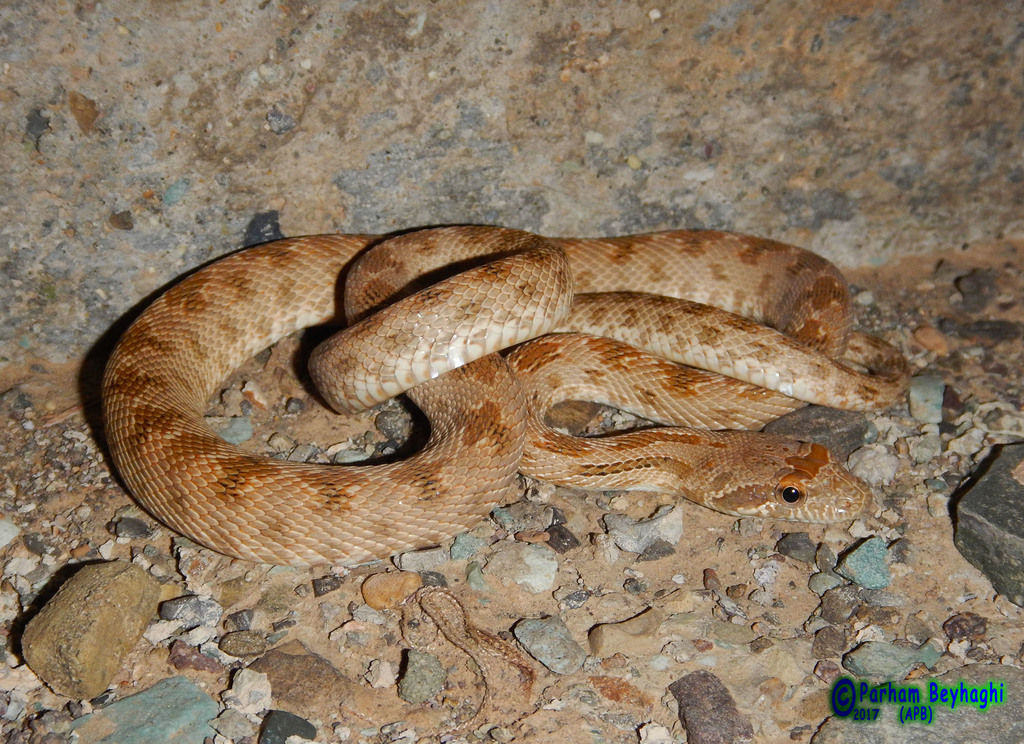
Diadem Snake
Spalerosophis diadema
Spalerosophis diadema, known commonly as the blotched diadem snake and the blotched royal snake, is a species of large snake in the subfamily Colubrinae of the family Colubridae. The species is endemic to Asia and northern Africa.
From the article Spalerosophis diadema on Wikipedia (CC BY-SA), quoted section by section
Description
S. diadema may attain a total length of 1.8 m (about 6 feet), of which about 34 cm (13½ inches) is tail. Dorsally, it is pale buff or sandy grey, with a median series of dark blotches, and smaller dark spots. Ventrally, it is usually uniform white, but rarely has small blackish spots.
Range & habitat
S. diadema is found in Algeria, Afghanistan, Egypt, northern India, Iran, Iraq, Israel, Lebanon, Jordan, southern Kazakhstan, Kyrgyzstan, Libya, Mali, Mauritania, Morocco, Niger, Oman, United Arab Emirates, western Pakistan, Russia, Saudi Arabia, northern Sudan, Syria, Tajikistan, Tunisia, Turkey, southern Turkmenistan, and Uzbekistan.
Wikipedia: “Geographic range”
In human culture
The subspecific name, cliffordi, is in honor of "M[onsieur]. Clifford Cocq van Breugel " who was Dutch consul at Tripoli, probably referring to Jacques Fabrice Herman Clifford Kocq van Breugel (1799–1867).
Wikipedia: “Etymology”
Where it lives
Recorded sightings
—
geo-referenced records in GBIF, from museums, herbaria and field observers.
Drag the globe to turn it. Dots are where records exist, not a range map; darker means more records.
In the stacks
Searching the stacks…
Every page naming Spalerosophis diadema in the Biodiversity Heritage Library →
This page is assembled live from iNaturalist, GBIF, Wikipedia, the Source Library and the Internet Archive. It is not yet part of the hand-edited codex. iNaturalist taxon 64080.