- Animals
- ›Chordates
- ›Vertebrates
- ›Birds
- ›Swifts and Hummingbirds
- ›Hummingbirds
- ›Brilliants, Coquettes, and Allies
- ›Coquettes and Allies
- ›Discosura
On eBird ↗
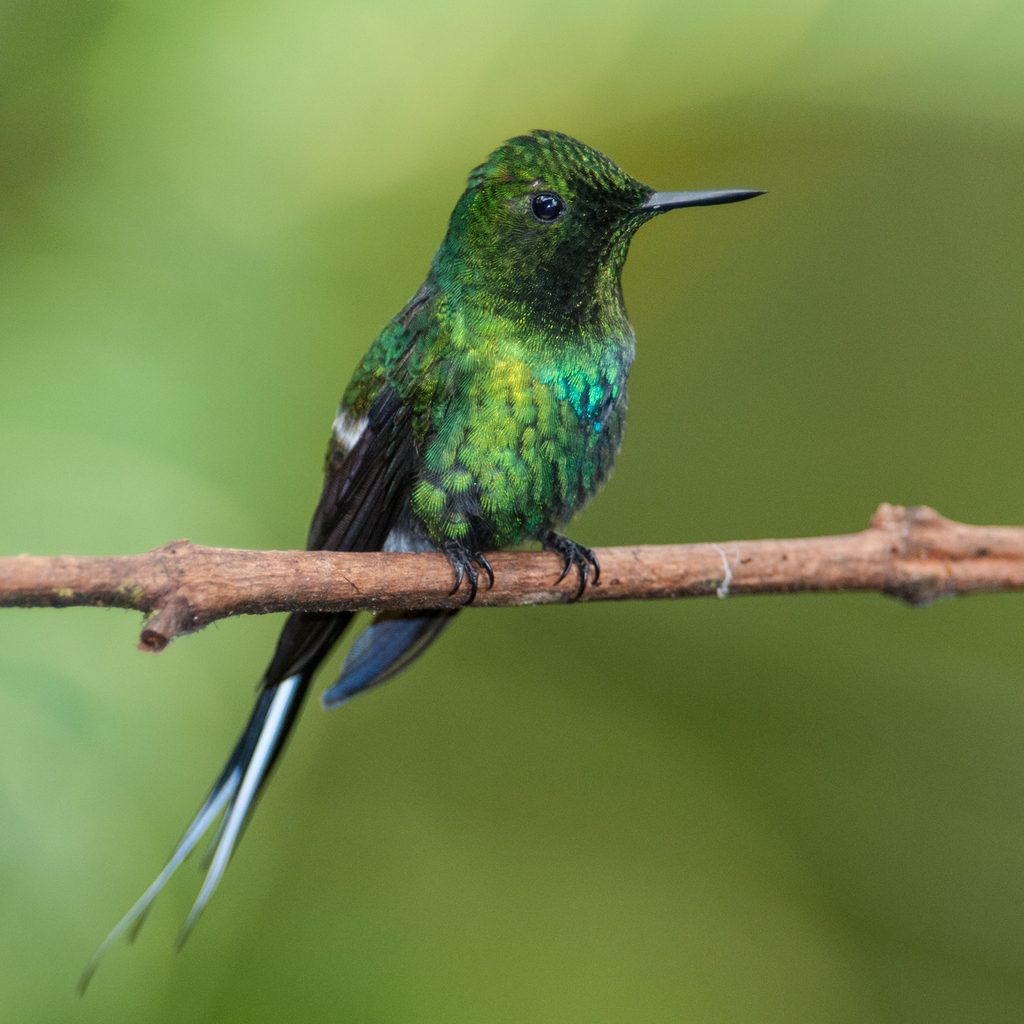
Green Thorntail
Live sightings near you, the range map, bar charts of when it is seen, and Macaulay Library photos and recordings.
Green Thorntail
Discosura conversii
The green thorntail (Discosura conversii) is a small hummingbird that is a resident breeder from Costa Rica to western Ecuador. It occurs at middle elevations from 700–1,400 m (2,300–4,600 ft) but may descend lower early in the wet season. In Costa Rica and Panama it is confined to the Caribbean slopes.
From the article Green thorntail on Wikipedia (CC BY-SA), quoted section by section
Description
Male green thorntails are about 9.5 to 10.2 cm (3.7 to 4.0 in) long and females about 6.6 to 7.5 cm (2.6 to 3.0 in). Five individuals whose sex was not recorded had an average weight of 3.0 g (0.11 oz). The adult male has a dark green crown and a lighter more metallic green back. The coppery bronze rump has bluish black inclusions and a white band across it. The bluish black tail is deeply forked and the outer feathers are very narrow, giving the species its common name. The throat is bright metallic green and the breast and belly mostly darker green with the center of the breast being metallic greenish blue. The adult female's upperparts are like the male's but for a darker rump. Its tail is notched but not elongated. All but the outermost pair of tail feathers are bluish black with dark green bases; the outmost have white bases, a blue-black middle, and white tips. Their face has a broad white cheek patch. The chin is dull black with white spots, the flanks dull green with a white spot, and the breast and belly dull black. Juveniles are like the adults but with a grayish white chin.
Range & habitat
The green thorntail is found on the Caribbean slope in Costa Rica and the Pacific slopes of Panama, Colombia, and Ecuador almost to the Peruvian border. It is thought to also occur on the Caribbean side of eastern Panama. It is primarily a forest canopy species, inhabiting the upper levels of the interior and edges of humid montane forest and lowland evergreen forest. It also occurs at flowering trees in clearings. In elevation it mostly ranges from 700 to 1,400 m (2,300 to 4,600 ft) in Costa Rica, 600 to 1,200 m (2,000 to 3,900 ft) in Panama, from near sea level to 1,000 m (3,300 ft) in Colombia, and at 300 to 1,000 m (980 to 3,300 ft) in Ecuador.
Wikipedia: “Distribution and habitat”
What it does
The green thorntail forages for nectar mostly at the tops of flowering trees but also from epiphytes and shrubs. It appears to favor legumes. It nectars while hovering with its tail cocked at nearly a right angle to its body. Its diet also includes small arthropods such as flies, wasps, and spiders that it captures by hawking from a perch and gleans from the underside of leaves while hovering.
Wikipedia: “Feeding”
Listen
Looking for field recordings…
Where it lives
Recorded sightings
—
geo-referenced records in GBIF, from museums, herbaria and field observers.
Drag the globe to turn it. Dots are where records exist, not a range map; darker means more records.
In the stacks
Searching the stacks…
Every page naming Discosura conversii in the Biodiversity Heritage Library →
This page is assembled live from iNaturalist, GBIF, Wikipedia, the Source Library and the Internet Archive. It is not yet part of the hand-edited codex. iNaturalist taxon 6396.