- Animals
- ›Chordates
- ›Vertebrates
- ›Birds
- ›Swifts and Hummingbirds
- ›Hummingbirds
- ›Bee Hummingbirds, Emeralds, Mountain-gems, and Allies
- ›Emerald Hummingbirds and Allies
- ›Orthorhyncus
On eBird ↗
Antillean Crested Hummingbird
Live sightings near you, the range map, bar charts of when it is seen, and Macaulay Library photos and recordings.
Antillean Crested Hummingbird
Orthorhyncus cristatus
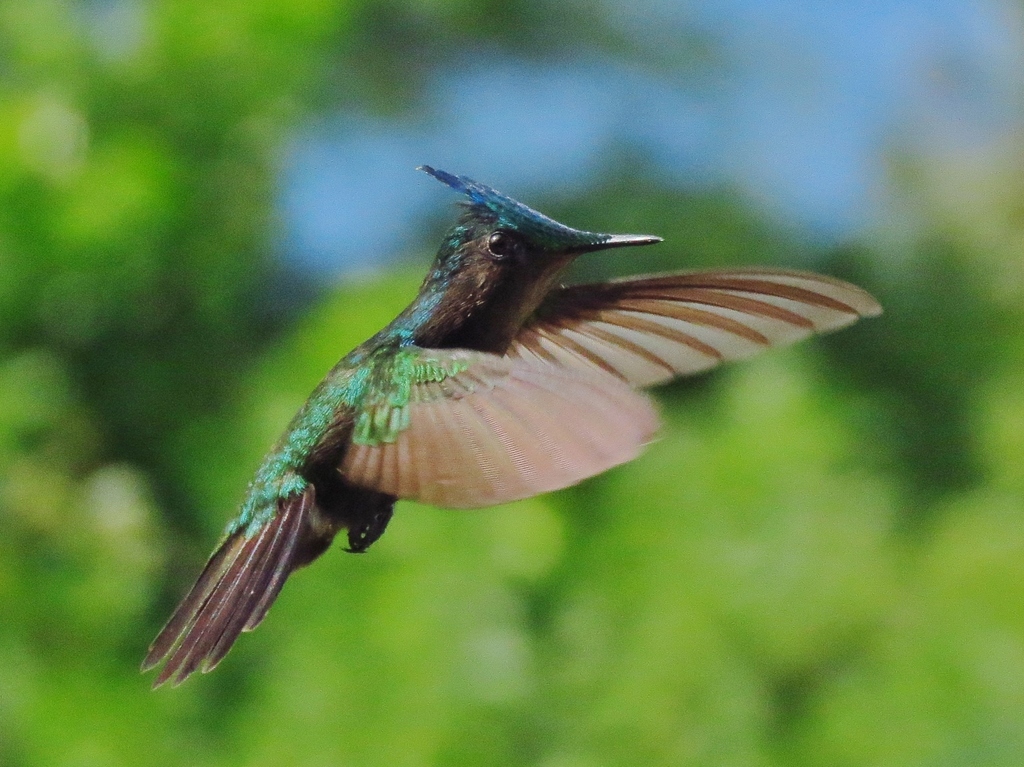
The Antillean crested hummingbird (Orthorhyncus cristatus) is a species of hummingbird in the Trochilidae family. It is found in Anguilla, Antigua and Barbuda, Barbados, Dominica, Grenada, Guadeloupe, Martinique, Montserrat, north-east Puerto Rico, Saba, Saint-Barthélemy, Saint Kitts and Nevis, Saint Lucia, Saint Martin, Saint Vincent and the Grenadines, Sint Eustatius, the British Virgin Islands, the U.S. Virgin Islands, and the Lesser Antilles
From the article Antillean crested hummingbird on Wikipedia (CC BY-SA), quoted section by section
Description
As the name implies, Antillean crested hummingbird is one of the few hummingbirds with a crest. It demonstrates the general sexual dimorphism for hummingbirds where the male is bright and colorful whilst the female is more tannish and dull. Males have a short straight black bill; head with green crest, tipped metallic green to bright blue-green, upperparts dull metallic bronze-green; underparts sooty black; tail black, rounded. The female bill is similar to male's but its head is without a crest; the forehead, crown and upperparts are metallic bronzy-green; underparts light grey; tail blackish, rounded, four outer rectrices broadly tipped whitish grey. The subspecies can be distinguished by the colour of their crests: exilis is wholly green or slightly tinged blue on tip; ornatus has the terminal portion abruptly blue; cristatus is golden to emerald, violet terminally; emigrans is similar to the nominate but more bluish violet, throat paler grey; the degree of paleness in underparts of female varies with race. Calls include short "tsip" or "tzip" notes and a longer series of "tslee-tslee-tslee-tslee".
Range & habitat
Its natural habitats are subtropical or tropical moist lowland forest, semiarid forest and heavily degraded former forest such as open vegetation, parks, plantations, forest borders from sea-level to high mountains. Commonest below 500 m. It lives a sedentary lifestyle, with possible dispersal to higher altitudes in Jul/Aug. Subspecies exilis is rare straggler to the United States.
Wikipedia: “Distribution and habitat”
What it does
This species holds the first record of any avian species that became prey to an amblypygid, otherwise known as a tailless whipscorpion; it is unclear though whether or not the amblypygid caught the bird as the animal was already observed deceased. The Antillean crested hummingbird had also been observed attacking the nest of a saddled anoles (Anolis stratulus). The antillean crested hummingbird and many other trochilid hummingbirds display agonistic behavior towards not only other species of hummingbirds but also other noncompetitor bird species, reptiles and insects, which can have for effect to locally reduce biotic diversity and associated ecosystem services.
Breeding. The Antillean crested hummingbird breeds all year round, but mainly from March–June. Its nest is cup-shaped, built on thin branches of shrub or vine 1–3 m above ground, often shaded by leaves. The nest interior is lined with soft plant fibre and the outside decorated with pieces of dead leaves, lichens, moss or bark. Clutch size is of two white eggs, size 11·6 mm × 8–8·2 mm; incubation is 17–19 days done by the female who will also persistently attack intruders; chicks are a darkish grey with two dorsal rows of down; fledging period is about 19–21 days; young remain with female for 3–4 weeks; single brood. They first begin to breed in their second year.
Food and feeding. …
Wikipedia: “Behavior”
Listen
Looking for field recordings…
Where it lives
Recorded sightings
—
geo-referenced records in GBIF, from museums, herbaria and field observers.
Drag the globe to turn it. Dots are where records exist, not a range map; darker means more records.
In the stacks
Searching the stacks…
Every page naming Orthorhyncus cristatus in the Biodiversity Heritage Library →
This page is assembled live from iNaturalist, GBIF, Wikipedia, the Source Library and the Internet Archive. It is not yet part of the hand-edited codex. iNaturalist taxon 6377.