- Animals
- ›Chordates
- ›Vertebrates
- ›Birds
- ›Swifts and Hummingbirds
- ›Hummingbirds
- ›Bee Hummingbirds, Emeralds, Mountain-gems, and Allies
- ›Bee Hummingbirds and Allies
- ›Calothorax
On eBird ↗
Lucifer Hummingbird
Live sightings near you, the range map, bar charts of when it is seen, and Macaulay Library photos and recordings.
Lucifer Hummingbird
Calothorax lucifer
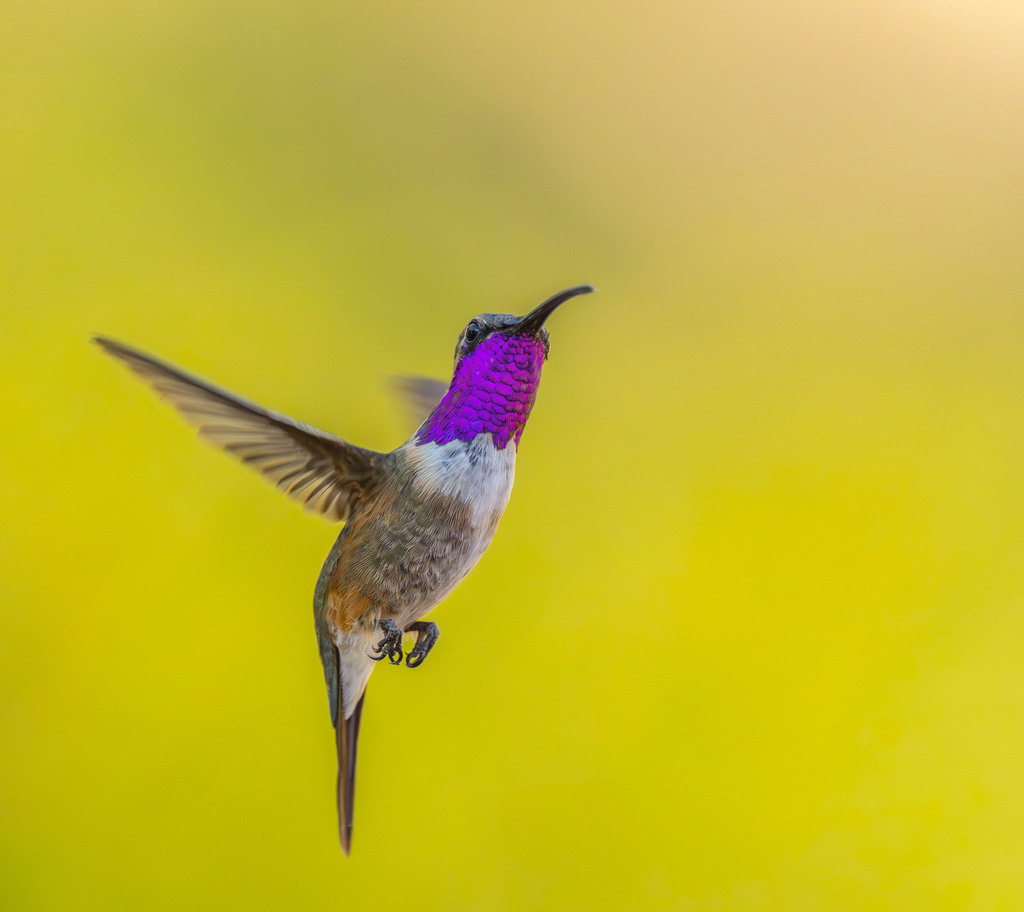
The lucifer sheartail or lucifer hummingbird (Calothorax lucifer) is a medium-sized, up to 10 cm long, green hummingbird with long decurved bill, small wings and white streak behind eye. The male has an iridescent plumage, forked dark tail, green crown, long magenta gorget and white underparts. The female is larger than male with duller plumage, pale throat and buff below.
From the article Lucifer sheartail on Wikipedia (CC BY-SA), quoted section by section
Description
The lucifer sheartail is a medium-sized, 10-centimetre (3.9 in) long, green hummingbird with a long curved bill, small wings, and white streak behind its eye. The male has an iridescent plumage, forked dark tail, green crown, long magenta gorget, and white underparts. The female is larger with duller plumage, pale throat and white or buff feathers underside, usually with crimson trim.
Range & habitat
The lucifer sheartail is distributed to deserts and arid areas with agave plants in the southwestern United States, from southwest Texas, extreme southwestern New Mexico to southeastern Arizona, and in central and northern Mexico. It is also found in the Madrean sky islands of the northern end of the Sierra Madre Occidental, Mexico. Its preferred habitat tends to be at altitudes of 3,500–5,500 feet (1,100–1,700 m) in canyons, mountain slopes, and dry washes having desert shrubs and cacti. In winter, the birds migrate to central Mexico.
Wikipedia: “Distribution”
What it does
The diet consists mainly of nectar from agave and colorful desert flowers, spiders and small insects. Lucifer sheartails have a typical hummingbird flight style while feeding from flowers, catching insects in flight, and flying in straight lines to specific destinations for other food, the nest or for roosting. Males defend feeding areas from males, other females, and black-chinned hummingbirds. However, most C. lucifer are non-territorial and forage at undefended agave or agave surrounded by dense vegetation.
Wikipedia: “Diet”
Listen
Looking for field recordings…
Where it lives
Recorded sightings
—
geo-referenced records in GBIF, from museums, herbaria and field observers.
Drag the globe to turn it. Dots are where records exist, not a range map; darker means more records.
In the stacks
Searching the stacks…
Every page naming Calothorax lucifer in the Biodiversity Heritage Library →
This page is assembled live from iNaturalist, GBIF, Wikipedia, the Source Library and the Internet Archive. It is not yet part of the hand-edited codex. iNaturalist taxon 6371.