- Animals
- ›Chordates
- ›Vertebrates
- ›Birds
- ›Swifts and Hummingbirds
- ›Hummingbirds
- ›Bee Hummingbirds, Emeralds, Mountain-gems, and Allies
- ›Bee Hummingbirds and Allies
- ›Selasphorus
On eBird ↗
Scintillant Hummingbird
Live sightings near you, the range map, bar charts of when it is seen, and Macaulay Library photos and recordings.
Scintillant Hummingbird
Selasphorus scintilla
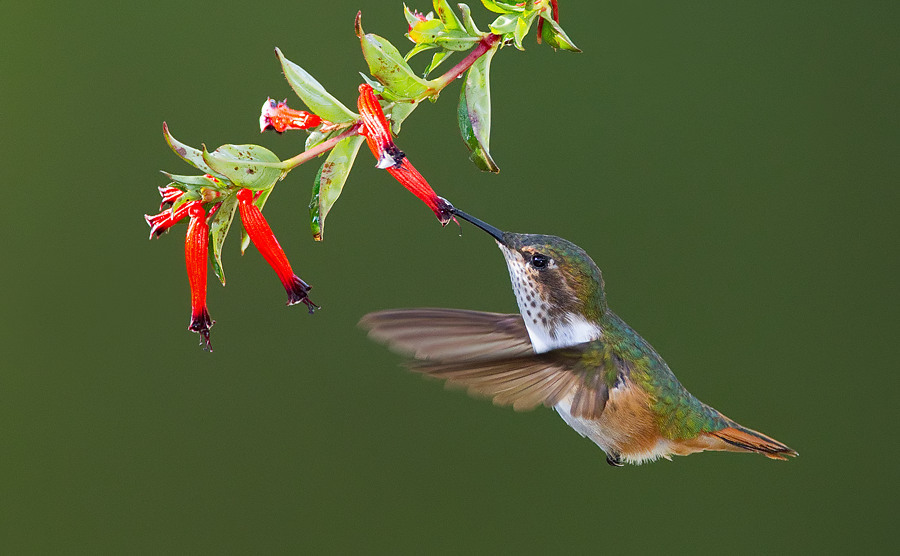
The scintillant hummingbird (Selasphorus scintilla) is a hummingbird endemic to Costa Rica and Panama. This species is replaced at higher elevations by its relative, the volcano hummingbird, S. flammula.
From the article Scintillant hummingbird on Wikipedia (CC BY-SA), quoted section by section
Description
It is only 6.5–8 cm (2.6–3.1 in) long, including the bill. The male weighs 2 g (0.071 oz) and the female 2.3 g (0.081 oz). This is one of the smallest birds in existence, marginally larger than the bee hummingbird. The black bill is short and straight. The adult male scintillant hummingbird has bronze-green upperparts and a rufous and black-striped tail. The throat is brilliant red, separated from the cinnamon underparts by a white neck band. The female is similar, but her throat is buff with small green spots and the flanks are richer rufous. Young birds resemble the female but have rufous fringes to the upperpart plumage.
Range & habitat
It inhabits brushy forest edges, coffee plantations and sometimes gardens at altitudes from 900–2,000 m (3,000–6,600 ft), and up to 2,500 m (8,200 ft) when not breeding.
Wikipedia: “Habitat”
What it does
The food of S. scintilla is nectar, taken from a variety of small flowers, including Salvia and species normally pollinated by insects. Like other hummingbirds it also takes some small insects as an essential source of protein. In the breeding season, scintillant hummingbird males perch conspicuously in open areas with Salvia and defend their feeding territories aggressively with diving displays. The call is a liquid tsip.
Wikipedia: “Diet”
Listen
Looking for field recordings…
Where it lives
Recorded sightings
—
geo-referenced records in GBIF, from museums, herbaria and field observers.
Drag the globe to turn it. Dots are where records exist, not a range map; darker means more records.
In the stacks
Searching the stacks…
Every page naming Selasphorus scintilla in the Biodiversity Heritage Library →
This page is assembled live from iNaturalist, GBIF, Wikipedia, the Source Library and the Internet Archive. It is not yet part of the hand-edited codex. iNaturalist taxon 6362.