- Animals
- ›Chordates
- ›Vertebrates
- ›Birds
- ›Swifts and Hummingbirds
- ›Hummingbirds
- ›Brilliants, Coquettes, and Allies
- ›Coquettes and Allies
- ›Lophornis
On eBird ↗
Dot-eared Coquette
Live sightings near you, the range map, bar charts of when it is seen, and Macaulay Library photos and recordings.
Dot-eared Coquette
Lophornis gouldii
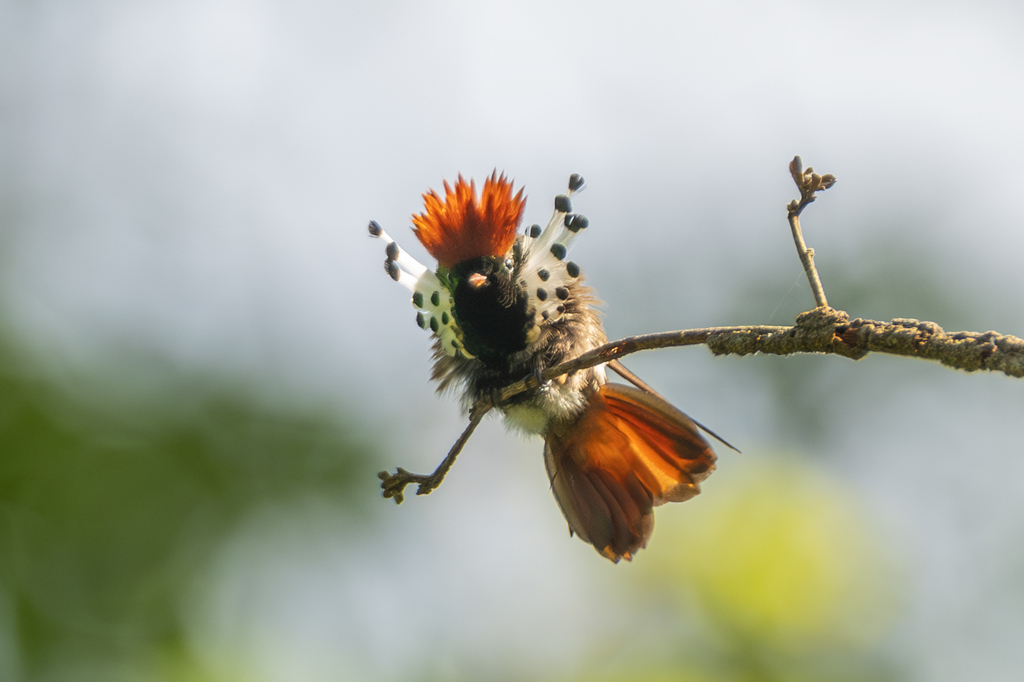
The dot-eared coquette (Lophornis gouldii) is a species of hummingbird in the family Trochilidae. It is found in Bolivia and Brazil. Its natural habitats are subtropical or tropical moist lowland forests and heavily degraded former forest.
From the article Dot-eared coquette on Wikipedia (CC BY-SA), quoted section by section
Description
The dot-eared coquette is 6.8 to 7.6 cm (2.7 to 3.0 in) long and weighs 2.4 to 2.8 g (0.085 to 0.099 oz). Both sexes have a short, straight, black-tipped red bill. The adult male's forehead is glittering golden green. Long dark rufous feathers on its crown form a crest. Its upperparts are bronzy green with a white band across the rump. Its throat is glittering emerald green. Long white feathers with shiny green dots make tufts that fan out and back on the cheeks. Its underparts are grayish green. Its central tail feathers are bronzy green and the rest rufous with bronzy green tips and edges. The adult female does not have the male's crest or cheek tufts. Its upperparts are colored like the male's but with a bronzy iridescence. Its throat is rufous with a grayish green lower border. Its tail is bronze with rufous tips. Juveniles are similar to the adult female.
Range & habitat
The dot-eared coquette is found primarily in Brazil, from the mouth of the Amazon River in Pará south and west to Mato Grosso and Goiás. It has been recorded as a vagrant in Bolivia's Santa Cruz department. It inhabits semi-open to open landscapes such as forest edges, savanna, and cerrado from sea level up to about 800 m (2,600 ft) of elevation.
Wikipedia: “Distribution and habitat”
What it does
The dot-eared coquette is a "trap-line" feeder, visiting a circuit of flowering plants for nectar. Details of its diet are not known.
Wikipedia: “Feeding”
Listen
Looking for field recordings…
Where it lives
Recorded sightings
—
geo-referenced records in GBIF, from museums, herbaria and field observers.
Drag the globe to turn it. Dots are where records exist, not a range map; darker means more records.
In the stacks
Searching the stacks…
Every page naming Lophornis gouldii in the Biodiversity Heritage Library →
This page is assembled live from iNaturalist, GBIF, Wikipedia, the Source Library and the Internet Archive. It is not yet part of the hand-edited codex. iNaturalist taxon 6344.