- Animals
- ›Chordates
- ›Vertebrates
- ›Birds
- ›Swifts and Hummingbirds
- ›Hummingbirds
- ›Mango Hummingbirds and Allies
- ›Doryfera
On eBird ↗
Green-fronted Lancebill
Live sightings near you, the range map, bar charts of when it is seen, and Macaulay Library photos and recordings.
Green-fronted Lancebill
Doryfera ludovicae
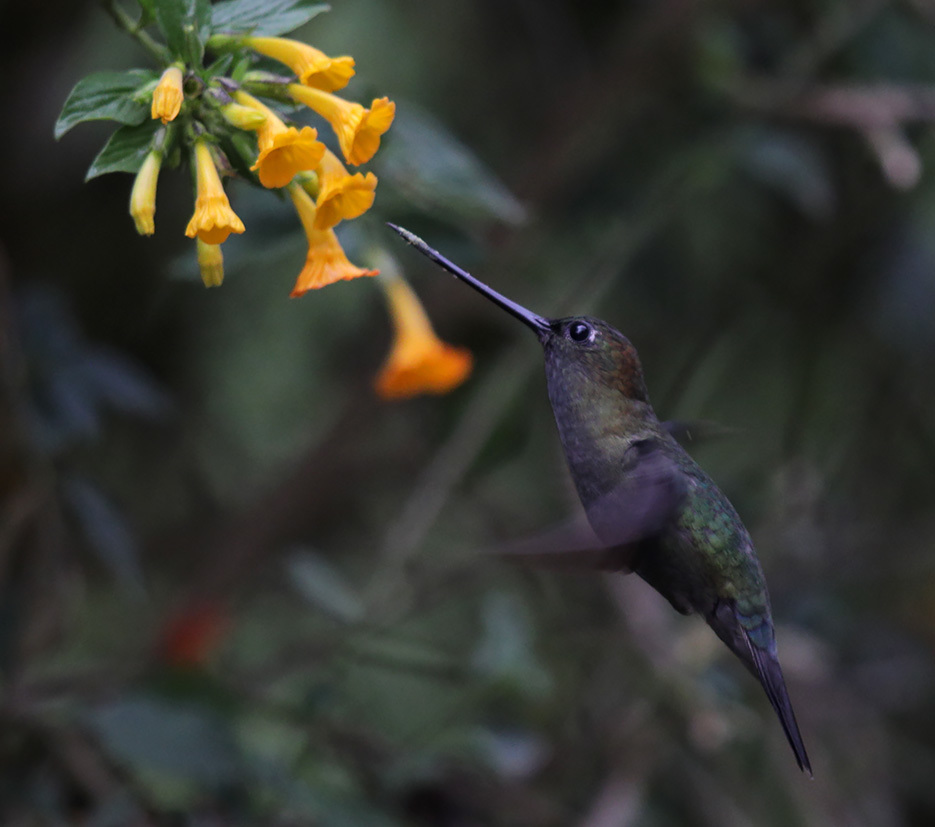
The green-fronted lancebill (Doryfera ludovicae) is a species of hummingbird in the family Trochilidae. Primarily known for its incredibly long bill and "glittering" green patch of feathers on its forehead, D. ludovicae is found in subtropical and tropical moist montane forest and prefers regions that include fast moving rivers and streams.
From the article Green-fronted lancebill on Wikipedia (CC BY-SA), quoted section by section
Description
The green-fronted lancebill, as the name suggests, is distinguished by a "glittering" green patch of feathers on their forehead. Between males and females, males consistently have a prominent forehead patch, however, literature is inconsistent on the appearance of females. One notable source claims females can vary widely between individuals, stating the female forehead with regards to both feather development and color intensity, can range from barely visible to indistinguishable from common male plumage. Body plumage is uniform regardless of sex with both males and females having a drab grey-green breast and belly. A coppery patch extends from the nape and down along the sides of the neck. This meets a rich green that occupies much of the crown except for the eponymous green forehead patch. Much of the back and dorsal face of the tail are a similar rich green as the green with an iridescence creating a situational alternation between green, teal, and turquoise. The last feature that distinguishes the green-fronted lancebill is its eponymous bill. …
Range & habitat
It has a disjunct distribution : Talamancan montane forests, the Serranía del Darién and the northern Andes. It is not considered migratory. This species and its sister species Doryfera johannae are found in highly developed forest locations adjacent to fast-moving streams. It is theorized that the specific needs of the species cause it to concentrate around ideal sites rather than be dispersed evenly around forested mountainsides.
Wikipedia: “Distribution and habitat”
What it does
The green-fronted lancebill like many hummingbirds is known for its distinct bill shape. Each shape serving to match a floral counterpart creating a system where in a particular ecosystem the floral-hummingbird partners are mutually reliant on one another for consistent access to their necessary resources, food in the form of nectar for the hummingbird and pollination for the flower. The degree to which a hummingbird adapts to a flower dictates how much of their resources (expended energy) that individual must exert in order to gather nectar. When a hummingbird is poorly matched to a flower. i.e. when the curvature and length of their bill is very different from the corolla of the flower they are gathering from, the handling time increases. This disincentivizes seeking flowers outside of a hummingbird's adaptive niche, and allows for a system of ecosystem resource partitioning. The green-fronted lancebill, having a particularly long and slightly upturned bill, has not been identified as having a single species partner but would benefit most from flowers with equally long corollas bearing a slight curve. The green-fronted lancebill feeds on the nectar of epiphytes, including mistletoe.
Wikipedia: “Feeding”
Listen
Looking for field recordings…
Where it lives
Recorded sightings
—
geo-referenced records in GBIF, from museums, herbaria and field observers.
Drag the globe to turn it. Dots are where records exist, not a range map; darker means more records.
In the stacks
Searching the stacks…
Every page naming Doryfera ludovicae in the Biodiversity Heritage Library →
This page is assembled live from iNaturalist, GBIF, Wikipedia, the Source Library and the Internet Archive. It is not yet part of the hand-edited codex. iNaturalist taxon 6322.