- Animals
- ›Chordates
- ›Vertebrates
- ›Birds
- ›Swifts and Hummingbirds
- ›Hummingbirds
- ›Mango Hummingbirds and Allies
- ›Doryfera
On eBird ↗
Blue-fronted Lancebill
Live sightings near you, the range map, bar charts of when it is seen, and Macaulay Library photos and recordings.
Blue-fronted Lancebill
Doryfera johannae
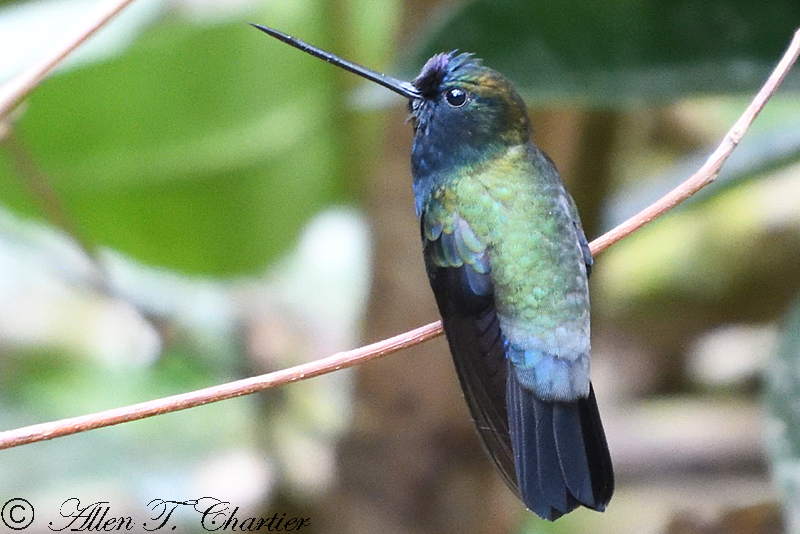
The blue-fronted lancebill (Doryfera johannae) is a species of hummingbird in the family Trochilidae. It is found in Brazil, Colombia, Ecuador, Guyana, Peru, and Venezuela. Its natural habitats are subtropical or tropical moist lowland forest and subtropical or tropical moist montane forest.
From the article Blue-fronted lancebill on Wikipedia (CC BY-SA), quoted section by section
Description
The blue-fronted lancebill is 9.6 to 11 cm (3.8 to 4.3 in) long. Males weigh 3 to 5 g (0.11 to 0.18 oz) and females 3.3 to 6 g (0.12 to 0.21 oz). Both sexes have a long straight to slightly upcurved bill, and often hold it at an upward angle. Males of the nominate subspecies have a violet forehead ("front"), a bronze nape, and otherwise dark bronzy green upperparts. The tail is short and blue-black. The underparts are blue-black with a bluish green gloss on the throat and breast. The female differs from the male by having a greenish blue forehead and dull grayish bronzy green underparts. Both sexes of D. j. guianensis have a shorter bill than the nominate and are overall paler but similarly colored.
Range & habitat
The nominate subspecies of blue-fronted lancebill is found on the east slope of the Andes from east central Colombia south through eastern Ecuador to central and southeastern Peru. It inhabits wet forests of lower Andean slopes and foothills and the adjacent lowlands. It favors ravines, gorges, and rock outcroppings and usually occurs from the forest's middle strata into the lower canopy. However, it occurs down to the shrub level at forest edges. In elevation it mostly ranges between 800 and 1,200 m (2,620 and 3,940 ft). D. j. guianensis is found disjunctly in southeastern Venezuela, western Guyana, and slightly into adjoining northern Brazil. It inhabits tropical and subtropical forests on the area's tepuis, mostly at elevations between 900 and 2,000 m (2,950 and 6,560 ft), and does not occur in the lowlands between them.
Wikipedia: “Distribution and habitat”
What it does
The blue-fronted lancebill's diet is nectar and small arthropods. It draws the former from tubular flowers, typically those that droop or are horizontal. It does not usually defend feeding territories. It catches arthropods on the wing or by hover-gleaning from vegetation.
Wikipedia: “Feeding”
Listen
Looking for field recordings…
Where it lives
Recorded sightings
—
geo-referenced records in GBIF, from museums, herbaria and field observers.
Drag the globe to turn it. Dots are where records exist, not a range map; darker means more records.
In the stacks
Searching the stacks…
Every page naming Doryfera johannae in the Biodiversity Heritage Library →
This page is assembled live from iNaturalist, GBIF, Wikipedia, the Source Library and the Internet Archive. It is not yet part of the hand-edited codex. iNaturalist taxon 6319.