- Animals
- ›Chordates
- ›Vertebrates
- ›Birds
- ›Swifts and Hummingbirds
- ›Hummingbirds
- ›Brilliants, Coquettes, and Allies
- ›Brilliants and Allies
- ›Eriocnemis
On eBird ↗
Glowing Puffleg
Live sightings near you, the range map, bar charts of when it is seen, and Macaulay Library photos and recordings.
Glowing Puffleg
Eriocnemis vestita
The glowing puffleg (Eriocnemis vestita) is a species of hummingbird in the "brilliants", tribe Heliantheini in subfamily Lesbiinae. It is found in Colombia, Ecuador, Peru, and Venezuela.
From the article Glowing puffleg on Wikipedia (CC BY-SA), quoted section by section
Description
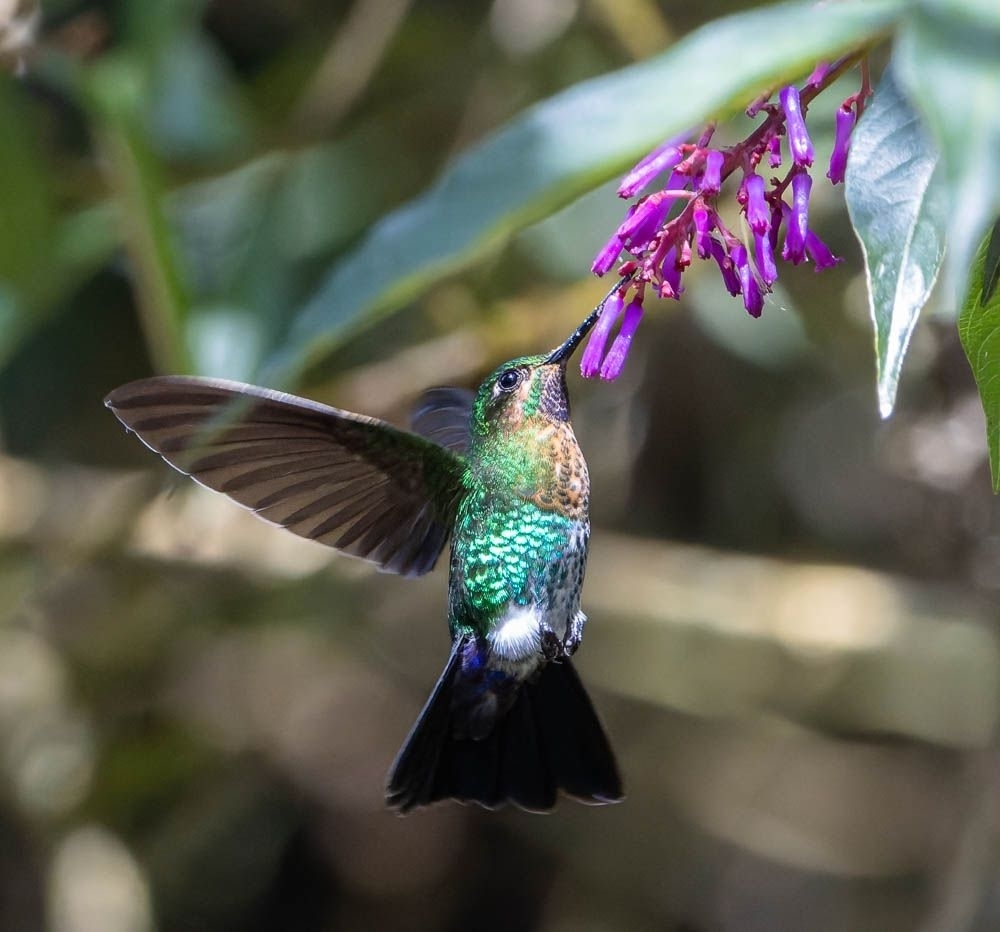
The glowing puffleg is 9 to 10 cm (3.5 to 3.9 in) long. Males weigh 3.3 to 7.2 g (0.12 to 0.25 oz) and females 3.6 to 5.3 g (0.13 to 0.19 oz). It has a straight blackish bill. The nominate subspecies' male has shining dark green upperparts with a golden green rump and uppertail coverts. It has a glittering purple throat patch thinly surrounded by golden green. The rest of its throat and its upper breast are shining blackish green, its belly glittering golden green, and its undertail coverts iridescent purplish blue. Its leg puffs are white. The tail is forked and dark steel blue. The female has shining golden green upperparts. Its throat patch is a few bluish purple discs on a buffy background. The rest of the throat and the breast are buff and the belly grayish white, all with golden green discs. The juvenile is similar to the female. Subspecies E. v. paramillo is like the nominate but without the golden green fringe to the purple throat. Males of E. v. smaragdinipectus have the largest purple throat patch of all. E. v. arcosae is similar to smaragdinipectus but its rump and uppertail coverts are yellowish green that extends up into the lower back; males also have shorter bills and a grayer belly than the nominate.
Range & habitat
The subspecies of glowing puffleg are found thus:
E. v. paramillo, northern parts of Colombia's Western and Central Andes, mostly in Antioquia Department E. v. vestita , from northwestern Venezuela's Mérida state into the Eastern and Central Colombian Andes as far as Cundinamarca and Huila departments E. v. smaragdinipectus, from southern Colombia's Central Andes in Cauca Department south to Ecuador's Cañar Province E. v. arcosae, the Andes from southern Ecuador's Azuay Province into extreme northern Peru's departments of Piura and Cajamarca The glowing puffleg inhabits a variety of fairly open landscapes. The edges of cloudforest and elfin forest predominate. It also occurs on brushy slopes, overgrown pastures, and páramo and occasionally in denser subtropical forest. In elevation it ranges between 2,300 and 4,200 m (7,500 and 13,800 ft) but mostly occurs between 2,800 and 3,500 m (9,200 and 11,500 ft).
Wikipedia: “Distribution and habitat”
What it does
The glowing puffleg feeds on nectar, usually at the flowers of low-growing shrubs with short corollas. It nectars while hovering, perching, or sometimes clinging to the flower. It is "pugnacious and territorial" at flowering plants. Its diet also includes insects and spiders taken by hawking.
Wikipedia: “Feeding”
Listen
Looking for field recordings…
Where it lives
Recorded sightings
—
geo-referenced records in GBIF, from museums, herbaria and field observers.
Drag the globe to turn it. Dots are where records exist, not a range map; darker means more records.
In the stacks
Searching the stacks…
Every page naming Eriocnemis vestita in the Biodiversity Heritage Library →
This page is assembled live from iNaturalist, GBIF, Wikipedia, the Source Library and the Internet Archive. It is not yet part of the hand-edited codex. iNaturalist taxon 6276.