- Animals
- ›Chordates
- ›Vertebrates
- ›Birds
- ›Swifts and Hummingbirds
- ›Hummingbirds
- ›Brilliants, Coquettes, and Allies
- ›Brilliants and Allies
- ›Haplophaedia
On eBird ↗
Hoary Puffleg
Live sightings near you, the range map, bar charts of when it is seen, and Macaulay Library photos and recordings.
Hoary Puffleg
Haplophaedia lugens
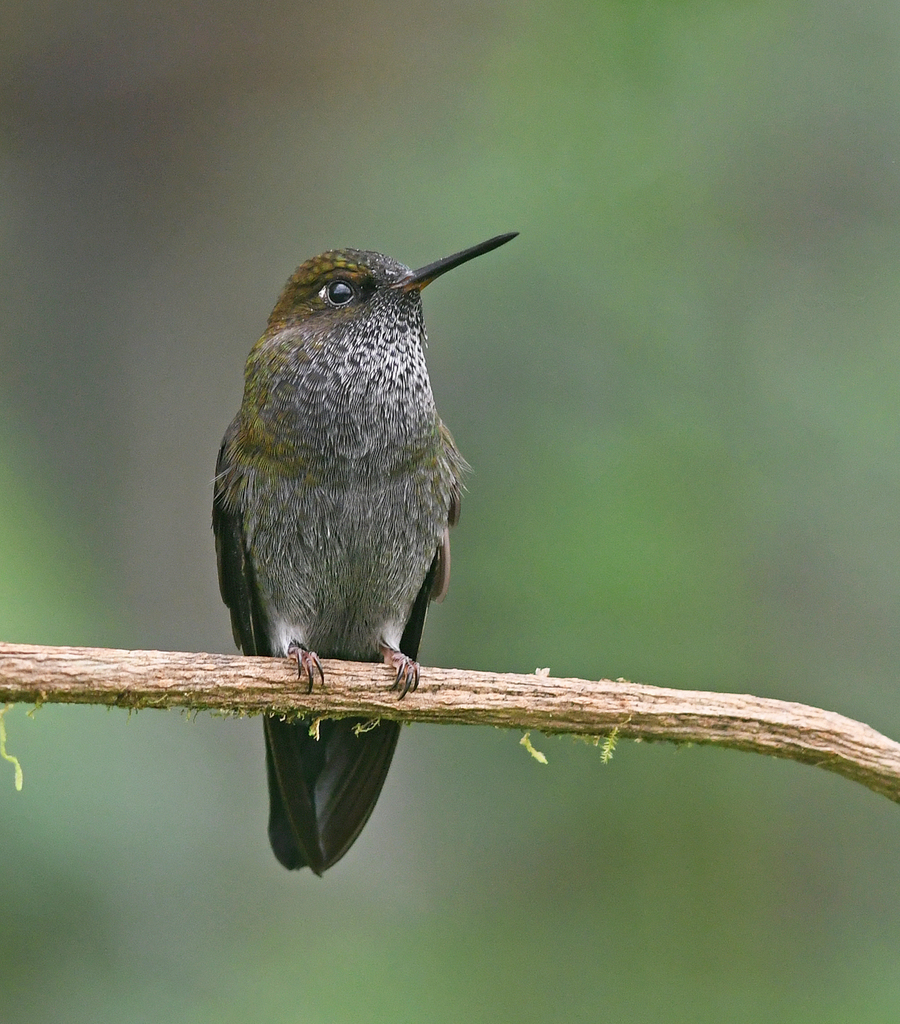
The hoary puffleg (Haplophaedia lugens) is a species of hummingbird in the "brilliants", tribe Heliantheini in subfamily Lesbiinae. It is found in Colombia and Ecuador.
From the article Hoary puffleg on Wikipedia (CC BY-SA), quoted section by section
Description
The hoary puffleg is 9 to 10 cm (3.5 to 3.9 in) long and weighs 5 to 6 g (0.18 to 0.21 oz). It has a straight black bill. Males have bronze-green upperparts with a coppery hue on the crown and rump. The underparts are dark gray with a whitish scaly appearance on the throat and breast and a greenish sheen on the flanks. The leg puffs are white on the outside and chestnut on the inside. The slightly forked tail is blackish. Females are similar but duller overall and their leg puffs are entirely white. Juveniles resemble females.
Range & habitat
The hoary puffleg is found in a fairly narrow band on the Pacific slope of the Andes, from southwestern Colombia's Nariño Department south into Ecuador as far as Pichincha Province. It inhabits cloudforest, the borders of other types of tropical and subtropical forest, and scrublands. It tends to stay in low dense vegetation, often near streams. In Colombia it has been recorded between elevations of 1,200 and 2,000 m (3,900 and 6,600 ft) and locally as high as 2,500 m (8,200 ft). In Ecuador records span from 1,525 to 2,100 m (5,000 to 6,900 ft).
Wikipedia: “Distribution and habitat”
What it does
The hoary puffleg forages for nectar mostly near the ground but occasionally in the canopy. It is territorial and defends clusters of flowers. It typically feeds on flowers with short corollas such as Besleria sp., Palicourea sp., Thibaudia sp., Melastomataceae, and Marantaceae. In addition to nectar, it feeds on insects that it gleans from leaves.
Wikipedia: “Feeding”
Listen
Looking for field recordings…
Where it lives
Recorded sightings
—
geo-referenced records in GBIF, from museums, herbaria and field observers.
Drag the globe to turn it. Dots are where records exist, not a range map; darker means more records.
In the stacks
Searching the stacks…
Every page naming Haplophaedia lugens in the Biodiversity Heritage Library →
This page is assembled live from iNaturalist, GBIF, Wikipedia, the Source Library and the Internet Archive. It is not yet part of the hand-edited codex. iNaturalist taxon 6262.