- Animals
- ›Chordates
- ›Vertebrates
- ›Birds
- ›Swifts and Hummingbirds
- ›Hummingbirds
- ›Brilliants, Coquettes, and Allies
- ›Brilliants and Allies
- ›Coeligena
On eBird ↗
Black Inca
Live sightings near you, the range map, bar charts of when it is seen, and Macaulay Library photos and recordings.
Black Inca
Coeligena prunellei
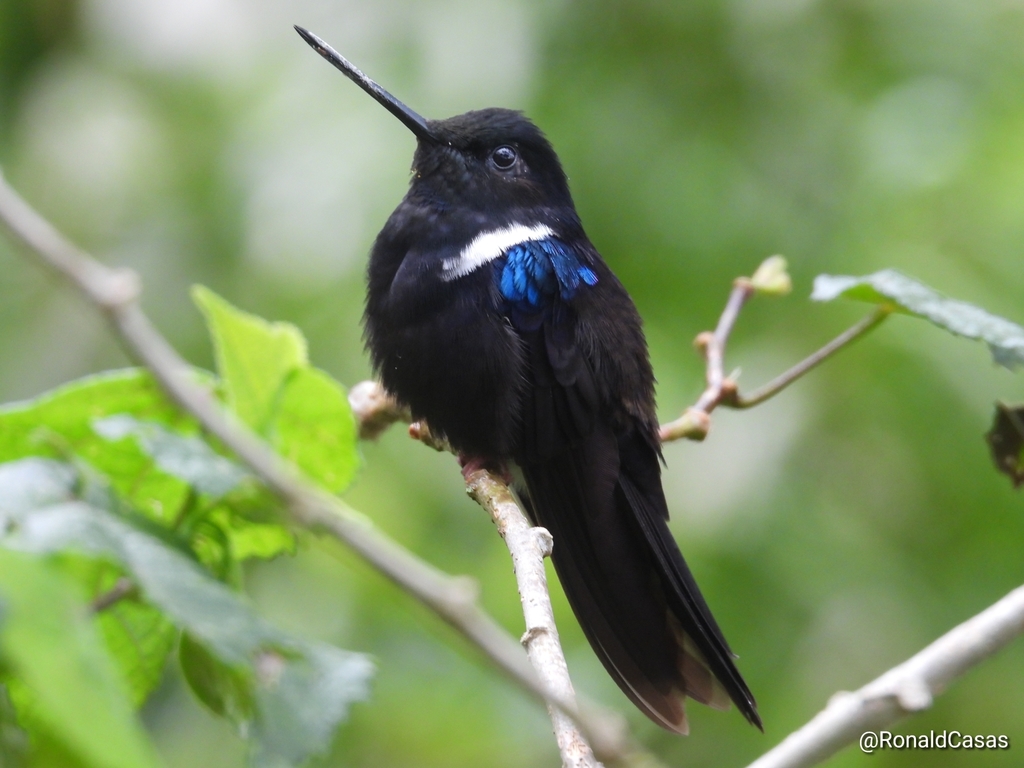
The black inca (Coeligena prunellei) is a species of hummingbird found only in Colombia. Its natural habitats are subtropical or tropical moist lowland forest, subtropical or tropical moist montane forest and urban areas. It is threatened by habitat loss.
From the article Black inca on Wikipedia (CC BY-SA), quoted section by section
Description
The black inca is about 14 cm (5.5 in) long and weighs about 6.6 to 7.0 g (0.23 to 0.25 oz). Both sexes have a long, straight, black bill and a white spot behind the eye. Adult males' upperparts are purplish black with dark metallic blue shoulders and a black forked tail. Their underparts are also dark purplish black with an iridescent blue-green gorget and a white patch on each side of the breast. Adult females are essentially the same as males but duller, with a longer bill, less blue on the shoulders, and a less forked tail. Immatures are duller than the adults and do not have a gorget.
Range & habitat
The black inca is endemic to Colombia. It is found on the west slope of the Eastern Andes from southeastern Santander and western Boyacá departments south into western Cundinamarca Department, and also on both slopes of Serranía de los Yariguíes in Santander. It mostly inhabits the interior of humid montane forest, especially those dominated by oaks, but males are also found in fragmented forest and other human-modified landscapes. In elevation it ranges between 1,200 and 2,800 m (3,900 and 9,200 ft).
Wikipedia: “Distribution and habitat”
What it does
The black inca mostly forages for nectar by trap-lining, visiting a circuit of a wide variety of flowering plants, though it occasionally defends concentrated flower patches. It nectars at mid-levels within forest and low levels at the edges. It prefers tubular red and yellow flowers such as those of genera Fuchsia, Bomarea, Aetanthus, Aphelandra, Palicourea, Psammisia, and Thibaudia. It prefers native plants when they are abundant but in one study frequented plants of genus Abutilon and other introduced species. In addition to feeding on nectar, the black inca gleans small arthropods from foliage.
Wikipedia: “Feeding”
Listen
Looking for field recordings…
Where it lives
Recorded sightings
—
geo-referenced records in GBIF, from museums, herbaria and field observers.
Drag the globe to turn it. Dots are where records exist, not a range map; darker means more records.
In the stacks
Searching the stacks…
Every page naming Coeligena prunellei in the Biodiversity Heritage Library →
This page is assembled live from iNaturalist, GBIF, Wikipedia, the Source Library and the Internet Archive. It is not yet part of the hand-edited codex. iNaturalist taxon 6252.