- Animals
- ›Chordates
- ›Vertebrates
- ›Birds
- ›Swifts and Hummingbirds
- ›Hummingbirds
- ›Brilliants, Coquettes, and Allies
- ›Brilliants and Allies
- ›Coeligena
On eBird ↗
Rainbow Starfrontlet
Live sightings near you, the range map, bar charts of when it is seen, and Macaulay Library photos and recordings.
Rainbow Starfrontlet
Coeligena iris
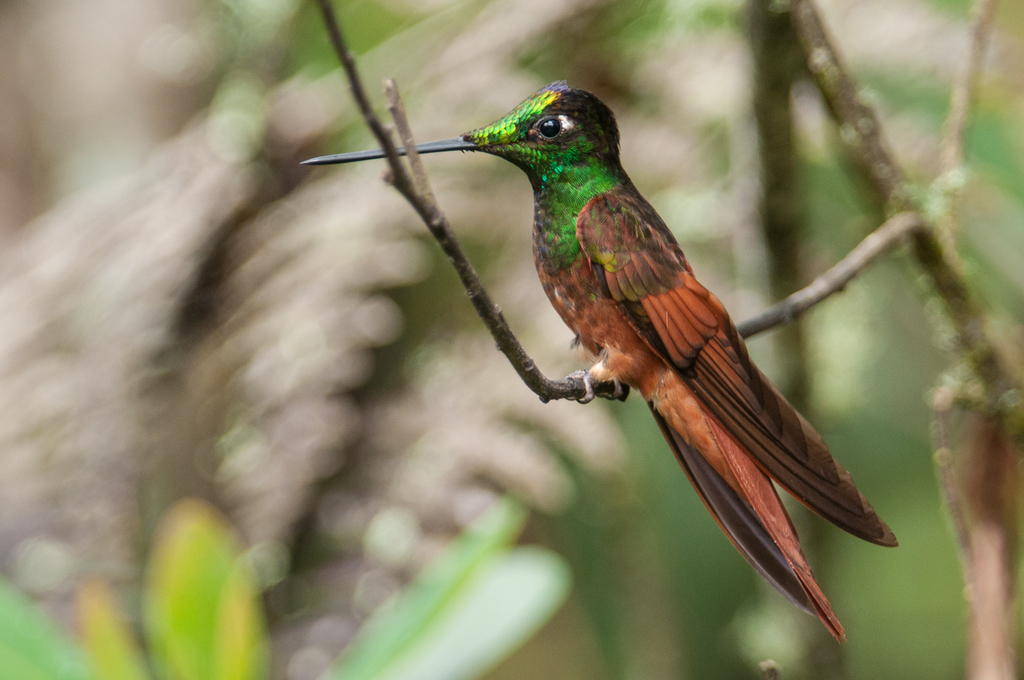
The rainbow starfrontlet (Coeligena iris) is a species of hummingbird in the family Trochilidae. It is found in Ecuador and Peru. Its natural habitats are subtropical or tropical moist montane forests, subtropical or tropical high-altitude shrubland, at elevations of 1500 – 3300 m, and heavily degraded former forest. They can be seen along the edges of forests and adjacent shrubby areas.
From the article Rainbow starfrontlet on Wikipedia (CC BY-SA), quoted section by section
Description
The rainbow starfrontlet is 12.5 to 14 cm (4.9 to 5.5 in) long. Males weigh 6.7 to 8.8 g (0.24 to 0.31 oz) and females 6 to 8.1 g (0.21 to 0.29 oz). Both sexes have a long, straight, black bill, with the female's being somewhat longer than the male's. Both sexes have a white spot behind the eye. Both sexes also have a forked tail, but the male's is more deeply indented than the female's. The subspecies differ significantly in their plumage. Males of the nominate subspecies have a glittering yellow-green forecrown that transitions through golden yellow to blue on the crown. Their upperparts are mostly blackish with a green sheen and are chestnut on the lower back and rump. The throat and chest are glittering emerald green and the throat has a small violet spot. The belly, undertail coverts, and tail are chestnut. Nominate females are generally similar to the males but with less of a metallic sheen, and juveniles are similar to adult females. Males of subspecies C. i. hesperus have a dark golden-red crown with a blue stripe, a golden green back, green underparts with a violet throat spot, and bronzy tips on the chestnut tail feathers. Females are a duller version of the male. Males of C. i. aurora have a turquoise crown with golden tips to the feathers, a black hindneck, and light chestnut upperparts. …
Range & habitat
The six subspecies of rainbow starfrontlet are found thus:
C. i. hesperus, southwestern Ecuador's Chimborazo and Azuay provinces C. i. iris, from Azuay Province in Ecuador into northern Peru's Department of Piura C. i. aurora, central and eastern Cajamarca Department in northwestern Peru C. i. flagrans, the western slope of the western Andes in Cajamarca Department. C. i. eva, the eastern slope of northern Peru's western Andes, west of the Marañón River C. i. fulgidiceps, Peru east of the Marañón River in southern Amazonas Department The rainbow starfrontlet inhabits the edges of both humid and semi-humid cloudforest, gardens, and riparian scrub. In elevation it generally ranges from 1,700 to 3,300 m (5,600 to 10,800 ft) but has been recorded as high as 4,000 m (13,000 ft) in northern Peru's Huascarán National Park.
Wikipedia: “Distribution and habitat”
What it does
The rainbow starfrontlet forages for nectar by trap-lining, visiting a circuit of a wide variety of flowering plants, most of which have tubular red flowers. Examples include those of genera Embothrium, Fuchsia, Iochroma, Mutisia, Salvia, and Tilandsia. It usually forages within 2 to 4 m (7 to 10 ft) of the ground. In addition to feeding on nectar it captures small arthropods by hawking.
Wikipedia: “Feeding”
Listen
Looking for field recordings…
Where it lives
Recorded sightings
—
geo-referenced records in GBIF, from museums, herbaria and field observers.
Drag the globe to turn it. Dots are where records exist, not a range map; darker means more records.
In the stacks
Searching the stacks…
Every page naming Coeligena iris in the Biodiversity Heritage Library →
This page is assembled live from iNaturalist, GBIF, Wikipedia, the Source Library and the Internet Archive. It is not yet part of the hand-edited codex. iNaturalist taxon 6245.