- Animals
- ›Chordates
- ›Vertebrates
- ›Birds
- ›Swifts and Hummingbirds
- ›Hummingbirds
- ›Brilliants, Coquettes, and Allies
- ›Brilliants and Allies
- ›Coeligena
On eBird ↗
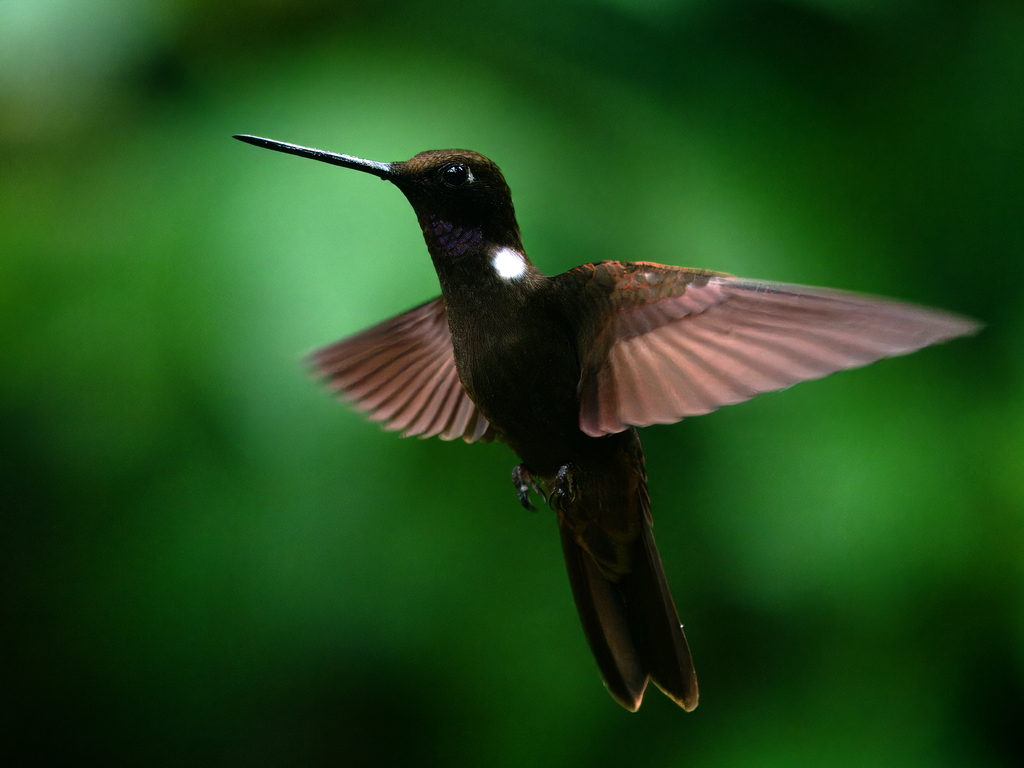
Brown Inca
Live sightings near you, the range map, bar charts of when it is seen, and Macaulay Library photos and recordings.
Brown Inca
Coeligena wilsoni
The Brown Inca (Coeligena wilsoni) is a species of hummingbird found in forests between 1000 and 2800 m along the Pacific slope of the Andes from western Colombia to southern Ecuador.
From the article Brown inca on Wikipedia (CC BY-SA), quoted section by section
Description
The brown inca is about 11 to 13 cm (4.3 to 5.1 in) long. Males weigh about 7.0 g (0.25 oz) and females about 6.5 g (0.23 oz). Both sexes have a long, straight, black bill and a white spot behind the eye. Adult males' upperparts are reddish bronze with a greenish olive lower back and a bronzy forked tail. Their underparts are mostly dull brown with an amethyst gorget and a white patch on each side of the breast. Adult females are essentially the same as males but for a longer bill, a smaller gorget, and a less forked tail. Immatures resemble the adult female.
Range & habitat
The brown inca is found on the Pacific slope of the Andes from Colombia's Chocó Department south through Ecuador all the way to Loja Province. It most commonly inhabits the edges of cloudforest and is also found in the forest interior. In elevation it generally ranges from 700 to 1,900 m (2,300 to 6,200 ft). However, it is most common below 1,300 m (4,300 ft) and has been recorded as high as 2,400 m (7,900 ft).
Wikipedia: “Distribution and habitat”
What it does
The brown inca forages for nectar by trap-lining, visiting a circuit of a wide variety of flowering plants low in the forest understory. Examples include genera Psammisia, Macleania, Cavendishia, and Fuchsia. In addition to feeding on nectar it gleans small arthropods from vegetation and sometimes captures them by hawking.
Wikipedia: “Feeding”
Listen
Looking for field recordings…
Where it lives
Recorded sightings
—
geo-referenced records in GBIF, from museums, herbaria and field observers.
Drag the globe to turn it. Dots are where records exist, not a range map; darker means more records.
In the stacks
Searching the stacks…
Every page naming Coeligena wilsoni in the Biodiversity Heritage Library →
This page is assembled live from iNaturalist, GBIF, Wikipedia, the Source Library and the Internet Archive. It is not yet part of the hand-edited codex. iNaturalist taxon 6236.