- Animals
- ›Chordates
- ›Vertebrates
- ›Birds
- ›Swifts and Hummingbirds
- ›Hummingbirds
- ›Brilliants, Coquettes, and Allies
- ›Brilliants and Allies
- ›Aglaeactis
On eBird ↗
Black-hooded Sunbeam
Live sightings near you, the range map, bar charts of when it is seen, and Macaulay Library photos and recordings.
Black-hooded Sunbeam
Aglaeactis pamela
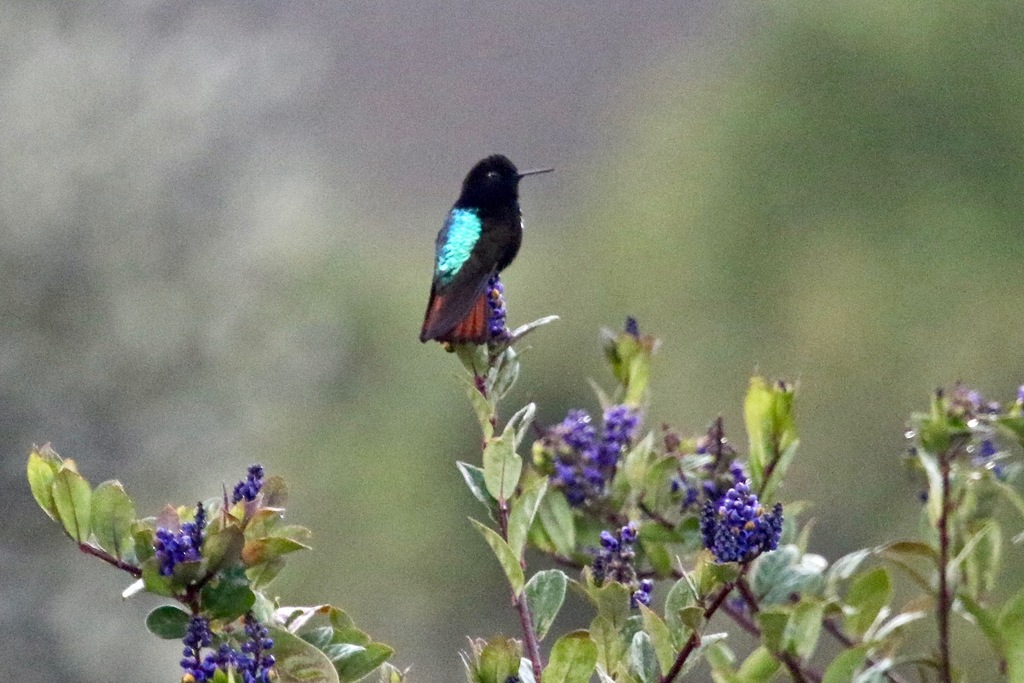
The black-hooded sunbeam (Aglaeactis pamela) is a species of hummingbird in the "brilliants", tribe Heliantheini in subfamily Lesbiinae. It is endemic to Bolivia.
From the article Black-hooded sunbeam on Wikipedia (CC BY-SA), quoted section by section
Description
The black-hooded sunbeam is about 12 cm (4.7 in) long including its 15 mm (0.59 in) straight black bill. Males weigh about 5.2 g (0.18 oz) and females 5.8 g (0.20 oz). The adult male is mostly purplish black, with glittering golden green to bluish green on the lower back and rump and a white tuft in the center of the breast. The tail is rufous with dusky tips to the feathers. Adult females are colored like the male but are duller overall and with less iridescent lower back and rump. Juveniles are somewhat browner than adults, with a reduced breast tuft and an olive cast to the tail.
Range & habitat
The black-hooded sunbeam is found only in the Andes of northern Bolivia, mainly in the departments of La Paz and Cochabamba. In elevation it mostly ranges between 2,500 and 4,200 m (8,200 and 13,800 ft) but there are records as low as 1,800 m (5,900 ft). It inhabits cloud forest and humid to semihumid montane scrublands.
Wikipedia: “Distribution and habitat”
What it does
The black-hooded sunbeam feeds primarily on nectar; it forages at all levels and clings to flowers to feed rather than hovering. It also feeds on small arthropods.
Wikipedia: “Feeding”
Listen
Looking for field recordings…
Where it lives
Recorded sightings
—
geo-referenced records in GBIF, from museums, herbaria and field observers.
Drag the globe to turn it. Dots are where records exist, not a range map; darker means more records.
In the stacks
Searching the stacks…
Every page naming Aglaeactis pamela in the Biodiversity Heritage Library →
This page is assembled live from iNaturalist, GBIF, Wikipedia, the Source Library and the Internet Archive. It is not yet part of the hand-edited codex. iNaturalist taxon 6206.