- Animals
- ›Chordates
- ›Vertebrates
- ›Birds
- ›Swifts and Hummingbirds
- ›Hummingbirds
- ›Bee Hummingbirds, Emeralds, Mountain-gems, and Allies
- ›Bee Hummingbirds and Allies
- ›Chaetocercus
On eBird ↗
Little Woodstar
Live sightings near you, the range map, bar charts of when it is seen, and Macaulay Library photos and recordings.
Little Woodstar
Chaetocercus bombus
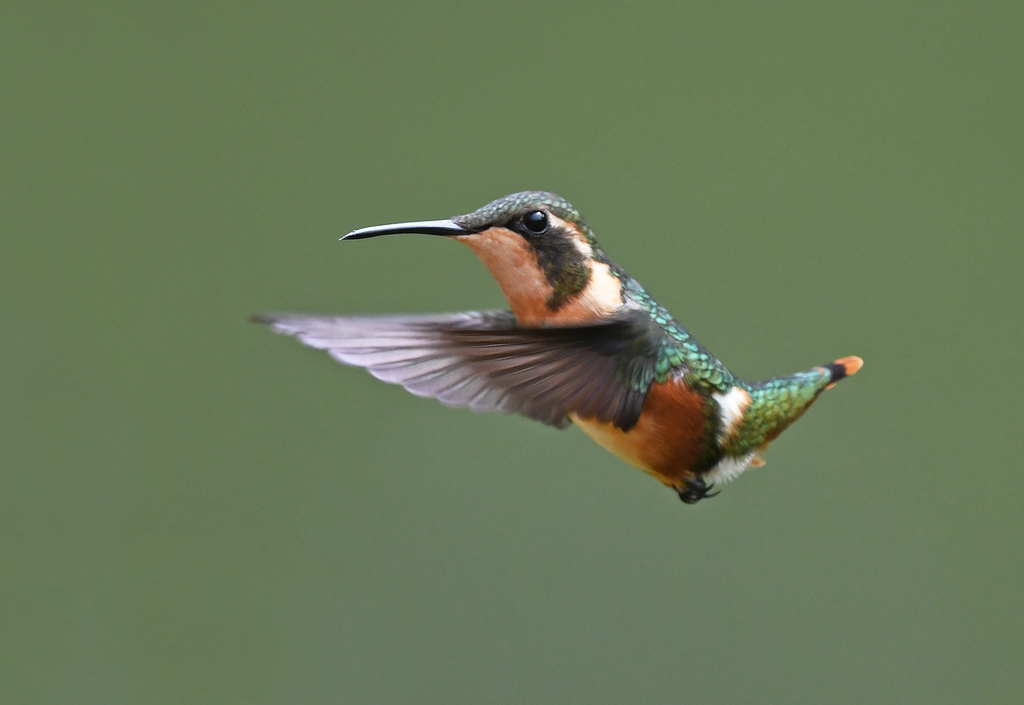
The little woodstar (Chaetocercus bombus), called estrellita chica in South America, is a Near Threatened species of hummingbird in tribe Mellisugini of subfamily Trochilinae, the "bee hummingbirds". It is found in Colombia, Ecuador and Peru.
From the article Little woodstar on Wikipedia (CC BY-SA), quoted section by section
Description
The little woodstar is 6 to 7 cm (2.4 to 2.8 in) long. Both sexes have a straightish black bill. The male is mostly dark bronzy blue-green. It has a buffy white line behind the eye that curves down to meet the buffy chest. Its gorget is rosy. The tail is forked and its outermost feathers are shafts with no vanes. The female is bronzy green above and mostly cinnamon below with tawny flanks and vent. The tail is rounded and tawny with a black bar near the end.
Range & habitat
The little woodstar is found from extreme southwestern Colombia through western Ecuador into northern Peru and discontinuously in eastern Ecuador and north central Peru. It inhabits the transition zone between semi-humid and humid deciduous forest. In elevation it ranges from sea level to 2,300 m (7,500 ft) in western Ecuador and between 900 and 3,000 m (3,000 and 9,800 ft) in eastern Ecuador and Peru.
Wikipedia: “Distribution and habitat”
What it does
The little woodstar forages from near the ground to the forest's middle level, visiting a wide variety of flowering plants and trees. Little is known about its foraging strategy but it is assumed to behave like its close relative the white-bellied woodstar (C. muslant). That species does not defend feeding territories, and because of its small size and slow bumblebee-like flight is able to feed in the territories of other hummingbirds.
Wikipedia: “Feeding”
Listen
Looking for field recordings…
Where it lives
Recorded sightings
—
geo-referenced records in GBIF, from museums, herbaria and field observers.
Drag the globe to turn it. Dots are where records exist, not a range map; darker means more records.
In the stacks
Searching the stacks…
Every page naming Chaetocercus bombus in the Biodiversity Heritage Library →
This page is assembled live from iNaturalist, GBIF, Wikipedia, the Source Library and the Internet Archive. It is not yet part of the hand-edited codex. iNaturalist taxon 6186.