- Animals
- ›Chordates
- ›Vertebrates
- ›Birds
- ›Swifts and Hummingbirds
- ›Hummingbirds
- ›Bee Hummingbirds, Emeralds, Mountain-gems, and Allies
- ›Bee Hummingbirds and Allies
- ›Chaetocercus
On eBird ↗
Santa Marta Woodstar
Live sightings near you, the range map, bar charts of when it is seen, and Macaulay Library photos and recordings.
Santa Marta Woodstar
Chaetocercus astreans
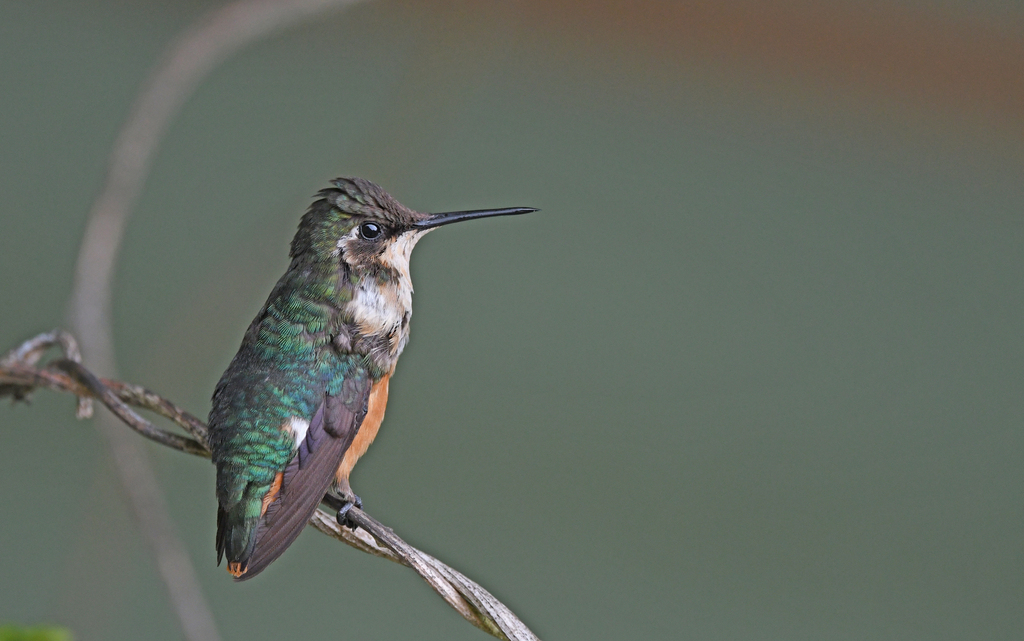
The Santa Marta woodstar (Chaetocercus astreans) is a species of hummingbird in tribe Mellisugini of subfamily Trochilinae, the "bee hummingbirds". It is endemic to Colombia.
From the article Santa Marta woodstar on Wikipedia (CC BY-SA), quoted section by section
Description
The Santa Marta woodstar is about 7 cm (2.8 in) long. Both sexes have a straight black bill. The male's head is shiny green and the rest of the upperparts dark shiny bluish. It has a reddish gorget that extends across the neck. The breast is gray and the belly bluish with a white spot on the flanks. The tail is forked, with very short central feathers and outer ones that are bare shafts. The female is bronzy green above and pale cinnamon-rufous below with a dark cheek patch and, like the male, a white spot on the flanks. Its rounded tail has green central feathers and the rest are cinnamon with a black bar near the end.
Range & habitat
The Santa Marta woodstar is found only in the isolated Sierra Nevada de Santa Marta of northern Colombia. It inhabits the edges of montane forest, semi-open woodlands, and coffee plantations, and occasionally visits the lower parts of the páramo. In elevation it ranges between 825 and 2,000 m (2,700 and 6,600 ft).
Wikipedia: “Distribution and habitat”
What it does
The Santa Marta woodstar feeds on nectar and insects, though no details are known. It is assumed to have a foraging strategy and diet like those of its close relative the gorgeted woodstar. That species feeds from vegetation's middle strata to the canopy; one important source is the flowers of Inga trees. It does not defend feeding territories, and because of its small size and slow bumblebee-like flight is sometimes able to feed in the territories of other hummingbirds.
Wikipedia: “Feeding”
Listen
Looking for field recordings…
Where it lives
Recorded sightings
—
geo-referenced records in GBIF, from museums, herbaria and field observers.
Drag the globe to turn it. Dots are where records exist, not a range map; darker means more records.
In the stacks
Searching the stacks…
Every page naming Chaetocercus astreans in the Biodiversity Heritage Library →
This page is assembled live from iNaturalist, GBIF, Wikipedia, the Source Library and the Internet Archive. It is not yet part of the hand-edited codex. iNaturalist taxon 6185.