- Animals
- ›Chordates
- ›Vertebrates
- ›Birds
- ›Swifts and Hummingbirds
- ›Hummingbirds
- ›Bee Hummingbirds, Emeralds, Mountain-gems, and Allies
- ›Bee Hummingbirds and Allies
- ›Chaetocercus
On eBird ↗
Gorgeted Woodstar
Live sightings near you, the range map, bar charts of when it is seen, and Macaulay Library photos and recordings.
Gorgeted Woodstar
Chaetocercus heliodor
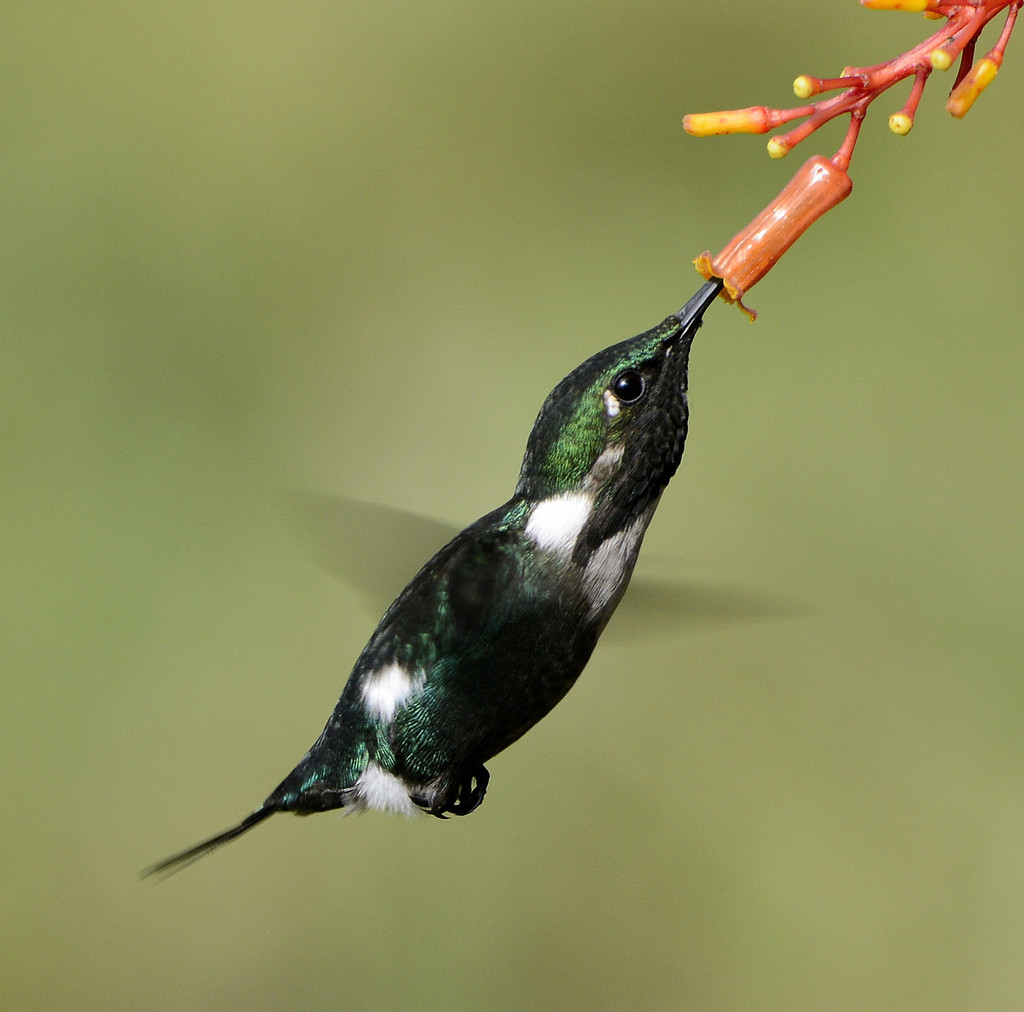
The gorgeted woodstar (Chaetocercus heliodor) is a species of hummingbird in the Trochilidae family. It is found in Colombia and Venezuela, and also has an isolated population in Ecuador. Its natural habitats are subtropical or tropical moist montane forests and heavily degraded former forest. This species favors forested areas highly but can be seen at flowering trees in gardens and in semi-open. The tail is frequently wagged while feeding.
From the article Gorgeted woodstar on Wikipedia (CC BY-SA), quoted section by section
Description
The gorgeted woodstar is 5.8 to 6.4 cm (2.3 to 2.5 in) long. It is the smallest woodstar, a group of species that collectively are among the world's smallest birds. Both sexes have a straight black bill. The nominate male is mostly dark metallic blue-green. It has a pinkish purple gorget that extends across the neck, a grayish line behind the eye, a grayish breast, and white spots on the flanks. The tail is forked, with very short central feathers and outer ones that are bare shafts. The nominate female's upperparts are bronzy green with a rufous rump. Its underparts are cinnamon-rufous and its rounded tail is cinnamon with a black bar near the end. Males of subspecies C. h. cleavesi are darker than the nominate, with a less purplish gorget and a shorter tail.
Range & habitat
The nominate subspecies of gorgeted woodstar is found in the Andes from Venezuela's Mérida state south through Colombia into western Ecuador. C. h. cleavesi is found in the Andes of northeastern Ecuador between Sucumbíos and Morona-Santiago provinces. The species inhabits semi-open to open landscapes such as the edges of humid forest, coffee plantations, and areas with some trees and shrubs; it occasionally visits the lower parts of the páramo. In elevation it ranges between 1,200 and 3,000 m (3,900 and 9,800 ft).
Wikipedia: “Distribution and habitat”
What it does
The gorgeted woodstar forages for nectar from vegetation's middle strata to the canopy; one important source is the flowers of Inga trees. It does not defend feeding territories, and because of its small size and slow bumblebee-like flight is sometimes able to feed in the territories of other hummingbirds. In addition to feeding on nectar, it captures small insects by hawking from a perch.
Wikipedia: “Feeding”
Listen
Looking for field recordings…
Where it lives
Recorded sightings
—
geo-referenced records in GBIF, from museums, herbaria and field observers.
Drag the globe to turn it. Dots are where records exist, not a range map; darker means more records.
In the stacks
Searching the stacks…
Every page naming Chaetocercus heliodor in the Biodiversity Heritage Library →
This page is assembled live from iNaturalist, GBIF, Wikipedia, the Source Library and the Internet Archive. It is not yet part of the hand-edited codex. iNaturalist taxon 6182.