- Animals
- ›Chordates
- ›Vertebrates
- ›Birds
- ›Swifts and Hummingbirds
- ›Hummingbirds
- ›Bee Hummingbirds, Emeralds, Mountain-gems, and Allies
- ›Bee Hummingbirds and Allies
- ›Chaetocercus
On eBird ↗
Esmeraldas Woodstar
Live sightings near you, the range map, bar charts of when it is seen, and Macaulay Library photos and recordings.
Esmeraldas Woodstar
Chaetocercus berlepschi
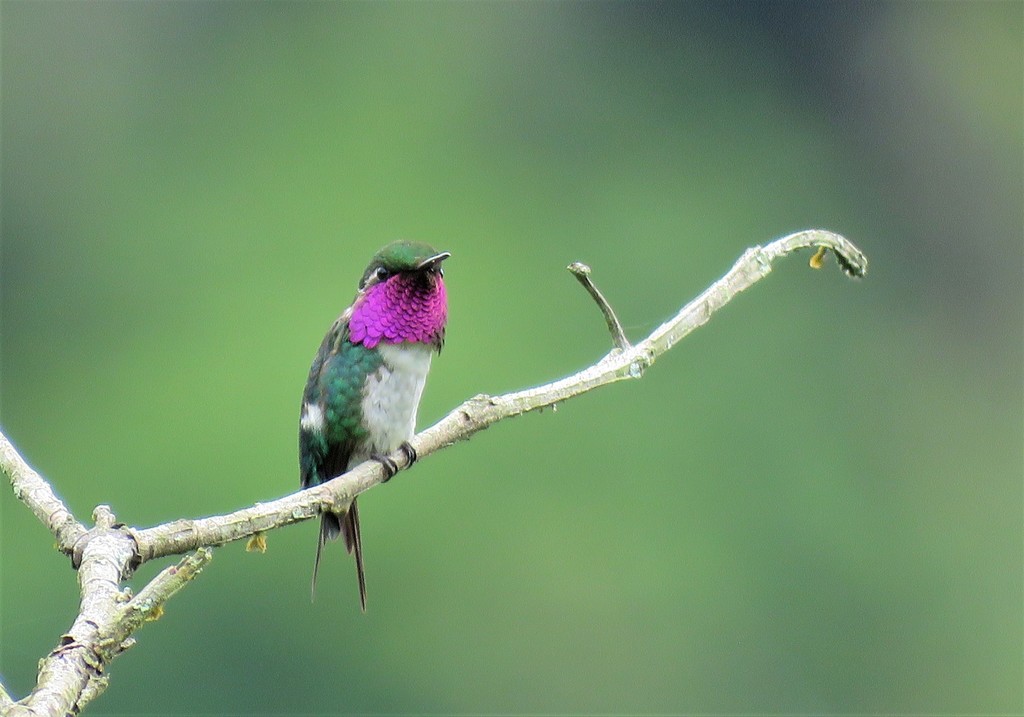
The Esmeraldas woodstar (Chaetocercus berlepschi) is a rare, neotropical species of hummingbird in the family Trochilidae. There are six different species in the woodstar genus. Most of them are poorly studied due to their small size, extremely similar resemblance to each other, and rarity. Esmeraldas woodstars are one of the smallest bird species. They are sexually dimorphic. The main difference between sexes is that males have a bright purple throat. Esmeraldas woodstars are found only on the Pacific coast of west Ecuador in semi-deciduous to evergreen forests. They feed on the nectar of flowering shrubs and trees. The main threat to this species is deforestation. Esmeraldas woodstars are Vulnerable and require habitat protection.
From the article Esmeraldas woodstar on Wikipedia (CC BY-SA), quoted section by section
Description
At only about 6 centimeters long, Esmeraldas woodstars are among the smallest species of hummingbird. Researchers recently found Esmeraldas woodstars at twelve new locations and collected the first female specimens of the species. Previously, the specimens labelled as female were misgendered juvenile males. Female Esmeraldas woodstars have yellowish-brown underparts and a dark greyish-black back, head, and tail. They have green patches on the sides of their chest and the center of their tail. Their tails also have small, cinnamon-rufous tips. They have a white postocular stripe (differently coloured feathers extending from the eye down to the neck). Little woodstars inhabit the same region as Esmeraldas woodstars, and the females of both species appear very similar to each other. Distinguishing features of little woodstar females are their green sheen, cinnamon postocular stripe which is short and narrow (rather than long and wide), cinnamon underparts, and larger size. Male Esmeraldas woodstars have green upperparts with a blue sheen, white underparts, a white postocular stripe, a green chest band, a forked tail and a bright purple throat. Male little woodstars also appear very similar to male Esmeraldas woodstars. …
Range & habitat
Esmeraldas woodstars are found only on the Pacific coast of western Ecuador. They occupy a small range which has been mostly deforested. Their range overlaps with the little woodstar. Esmeraldas woodstars inhabit semi-deciduous to evergreen moist forests. They are found anywhere between sea level and 750 meters in elevation. This includes both low elevation areas which have been disturbed by human settlement, and undisturbed, high elevation areas.
Wikipedia: “Distribution and habitat”
What it does
Esmeraldas woodstars breed from November to April near the coast at low elevations of 30 to 350 meters. These areas are typically developed with cattle ranching and agriculture, but are adjacent to large forest patches. Occasionally, they reproduce directly in mature moist forests. This species displays a specific mating behaviour. It begins with a male defending his perch at the top of a small dead tree. When a female arrives, the male flies directly up above the perch until he is completely out of sight. He then drops down to the perch while making mechanical noises with his wings. They make nests out of balsa wood fibers and a variety of Asteraceae seeds. The fibers and seeds are held together by spider webs and camouflaged with lichens. They always build their nests near the tops of small dead trees (about 5 meters tall). These trees are typically near creeks or roads. Esmeraldas woodstars typically lay two eggs at a time. The eggs are small and white.
Wikipedia: “Reproduction”
Listen
Looking for field recordings…
Where it lives
Recorded sightings
—
geo-referenced records in GBIF, from museums, herbaria and field observers.
Drag the globe to turn it. Dots are where records exist, not a range map; darker means more records.
In the stacks
Searching the stacks…
Every page naming Chaetocercus berlepschi in the Biodiversity Heritage Library →
This page is assembled live from iNaturalist, GBIF, Wikipedia, the Source Library and the Internet Archive. It is not yet part of the hand-edited codex. iNaturalist taxon 6176.