- Animals
- ›Chordates
- ›Vertebrates
- ›Birds
- ›Swifts and Hummingbirds
- ›Hummingbirds
- ›Bee Hummingbirds, Emeralds, Mountain-gems, and Allies
- ›Emerald Hummingbirds and Allies
- ›Cynanthus
On eBird ↗
Broad-billed Hummingbird
Live sightings near you, the range map, bar charts of when it is seen, and Macaulay Library photos and recordings.
Broad-billed Hummingbird
Cynanthus latirostris
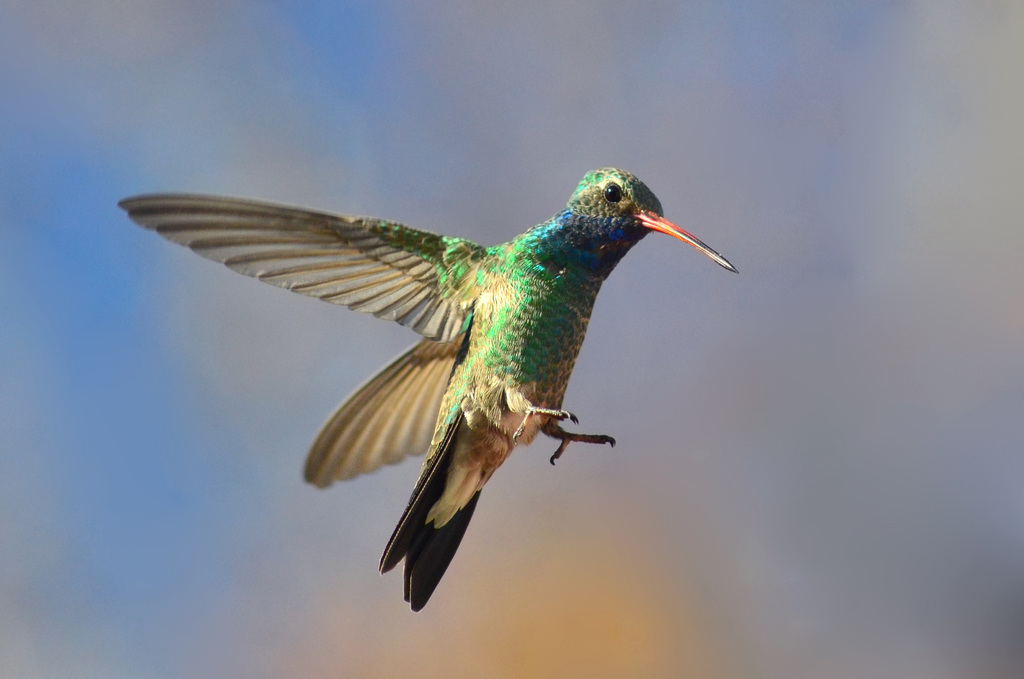
The broad-billed hummingbird (Cynanthus latirostris) is a small hummingbird that resides in Mexico and the southwestern United States. Males and females have different features (see sexual dimorphism). The juveniles resemble the female adult more than the male adult. The broad-billed hummingbird is a bright green bird. The broad, red bill in both sexes and the male's blue gorget are useful for identification. The bird is also known for its other common names – the Colibrí Pico Ancho in Spanish and Colibri circé in French. It is more active during the day and less active during the night (see diurnality).
From the article Broad-billed hummingbird on Wikipedia (CC BY-SA), quoted section by section
Description
The broad-billed hummingbird is a small hummingbird about 8–10 cm (3.1–3.9 in) long. It weighs only 3–4 grams, with the male weighing slightly more than the female. The wingspan of this hummingbird is about 13 cm (5.1 in). It has a long, bright reddish coloured bill that has a black tip. The birds are metallic green dorsally with dull colouring on the crown and forehead. The hummingbird is sexually dimorphic, with male and female adults appearing significantly different. The male is dark green with white undertail-coverts and a blue throat or gorget. The adult male's tail is blackish-blue and broad. The flight feathers are brownish-gray. The adult female has a pale belly and has a white eyestripe behind her eye. Her tail feathers are white-tipped. The bill of the male is shorter but brighter red. As for size, both the juvenile and adult males have larger wings and tails than the female. The colouring of the juveniles tends to resemble the adult female. With time, the bill of the juvenile males will redden, and iridescent feathers will appear on its throat. Unlike the females, the juvenile males do not have a white-tipped tail. The hatchings have a brown body and orange downy feathers and an orange bill. Not much is known about hatchlings, but in captivity, the juvenile birds have been seen to have adult plumage within 6–8 months.
Vocalizations. The C. …
Range & habitat
In the United States, C. l. latirostris lives along streamsides and oak woodlands. It prefers areas with streamside groves and dense vegetation, as well as open oak woodlands in lower canyons. It favours living in areas with Arizona sycamore (Platanus wrightii), Fremont cottonwoods (Populus fremontii), and mesquite. In Mexico, specimens have been collected at nearly every elevation above sea level, even from 1494 to 3048 meters high. Along the Pacific coast, the broad-billed hummingbird is known to be a common resident of arid thorn forests, tropical deciduous forests and riparian gallery forests. During breeding season, the broad-billed hummingbird is common in desert canyons and low mountain oak woodlands. It's found in the Southwest United States through to central Mexico. It has been noted breeding in southeast Arizona, southwest New Mexico, and rarely in southwest Texas. There have also been rare sightings across the continent, including in Arkansas. In the state of Sonora, Mexico, it is the most common hummingbird.
Migration and permanent residents. The breeding populations of C. l. latirostris in the United States, Sonora and Nuevo León are all migratory. Not enough information is known about the migration but it's believed that the birds fly deeper south into Mexico, into Guerrero and Baja California Sur. …
Wikipedia: “Distribution and habitat”
What it does
The broad-billed hummingbird eats both nectar and insects. The hummingbird is also known to visit sugar-water hummingbird feeders. Their eating habits showed that the broad-billed hummingbird prefers visiting red or red-and-yellow flowers the most. To feed on nectar, the hummingbird will extend its bill and long tongue into the flower to access the nectar while hovering. This differs from their behaviour at feeders, where oftentimes they will perch. To feed on insects, the bird species catch them midair or hover and pluck them from a plant. Not much is known on the metabolism, drinking, and food selection process of this species.
In the United States, the Broad-billed hummingbird is known to eat from the following flowering species: Agave (Agave parryi and A. schottii), desert honeysuckle (Anisacanthus thurberi), milkweed (Asclepias spp.), Bouvardia (Bouvardia glaberima), bird-of-paradise (Caesalpinia gilliesii), Indian paintbrush (Castilleja spp.), desert willow (Chilopsis linearis), New Mexico thistle (Cirsium neomexicanum), fireweed (Epilobium canum), coral bean (Erythrina flabelliformis), ocotillo (Fouquieria splendens), trumpet honeysuckle (Lonicera sempervirens), scarlet bugler (Penstemon barbatus), Mojave beardtongue (P. pseudospectabilis), superb penstemon (P. …
Wikipedia: “Diet”
Listen
Looking for field recordings…
Where it lives
Recorded sightings
—
geo-referenced records in GBIF, from museums, herbaria and field observers.
Drag the globe to turn it. Dots are where records exist, not a range map; darker means more records.
In the stacks
Searching the stacks…
Every page naming Cynanthus latirostris in the Biodiversity Heritage Library →
This page is assembled live from iNaturalist, GBIF, Wikipedia, the Source Library and the Internet Archive. It is not yet part of the hand-edited codex. iNaturalist taxon 6141.