- Animals
- ›Chordates
- ›Vertebrates
- ›Birds
- ›Swifts and Hummingbirds
- ›Hummingbirds
- ›Jacobins and Topazes
- ›Topaza
On eBird ↗
Crimson Topaz
Live sightings near you, the range map, bar charts of when it is seen, and Macaulay Library photos and recordings.
Crimson Topaz
Topaza pella
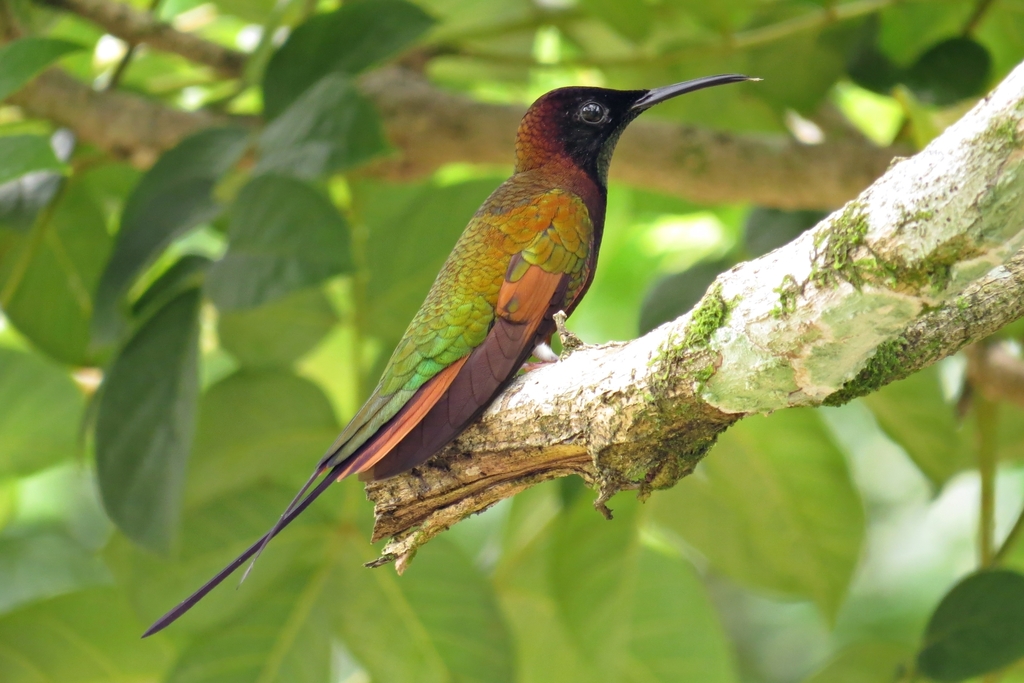
The crimson topaz (Topaza pella) is a species of hummingbird in the family Trochilidae. It is found in Brazil, French Guiana, Guyana, Suriname, and Venezuela.
From the article Crimson topaz on Wikipedia (CC BY-SA), quoted section by section
Description
The male crimson topaz is 21 to 23 cm (8.3 to 9.1 in) long including the 5 cm (2.0 in) bill and 8.6 to 12 cm (3.4 to 4.7 in) tail, and weighs 11 to 18 g (0.39 to 0.63 oz). Females are 13 to 14 cm (5.1 to 5.5 in) long and weigh 9 to 12.5 g (0.32 to 0.44 oz). It may be the second largest species of hummingbird after the giant hummingbird, rivaled only by its cousin, the fiery topaz. Male and female crimson topaz have different plumages. Both have a straight to slightly decurved bill. The male's head, face, and the sides of the neck are velvety black. Its back is iridescent crimson to gold on the uppertail coverts. The central tail feathers are bronzy green and the outer ones chestnut; two of the latter are elongated and crossed. The throat is golden green surrounded by a black band and the underparts bright red. The wings are brown. The female's head and back are dark green and its underparts a lighter green with golden green inclusions; the throat is green with crimson inclusions. The central tail feathers are bronzy, the middle pair violet, and the outer pair chestnut, and none are elongated like the male's.
Range & habitat
The subspecies of crimson topaz are distributed thus:
T. p. pella, eastern Venezuela through Guyana and Suriname into northern and western Brazil as far south as Rondônia T. p. smaragdulus, French Guiana and northeastern Brazil to between the Tapajós and Tocantins Rivers T. p. microrhyncha, Brazil's northeastern Pará state east of the Tocantins and Marajó Island at the mouth of the Amazon The species mainly inhabits inland rainforest in lowlands and foothills at elevations up to 500 m (1,600 ft). It frequents granite outcrops and also gallery forest along small waterways.
Wikipedia: “Distribution and habitat”
What it does
Male crimson topaz defend feeding territories. The species feeds on nectar of flowering trees, mainly in the canopy of the forest, and also the flowers of vines and epiphytes. It has been observed feeding in flowering shrubs near the ground in Suriname. It also captures small insects in the air, both above the canopy and low along streams.
Wikipedia: “Feeding”
Listen
Looking for field recordings…
Where it lives
Recorded sightings
—
geo-referenced records in GBIF, from museums, herbaria and field observers.
Drag the globe to turn it. Dots are where records exist, not a range map; darker means more records.
In the old herbals & bestiaries


In the stacks
Searching the stacks…
Every page naming Topaza pella in the Biodiversity Heritage Library →
This page is assembled live from iNaturalist, GBIF, Wikipedia, the Source Library and the Internet Archive. It is not yet part of the hand-edited codex. iNaturalist taxon 6126.