- Animals
- ›Chordates
- ›Vertebrates
- ›Birds
- ›Swifts and Hummingbirds
- ›Hummingbirds
- ›Mango Hummingbirds and Allies
- ›Colibri
On eBird ↗
White-vented Violetear
Live sightings near you, the range map, bar charts of when it is seen, and Macaulay Library photos and recordings.
White-vented Violetear
Colibri serrirostris
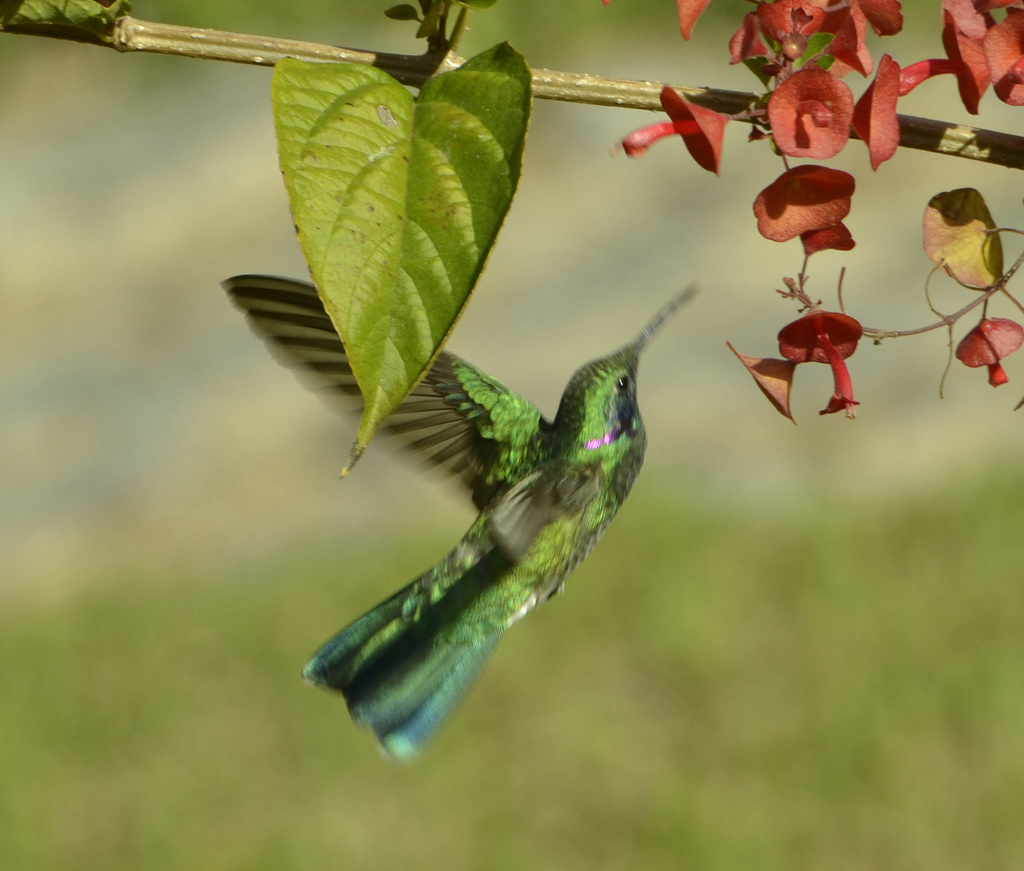
The white-vented violetear (Colibri serrirostris) is a species of hummingbird in the subfamily Polytminae, the mangoes. It is found in Argentina, Bolivia, Brazil, and Paraguay. In April, 2024, one was also photographed at Batsu Gardens in Costa Rica.
From the article White-vented violetear on Wikipedia (CC BY-SA), quoted section by section
Description
The white-vented violetear is 12 to 13 cm (4.7 to 5.1 in) long and weighs 5.6 to 6.8 g (0.20 to 0.24 oz). The male is mostly shiny green, of a shade lighter than that of other violetears. Towards the rump it is yellow-green with a blue shimmer. The tail is glittering green with a wide steel-blue band near the end. The undertail coverts are pure white. The area behind the eye and covering the ears is violet blue. The female is similar to the male but paler and more grayish. The maxilla of both sexes is sometimes serrated, which provides its specific epithet.
Range & habitat
The white-vented violetear is found in a wide swath of southern Brazil, from Mato Grosso east to Goiás, Bahia and Espírito Santo and south to Santa Catarina. Its range extends west into Bolivia, central Paraguay, and northern Argentina as far south as Córdoba Province. It inhabits a variety of semi-open landscapes including scrublands, savanna, grassland, and gardens and parks. In elevation it is most common between 1,000 and 1,500 m (3,300 and 4,900 ft) but its range begins at sea level and extends to 3,600 m (11,800 ft) in the Andes.
Wikipedia: “Distribution and habitat”
What it does
The white-vented violetear forages for nectar from a wide variety of flowering plants and trees. It also captures insects on the wing. It is very aggressive, calling from a perch and chasing other nectar-feeding birds and even butterflies from flower patches. It tends to begin feeding earlier in the day than other hummingbirds.
Wikipedia: “Feeding”
Listen
Looking for field recordings…
Where it lives
Recorded sightings
—
geo-referenced records in GBIF, from museums, herbaria and field observers.
Drag the globe to turn it. Dots are where records exist, not a range map; darker means more records.
In the stacks
Searching the stacks…
Every page naming Colibri serrirostris in the Biodiversity Heritage Library →
This page is assembled live from iNaturalist, GBIF, Wikipedia, the Source Library and the Internet Archive. It is not yet part of the hand-edited codex. iNaturalist taxon 6083.