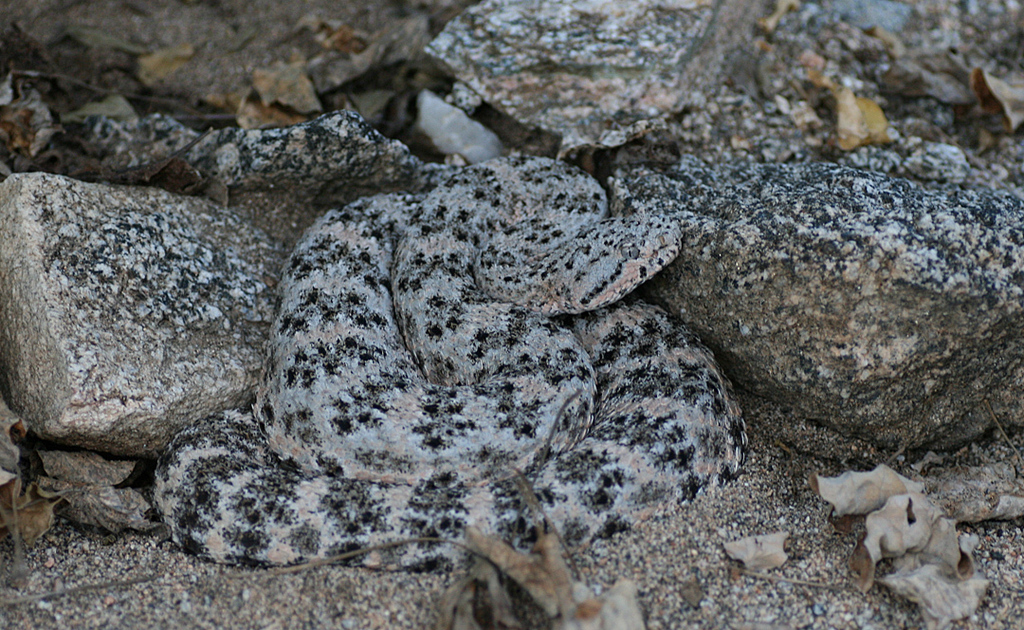
Speckled Rattlesnake
Crotalus mitchellii
Common names: speckled rattlesnake, Mitchell's rattlesnake, white rattlesnake
Crotalus mitchellii is a venomous pit viper species in the family Viperidae. The species is native to the Southwestern United States and adjacent northern Mexico. The species was named in honor of Silas Weir Mitchell (1829–1914), an American medical doctor who also studied rattlesnake venoms. Two subspecies are recognized as being valid, including the nominate subspecies described here.
From the article Crotalus mitchellii on Wikipedia (CC BY-SA), quoted section by section
Description
Generally, Crotalus mitchellii does not exceed 100 cm (39 in) in total length (tail included), with large males measuring between 90 and 100 cm (35 and 39 in). The race on Isla Ángel de la Guarda is known to become larger, the maximum recorded length for a specimen there being 136.7 cm (53.8 in). In contrast, the population on El Muerto Island only reaches a maximum of 63.7 cm (25.1 in) in length. On the back are about thirty sometimes vague markings often in the form of crossbars. The speckled rattlesnake is sometimes erroneously called the tiger rattlesnake because of these markings. Other times the markings are clearly defined geometric shapes – diamonds, hexagons, hourglasses – which vary in color from snake to snake but are always darker than the ground color. Normally there is a community coloration based on the snakes' specific rock setting. The whole effect: an individual snake looks like it had been formed from granite, a protective coloration it uses with great effect, and that is also quite beautiful when examined, as one might a work of art, against a contrasting background.
Range & habitat
Crotalus mitchellii is found in the southwestern United States and in northwestern Mexico. In the US, its range includes east-central and southern California, southwestern Nevada, extreme southwestern Utah, and western Arizona. In Mexico, it is native in northwestern Sonora and most of Baja California, including Baja California Sur. It also inhabits a number of islands in the Gulf of California, including Angel de la Guarda Island, Carmen, Cerralvo, El Muerto, Espíritu Santo, Monserrate, Piojo, Salsipuedes, and San José, as well as on Santa Margarita Island off the Pacific coast of Baja California Sur. The type locality is listed as "Cape St. Lucas, Lower California" (Cabo San Lucas, Baja California Sur, Mexico).
Wikipedia: “Geographic distribution”
What it does
Crotalus mitchellii is terrestrial, but will sometimes climb into low vegetation.
Wikipedia: “Behavior”
Where it lives
Recorded sightings
—
geo-referenced records in GBIF, from museums, herbaria and field observers.
Drag the globe to turn it. Dots are where records exist, not a range map; darker means more records.
In the stacks
Searching the stacks…
Every page naming Crotalus mitchellii in the Biodiversity Heritage Library →
This page is assembled live from iNaturalist, GBIF, Wikipedia, the Source Library and the Internet Archive. It is not yet part of the hand-edited codex. iNaturalist taxon 605972.