- Animals
- ›Chordates
- ›Vertebrates
- ›Birds
- ›Swifts and Hummingbirds
- ›Hummingbirds
- ›Bee Hummingbirds, Emeralds, Mountain-gems, and Allies
- ›Emerald Hummingbirds and Allies
- ›Campylopterus
On eBird ↗
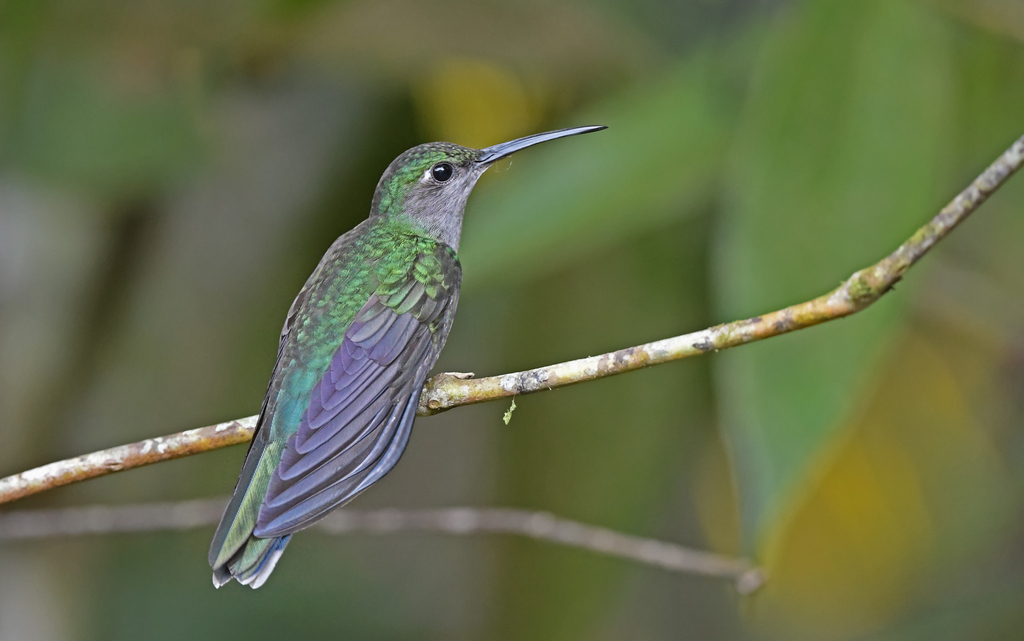
Gray-breasted Sabrewing
Live sightings near you, the range map, bar charts of when it is seen, and Macaulay Library photos and recordings.
Gray-breasted Sabrewing
Campylopterus largipennis
The grey-breasted sabrewing (Campylopterus largipennis) is a species of hummingbird in the "emeralds", tribe Trochilini of subfamily Trochilinae. It is found in Bolivia, Brazil, Ecuador, the Guianas, Peru, and Venezuela.
From the article Grey-breasted sabrewing on Wikipedia (CC BY-SA), quoted section by section
Description
The grey-breasted sabrewing is a large hummingbird, 12.4 to 14.9 cm (4.9 to 5.9 in) long. Males weigh 9 to 10 g (0.32 to 0.35 oz) and females about 7 to 8 g (0.25 to 0.28 oz). The sexes have almost identical plumage. Their bill is slightly decurved; the maxilla is black and the mandible pinkish with a black tip. The nominate subspecies' upperparts are dark shining green and the underparts dark gray. They have a white spot behind the eye. Their central pair of tail feathers is green and the rest bluish black on their inner half and white on the outer. Subspecies C. l. obscurus (with C. l. aequatorialis) is smaller than the nominate and its outer tail feathers' ends are usually gray rather than white.
Range & habitat
The three subspecies of grey-breasted sabrewing recognized by the IOC are distributed thus:
C. l. largipennis, eastern Venezuela, the Guianas, and northern Brazil as far west as the Rio Negro C. l. obscurus, northeastern Brazil C. l. aequatorialis, from eastern Colombia and northwestern Brazil south through eastern Ecuador and Peru into northern Bolivia The species inhabits humid primary and secondary forest, clearings within them, and plantations. In elevation it ranges between 100 and 800 m (330 and 2,600 ft).
Wikipedia: “Distribution and habitat”
What it does
The grey-breasted sabrewing forages for nectar at a variety of flowering plants, usually at low to medium heights. Males defend feeding territories. In addition to nectar, the species captures small insects by hawking from a perch.
Wikipedia: “Feeding”
Listen
Looking for field recordings…
Where it lives
Recorded sightings
—
geo-referenced records in GBIF, from museums, herbaria and field observers.
Drag the globe to turn it. Dots are where records exist, not a range map; darker means more records.
In the stacks
Searching the stacks…
Every page naming Campylopterus largipennis in the Biodiversity Heritage Library →
This page is assembled live from iNaturalist, GBIF, Wikipedia, the Source Library and the Internet Archive. It is not yet part of the hand-edited codex. iNaturalist taxon 6011.