- Animals
- ›Chordates
- ›Vertebrates
- ›Birds
- ›Swifts and Hummingbirds
- ›Hummingbirds
- ›Bee Hummingbirds, Emeralds, Mountain-gems, and Allies
- ›Emerald Hummingbirds and Allies
- ›Campylopterus
On eBird ↗
White-tailed Sabrewing
Live sightings near you, the range map, bar charts of when it is seen, and Macaulay Library photos and recordings.
White-tailed Sabrewing
Campylopterus ensipennis
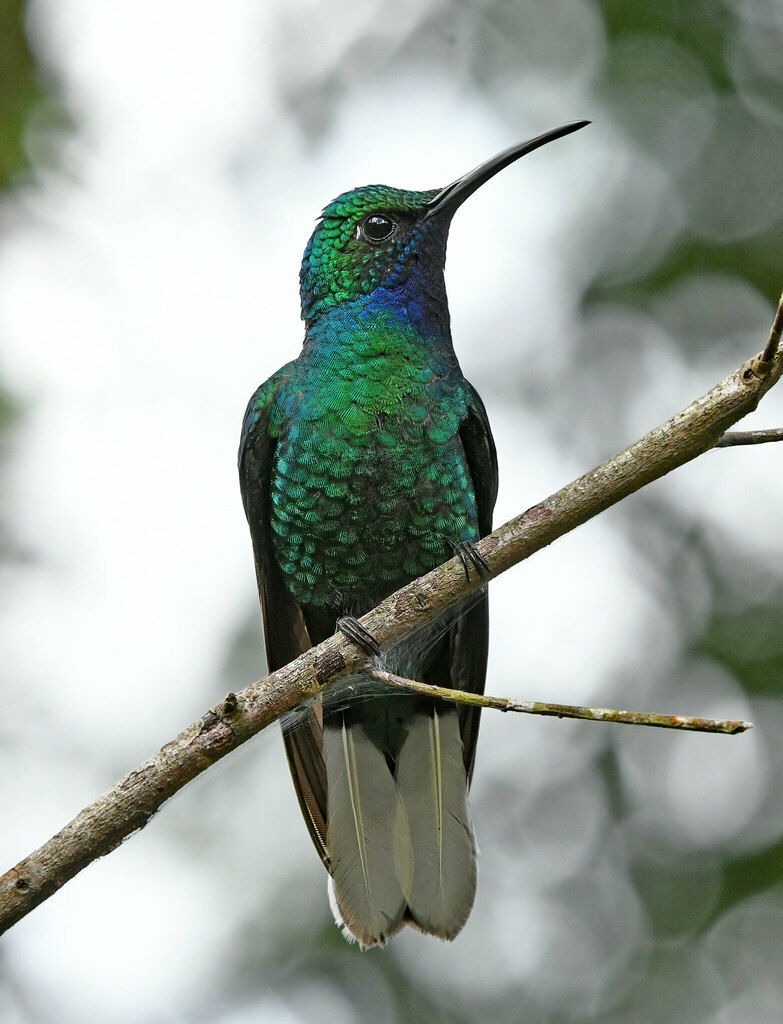
The white-tailed sabrewing (Campylopterus ensipennis) is a large hummingbird that breeds in northeastern Venezuela and Tobago. It was thought to have become extinct in Tobago after Hurricane Flora in 1963, but the population has now largely recovered. This species is now featured on Tobago’s environmental posters under the nickname “Campy”.
From the article White-tailed sabrewing on Wikipedia (CC BY-SA), quoted section by section
Description
The white-tailed sabrewing is about 12 to 13 cm (4.7 to 5.1 in) long. Males weigh 9.5 to 10.5 g (0.34 to 0.37 oz) and females are assumed to be lighter. Both sexes have a black decurved bill and a white spot behind the eye. Males have glittering green upperparts, an iridescent blue to dark violet throat, and glittering green underparts. Their inner two pairs of tail feathers are dark bronzy green; the inner third of the length of the outer three pairs is black and the outer two thirds white. Females are similar but the blue of their throat is smaller and duller and their underparts are pale gray with green spots on the flanks. The shafts of the outer flight feathers are thickened and flattened which gives the distinctive feature of the sabrewings their English and genus names. In this case, both parts of the scientific name refer to this feature, Campylopterus and ensipennis being derived from the Greek and Latin respectively for "bent wing".
Range & habitat
The white-tailed sabrewing is found in two locations in Venezuela, the Cordillera de Caripe and the Paria Peninsula, and also on Tobago. The Tobago population was almost extirpated by Hurricane Flora in 1963 but it appears to have somewhat recovered. The species inhabits montane forest, mature secondary forest, and plantations, especially those of coffee. In elevation it ranges between 400 and 2,000 m (1,300 and 6,600 ft) but on the mainland is most common between 1,000 and 1,600 m (3,300 and 5,200 ft) and all nest records on Tobago are between 300 and 520 m (980 and 1,700 ft).
Wikipedia: “Distribution and habitat”
What it does
The white-tailed sabrewing forages for nectar mostly between the low and middle strata of the forest but in more open landscapes also in treetops. Its diet includes a wide variety of flowering plants. It both trap-lines and defends feeding territories. In addition to nectar, it captures small insects (such as ants and wasps) and spiders by hawking from perches.
Wikipedia: “Feeding”
Listen
Looking for field recordings…
Where it lives
Recorded sightings
—
geo-referenced records in GBIF, from museums, herbaria and field observers.
Drag the globe to turn it. Dots are where records exist, not a range map; darker means more records.
In the stacks
Searching the stacks…
Every page naming Campylopterus ensipennis in the Biodiversity Heritage Library →
This page is assembled live from iNaturalist, GBIF, Wikipedia, the Source Library and the Internet Archive. It is not yet part of the hand-edited codex. iNaturalist taxon 6009.