- Animals
- ›Chordates
- ›Vertebrates
- ›Birds
- ›Swifts and Hummingbirds
- ›Hummingbirds
- ›Bee Hummingbirds, Emeralds, Mountain-gems, and Allies
- ›Emerald Hummingbirds and Allies
- ›Campylopterus
On eBird ↗
Violet Sabrewing
Live sightings near you, the range map, bar charts of when it is seen, and Macaulay Library photos and recordings.
Violet Sabrewing
Campylopterus hemileucurus
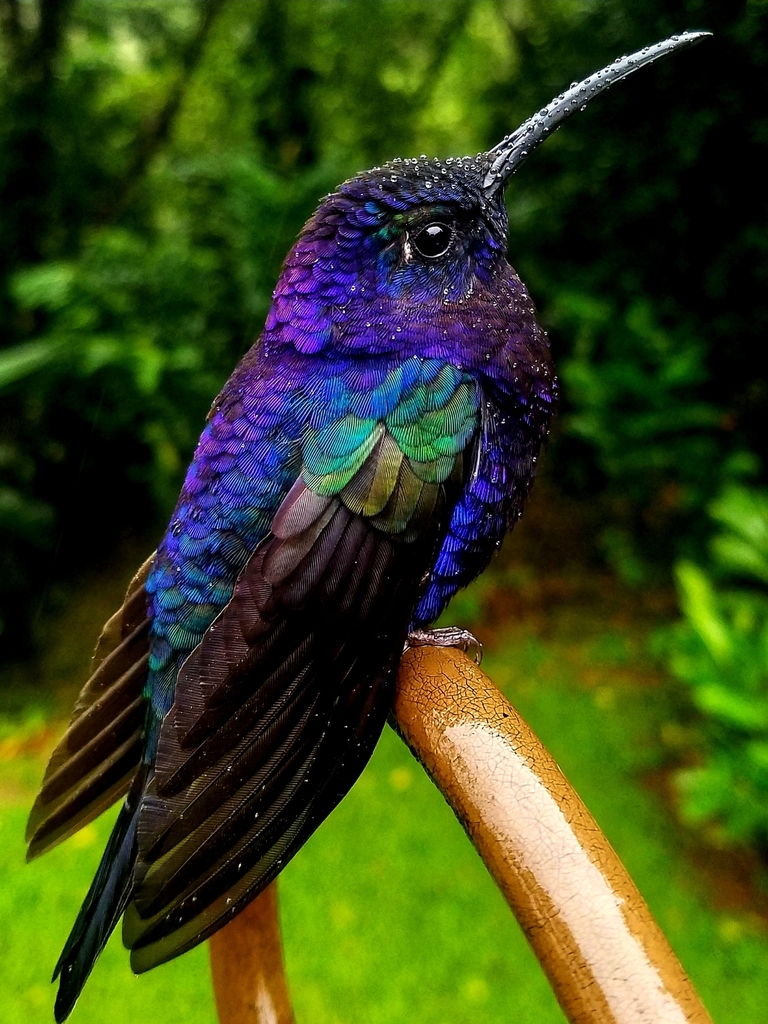
The violet sabrewing (Campylopterus hemileucurus) is a species of hummingbird in the "emeralds", tribe Trochilini of the subfamily Trochilinae. It is found from Mexico to Panama.
From the article Violet sabrewing on Wikipedia (CC BY-SA), quoted section by section
Description
The violet sabrewing is the largest hummingbird of Mexico and Central America. It is 13 to 15 cm (5.1 to 5.9 in) long and weighs 9 to 12 g (0.32 to 0.42 oz). Both sexes have a black bill, though those of subspecies C. h. mellitus are longer than the nominate's. Males of the nominate subspecies have a dusky crown with a bluish green gloss. Their nape and upper back, face, and underparts are metallic violet blue that is somewhat bluer on the belly. Their lower back and uppertail coverts are metallic green. Their central tail feathers are bluish green to bluish black and the rest blackish with wide white tips. Females have a dusky crown and metallic green to bronze green upperparts with a more bluish green rump. They have a violet blue throat. Their underparts are mostly gray with a whiter belly and metallic green spots along the sides and green undertail coverts. Their central tail feathers are bluish green and the rest blacker with wide white tips. Males of subspecies C. h. mellitus have more green on their upper parts than the nominate and almost entirely violet underparts with no blue on the belly. Female's upper-parts have a coppery tinge and their throat is violet.
Range & habitat
The nominate subspecies of violet sabrewing is found from the Mexican states of Guerrero and Veracruz intermittently south through Guatemala, southern Belize, Honduras, and El Salvador into northern Nicaragua. Subspecies C. h. mellitus is found most of the length of Costa Rica into western Panama. The species inhabits the edges and interior of humid evergreen montane forest and mature secondary forest, banana plantations, and gardens. In Mexico, it generally ranges in elevation between 500 and 2,000 m (1,600 and 6,600 ft) but occurs as high as 2,500 m (8,200 ft). In Costa Rica, it ranges between 1,500 and 2,400 m (4,900 and 7,900 ft).
Wikipedia: “Distribution and habitat”
What it does
The violet sabrewing feeds on nectar primarily by trap-lining, visiting a circuit of flowering plants. Males occasionally defend patches of flowers and are dominant over other hummingbirds. The species forages mostly in the understory, often on Heliconia, banana (Musa), Cephalism, and Palic urea though it visits others as well. It frequents nectar (sugar water) feeders and chases other hummingbirds from them. In addition to nectar, violet sabrewings also eat arthropods gleaned from foliage and spiderwebs.
Wikipedia: “Feeding”
Listen
Looking for field recordings…
Where it lives
Recorded sightings
—
geo-referenced records in GBIF, from museums, herbaria and field observers.
Drag the globe to turn it. Dots are where records exist, not a range map; darker means more records.
In the stacks
Searching the stacks…
Every page naming Campylopterus hemileucurus in the Biodiversity Heritage Library →
This page is assembled live from iNaturalist, GBIF, Wikipedia, the Source Library and the Internet Archive. It is not yet part of the hand-edited codex. iNaturalist taxon 5987.