- Animals
- ›Chordates
- ›Vertebrates
- ›Birds
- ›Swifts and Hummingbirds
- ›Hummingbirds
- ›Bee Hummingbirds, Emeralds, Mountain-gems, and Allies
- ›Emerald Hummingbirds and Allies
- ›Hylocharis
On eBird ↗
Rufous-throated Sapphire
Live sightings near you, the range map, bar charts of when it is seen, and Macaulay Library photos and recordings.
Rufous-throated Sapphire
Hylocharis sapphirina
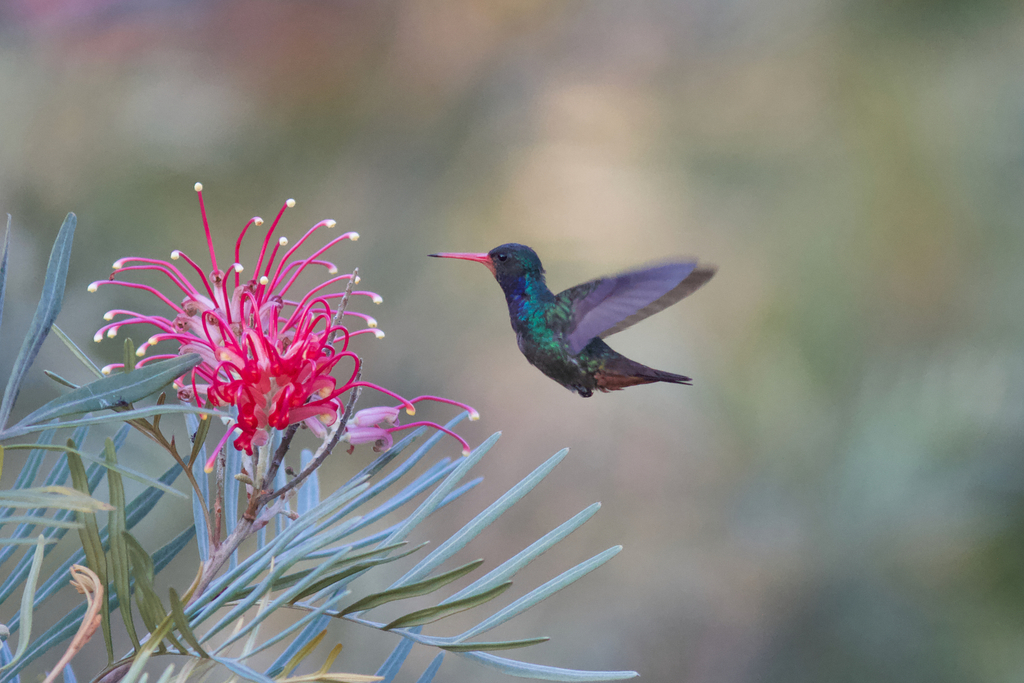
The rufous-throated sapphire (Amazilia sapphirina) is a species of hummingbird in the Trochilidae family. It is found at forest edge, savanna-like habitats and plantations in northern and central South America. Previously placed within Hylocharis, it now belongs to the Amazilia genus.
From the article Rufous-throated sapphire on Wikipedia (CC BY-SA), quoted section by section
Description
The rufous-throated sapphire is 8.4 to 9.1 cm (3.3 to 3.6 in) long. Males weigh 4.1 to 4.5 g (0.14 to 0.16 oz) and females 3.9 to 4.3 g (0.14 to 0.15 oz). Males have a medium length, straight, coral red bill with a black tip; females' bills have less red. The species gets its English name from the males' intensely rufous chin; females' chins are a paler rufous. Adult males have dark green upperparts with coppery violet uppertail coverts. Their throat, chest, and belly are iridescent violet-blue and their undertail coverts chestnut. Their central pair of tail feathers are coppery with a violet tinge and the other four pairs chestnut with dusky gray tips. Adult females' upperparts are the same as males'. Their underparts are grayish with large glittering blue-green spots on the throat and chest and buffy undertail coverts. Their tail is like the male's with paler edges on the outer feathers. Juveniles are similar to adult females but males have richer rufous on the chin.
Range & habitat
The rufous-throated sapphire has three separate ranges. The largest spans from eastern Colombia east through Venezuela, the Guianas, and northern Brazil to the coast, from Colombia southwest through eastern Ecuador into northern Peru, and southwest in a wide swath from northeastern Brazil into northeastern Bolivia. Another spans from southeastern Brazil's Bahia state south to northern Paraná. The third encompasses southeastern Paraguay, northeastern Argentina, and adjacent southwestern Brazil according to the International Ornithological Committee and the Clements taxonomy. The South American Classification Committee of the American Ornithological Society lists the species as hypothetical in Paraguay and Argentina because the records have not been documented by photographs or other tangible evidence. The rufous-throated sapphire inhabits semi-open to open landscapes such as the edges of lowland forest, savanna with scattered stands of trees, clearings around rock outcrops, coffee plantations, and (rarely) open coastal vegetation. In elevation it is most numerous between 200 and 500 m (660 and 1,600 ft) but occurs as high as 1,850 m (6,100 ft).
Wikipedia: “Distribution and habitat”
What it does
The rufous-throated sapphire forages for nectar at a variety of flowering epiphytes, shrubs, vines, and trees. Species in least seven families are known nectar sources. It usually feeds from near the ground to the middle strata of forest, but in Amazonia will gather with other hummingbirds at flowering treetops. Males aggressively defend feeding territories. In addition to nectar the species feeds on insects caught by hawking from a perch and also gleaned from leaves or spiderwebs.
Wikipedia: “Feeding”
Listen
Looking for field recordings…
Where it lives
Recorded sightings
—
geo-referenced records in GBIF, from museums, herbaria and field observers.
Drag the globe to turn it. Dots are where records exist, not a range map; darker means more records.
In the stacks
Searching the stacks…
Every page naming Hylocharis sapphirina in the Biodiversity Heritage Library →
This page is assembled live from iNaturalist, GBIF, Wikipedia, the Source Library and the Internet Archive. It is not yet part of the hand-edited codex. iNaturalist taxon 5974.