- Animals
- ›Chordates
- ›Vertebrates
- ›Birds
- ›Swifts and Hummingbirds
- ›Hummingbirds
- ›Bee Hummingbirds, Emeralds, Mountain-gems, and Allies
- ›Emerald Hummingbirds and Allies
- ›Thalurania
On eBird ↗
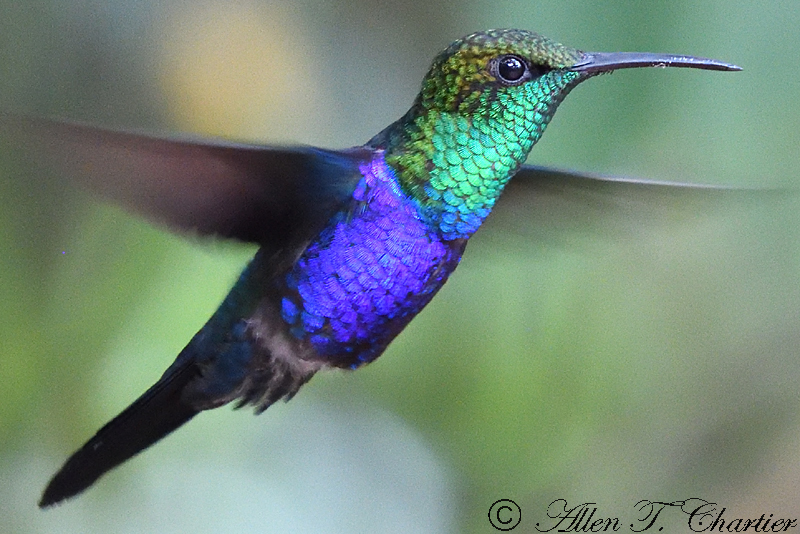
Fork-tailed Woodnymph
Live sightings near you, the range map, bar charts of when it is seen, and Macaulay Library photos and recordings.
Fork-tailed Woodnymph
Thalurania furcata
The fork-tailed woodnymph (Thalurania furcata) is a species of hummingbird in the family Trochilidae. It is found in Argentina, Bolivia, Brazil, Colombia, Ecuador, French Guiana, Guyana, Paraguay, Peru, Suriname, Trinidad and Tobago, and Venezuela. Its natural habitats are subtropical or tropical moist lowland forests, subtropical or tropical moist montane forests, and heavily degraded former forest.
From the article Fork-tailed woodnymph on Wikipedia (CC BY-SA), quoted section by section
Description
Fork-tailed woodnymph males are 9.5 to 12.9 cm (3.7 to 5.1 in) long and weigh 3.6 to 6 g (0.13 to 0.21 oz). Females are 8 to 10.7 cm (3.1 to 4.2 in) long and weigh 3 to 5 g (0.11 to 0.18 oz). Both sexes of all subspecies have a straight, black, medium-length bill. Adult males of the nominate subspecies have mostly dark bronzy green upperparts, dark dusky bronze crown and nape, and a violet band across the upper back. Their throat is glittering green, the belly violet, and the undertail coverts dark steely blue with dull white edges. Their tail is forked and blue-black. The nominate adult female has bright green upperparts with a duller and more bronze crown. Its underparts are pale gray. The tail is green near the base and the rest steely blue-black with white tips on the outer three pairs of feathers. Juvenile males are dull bronze-green above and dusky bronze-green below. Juvenile females are more bronzy green above than the adult and some feathers have buffy fringes. Subspecies T. f. refulgens and T. f. orenocensis are essentially like the nominate. T. f. fissilis males have solid blue undertail coverts. T. f. nigrofasciata males have golden-green upperparts, a band of black between the extensive green throat and the violet belly, and a gap in the violet band on the upper back. The male T. f. …
Range & habitat
The subspecies of fork-tailed woodnymph are found thus"
T. f. refulgens, Paria Peninsula and Sierra de Cumaná of northeastern Venezuela T. f. furcata, from extreme eastern Venezuela through the Guianas to northeast Brazil north of the Amazon T. f. fissilis, southeastern Venezuela, extreme western Guyana, and Roraima in northern Brazil T. f. orenocensis, upper Orinoco basin of southern Venezuela T. f. nigrofasciata, Colombia's Guainía Department, southern Venezuela's Amazonas state, and the upper Rio Negro in northwestern Brazil T. f. viridipectus, eastern Colombia, eastern Ecuador, and northeastern Peru T. f. jelskii, eastern Peru and adjoining western Brazil T. f. simoni, south of the Amazon in extreme eastern Peru and western Brazil T. f. balzani, north-central Brazil south of the Amazon east to the Rio Tapajós T. f. furcatoides, eastern Brazil south of the Amazon east of the Tapajós T. f. boliviana, southeastern Peru through east-central Bolivia into Santa Cruz Department T. f. baeri, northeastern and central Brazil to southern Bolivia and northwestern and north-central Argentina T. f. eriphile, southeastern Brazil from Bahia south into Paraguay and northeastern Argentina's Misiones Province The fork-tailed woodnymph inhabits a variety of landscapes within Amazonia. …
Wikipedia: “Distribution and habitat”
What it does
The fork-tailed woodnymph forages for nectar at all levels of its habitat, utilizing a wide variety of flowering plants, shrubs, vines, and trees. Males often defend flower patches against both conspecifics and other hummingbird species. Females are sometimes territorial but more often forage by trap-lining, visiting a circuit of nectar sources. In addition to nectar, the species captures small arthropods on the wing and sometimes by gleaning from foliage.
Wikipedia: “Feeding”
Listen
Looking for field recordings…
Where it lives
Recorded sightings
—
geo-referenced records in GBIF, from museums, herbaria and field observers.
Drag the globe to turn it. Dots are where records exist, not a range map; darker means more records.
In the stacks
Searching the stacks…
Every page naming Thalurania furcata in the Biodiversity Heritage Library →
This page is assembled live from iNaturalist, GBIF, Wikipedia, the Source Library and the Internet Archive. It is not yet part of the hand-edited codex. iNaturalist taxon 5948.