- Animals
- ›Chordates
- ›Vertebrates
- ›Birds
- ›Swifts and Hummingbirds
- ›Hummingbirds
- ›Brilliants, Coquettes, and Allies
- ›Brilliants and Allies
- ›Heliodoxa
On eBird ↗
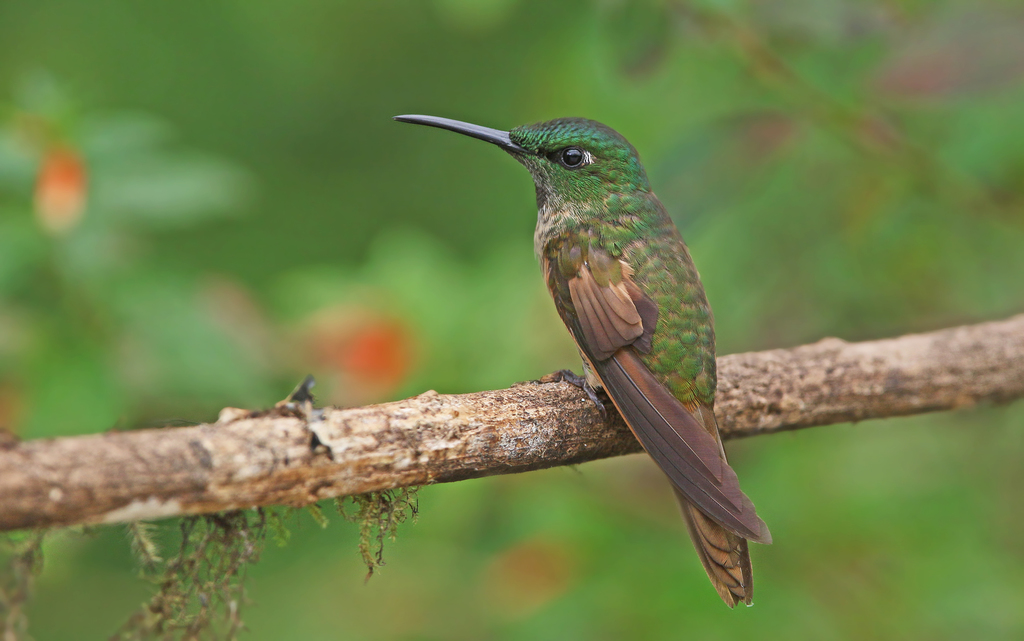
Fawn-breasted Brilliant
Live sightings near you, the range map, bar charts of when it is seen, and Macaulay Library photos and recordings.
Fawn-breasted Brilliant
Heliodoxa rubinoides
The fawn-breasted brilliant (Heliodoxa rubinoides) is a medium-sized species of hummingbird in the family Trochilidae. It is native to South America, where it occurs in Bolivia, Colombia, Ecuador, and Peru. Other common names include lilac-throated brilliant in English and brillante pechigamuza, colibrí de vientre ocre, and diamante pechigamuza in Spanish.
From the article Fawn-breasted brilliant on Wikipedia (CC BY-SA), quoted section by section
Description
The fawn-breasted brilliant is a medium-sized hummingbird, measuring 11 to 13 cm (4.3 to 5.1 in) in length and weighing approximately 7.2 to 10.2 g (0.25 to 0.36 oz). The bill is stout, fairly long (22–27 mm (0.87–1.06 in)), slightly decurved, and black. Adult males have shining bronzy-green upperparts, with coppery tones on the wing coverts and a slightly forked, coppery-green tail. The underparts are warm buffy-cinnamon, with irregular green spotting on the flanks and throat sides. A distinctive feature is the small, isolated pinkish to lilac gorget patch on the lower throat. Females are similar but have duller plumage, more extensive green spotting on the underparts, and a smaller or absent throat patch. Juveniles resemble females but have buffy fringes on the head feathers.
Range & habitat
The fawn-breasted brilliant is found in the Andes from western Colombia south to central Bolivia. It inhabits humid montane forests and cloud forests, primarily in the lower to mid-levels of the forest interior. It occasionally occurs at shaded forest borders, clearings, and near feeders. The species is found at elevations between 1,000 and 2,600 m (3,300 and 8,500 ft), though most records are from 1,100 to 2,200 m (3,600 to 7,200 ft). It is generally uncommon and patchily distributed in natural habitats, but can be more frequently observed at nectar feeders.
Wikipedia: “Distribution and habitat”
What it does
The diet of the fawn-breasted brilliant consists primarily of nectar from a variety of brightly colored, tubular flowers. It supplements this with small insects and spiders, which provide essential protein, especially during the breeding season. The bird catches insect prey by hawking in flight, gleaning from foliage, and plucking from spider webs. When feeding on nectar, it hovers before the flower or perches and hangs from it, inserting its long tongue up to 13 times per second. The species is strongly territorial around high-quality nectar sources, aggressively chasing away intruders such as other hummingbirds, bumblebees, and hawk moths.
Wikipedia: “Diet”
Listen
Looking for field recordings…
Where it lives
Recorded sightings
—
geo-referenced records in GBIF, from museums, herbaria and field observers.
Drag the globe to turn it. Dots are where records exist, not a range map; darker means more records.
In the stacks
Searching the stacks…
Every page naming Heliodoxa rubinoides in the Biodiversity Heritage Library →
This page is assembled live from iNaturalist, GBIF, Wikipedia, the Source Library and the Internet Archive. It is not yet part of the hand-edited codex. iNaturalist taxon 5921.