- Animals
- ›Chordates
- ›Vertebrates
- ›Birds
- ›Swifts and Hummingbirds
- ›Hummingbirds
- ›Brilliants, Coquettes, and Allies
- ›Brilliants and Allies
- ›Heliodoxa
On eBird ↗
Empress Brilliant
Live sightings near you, the range map, bar charts of when it is seen, and Macaulay Library photos and recordings.
Empress Brilliant
Heliodoxa imperatrix
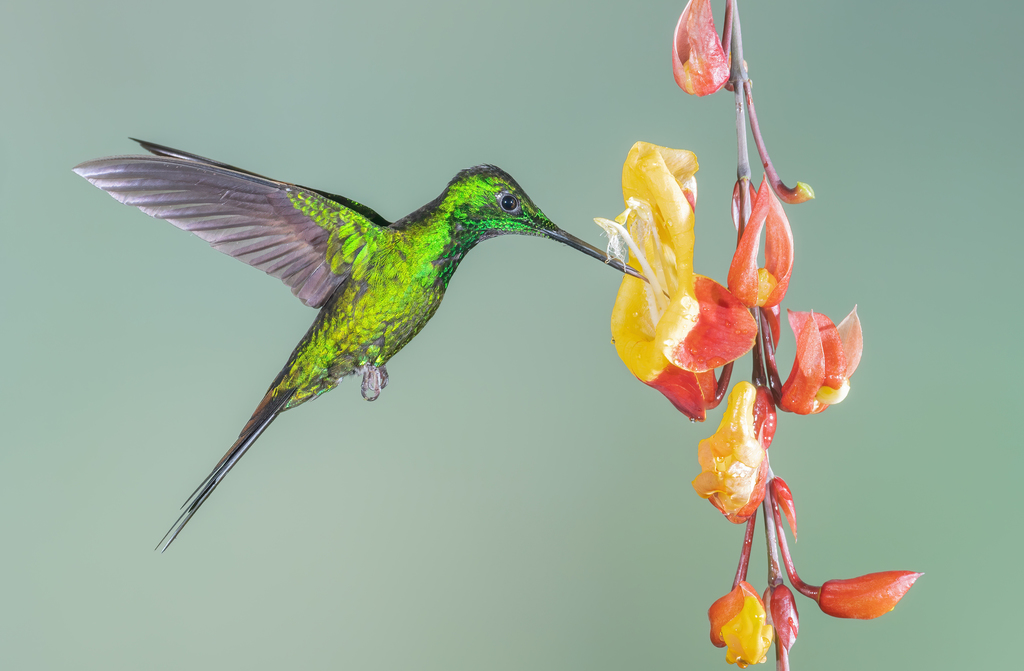
The empress brilliant (Heliodoxa imperatrix) is a species of hummingbird in the "brilliants", tribe Heliantheini in subfamily Lesbiinae. It is found in Colombia and Ecuador.
From the article Empress brilliant on Wikipedia (CC BY-SA), quoted section by section
Description
Male empress brilliants are 15 to 17 cm (5.9 to 6.7 in) long and weigh about 9.3 g (0.33 oz). Females are 12 to 13.5 cm (4.7 to 5.3 in) long and weigh about 8.3 g (0.29 oz). The adult male's forehead, face, and breast are mostly glittering dark green, with a square glittering pale violet patch in the center of the throat. Its crown and nape are dark green and the rest of the upperparts dark bronzy green. Its belly is glittering golden green. The central tail feathers are dark bronze and the rest longer and black with a bronze gloss. The adult female's upperparts are bronzy green. The center of its throat and breast are grayish with much bronzy green flecking, the flanks solid bronzy green, and the belly golden green. The central tail feathers are bronzy green and the others dull black with a bronze gloss. Immature males have a dull dark bronzy green head, throat, and breast; bright buff chin and sides of the throat; and a duller and bronzier green belly than the adult. Immature females also have a buffy chin, and the green feathers of the breast are duller than the adult's and have buffy fringes.
Range & habitat
The empress brilliant is found on the Pacific slope of the Andes from Colombia's Chocó Department south into Ecuador as far as Pichincha Province. It inhabits a variety of very wet landscapes including foothill forest, the interior and edges of cloudforest, and mature secondary forest. In elevation it ranges from 400 to 2,000 m (1,300 to 6,600 ft).
Wikipedia: “Distribution and habitat”
What it does
Both sexes of empress brilliant forage from the mid-level to the forest canopy, and females also forage in the understorey. A primary source of nectar are the flowers of Marcgravia and Marcgraviastrum vines, where it perches to feed. It also feeds by hovering under drooping flowers of Ericaceae. In addition to feeding on nectar, it also captures small insects by gleaning from foliage and hawking from a perch.
Wikipedia: “Feeding”
Listen
Looking for field recordings…
Where it lives
Recorded sightings
—
geo-referenced records in GBIF, from museums, herbaria and field observers.
Drag the globe to turn it. Dots are where records exist, not a range map; darker means more records.
In the stacks
Searching the stacks…
Every page naming Heliodoxa imperatrix in the Biodiversity Heritage Library →
This page is assembled live from iNaturalist, GBIF, Wikipedia, the Source Library and the Internet Archive. It is not yet part of the hand-edited codex. iNaturalist taxon 5919.