- Animals
- ›Arthropods
- ›Hexapods
- ›Insects
- ›Winged and Once-winged Insects
- ›Butterflies and Moths
- ›Butterflies
- ›Brush-footed Butterflies
- ›Checkerspots, Anglewings, Peacocks, and Allies
- ›Checkerspots
- ›Euphydryas
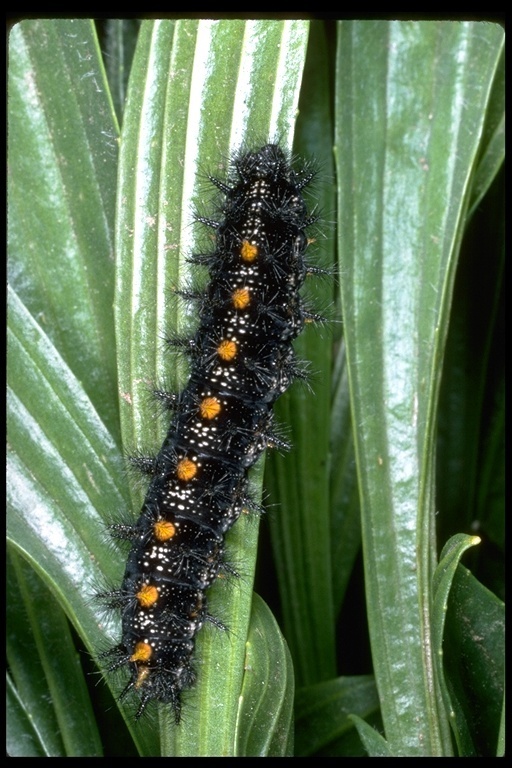
Edith's Checkerspot
Euphydryas editha
Edith's checkerspot (Euphydryas editha) is a species of butterfly in the family Nymphalidae. It is a resident species of western North America and among the subspecies, entomologists have long been intrigued by their many phenotypic variations in coloration, wing length, and overall body size. Most populations are monophagous and rely on plants including Plantago erecta, Pedicularis semibarbata, Collinsia torreyi and Orthocarpus densiflorus as their host species in developing from eggs through to larvae, pupae, and mature butterflies. Males exhibit polygyny whereas females rarely mate more than once. Males devote most of their attention to mate acquisition, and such mate locating strategies such as hilltopping behavior have developed. Climate change, range shifts and habitat destruction have impacted certain subspecies. Three subspecies in particular, Euphydryas editha quino, Euphydryas editha bayensis and Euphydryas editha taylori, are currently under protection via the Endangered Species Act.
From the article Edith's checkerspot on Wikipedia (CC BY-SA), quoted section by section
Description
The Edith's checkerspot can be identified by its wings which are black with red and pale yellow or white bands. It also has a submarginal band that consists of yellow or white spots along with a wide postmedian band that is red. The undersides of the wings consists of alternating bands of yellow orange and cream. The wingspan is 3.2 to 5.1 centimetres (1.3 to 2.0 in). However, the subspecies of Edith's checkerspot vary slightly in appearance based on the areas they routinely inhabit. Coastal populations are black with red and cream spots; mountain populations are red or mottled with red, black, and cream spots. The higher-altitude populations are smaller and darker. The larvae of the butterfly are black, spotted with white or orange, or striped with white. The pupae are white or gray, with black blotches and streaks.
Range & habitat
The Edith's checkerspot is found in North America, where it ranges from southern British Columbia and Alberta south to Baja California, Nevada, Utah, and Colorado. The species can be found in locations of the San Bernardino Mountains, Sierra Nevada, higher Cascade Mountains of Oregon to Washington, and in areas of the Great Basin, including central Oregon and the Rocky Mountains. It can also be found on several trails such as Animas River Trail, Falls Creek Trail, Colorado Trail, Hermosa Creek Trail, Engineer Mountain Trail, and Spud Lake Trail.
Wikipedia: “Distribution”
What it does
Populations of Edith's checkerspots use several different hosts to house and feed their larvae. Though they usually do not pollinate the flowers of the host, larvae have been known to eat the leaves, the flowers, and sometimes the entire host plant, and have starved trying to find another. Adult females and females feed on flower nectar. Caterpillars feed on leaves and flowers of the host plant and sometimes surrounding plants. Pre-diapause larvae tend to show stronger preference for particular host plants and only feed on the plant where they hatch from the egg, wheareas post-diapause larve are more generalist and feed on a variety of plants.
Wikipedia: “Feeding”
Listen
Looking for field recordings…
Where it lives
Recorded sightings
—
geo-referenced records in GBIF, from museums, herbaria and field observers.
Drag the globe to turn it. Dots are where records exist, not a range map; darker means more records.
In the stacks
Searching the stacks…
Every page naming Euphydryas editha in the Biodiversity Heritage Library →
This page is assembled live from iNaturalist, GBIF, Wikipedia, the Source Library and the Internet Archive. It is not yet part of the hand-edited codex. iNaturalist taxon 59182.