- Animals
- ›Chordates
- ›Vertebrates
- ›Birds
- ›Swifts and Hummingbirds
- ›Hummingbirds
- ›Brilliants, Coquettes, and Allies
- ›Brilliants and Allies
- ›Heliodoxa
On eBird ↗
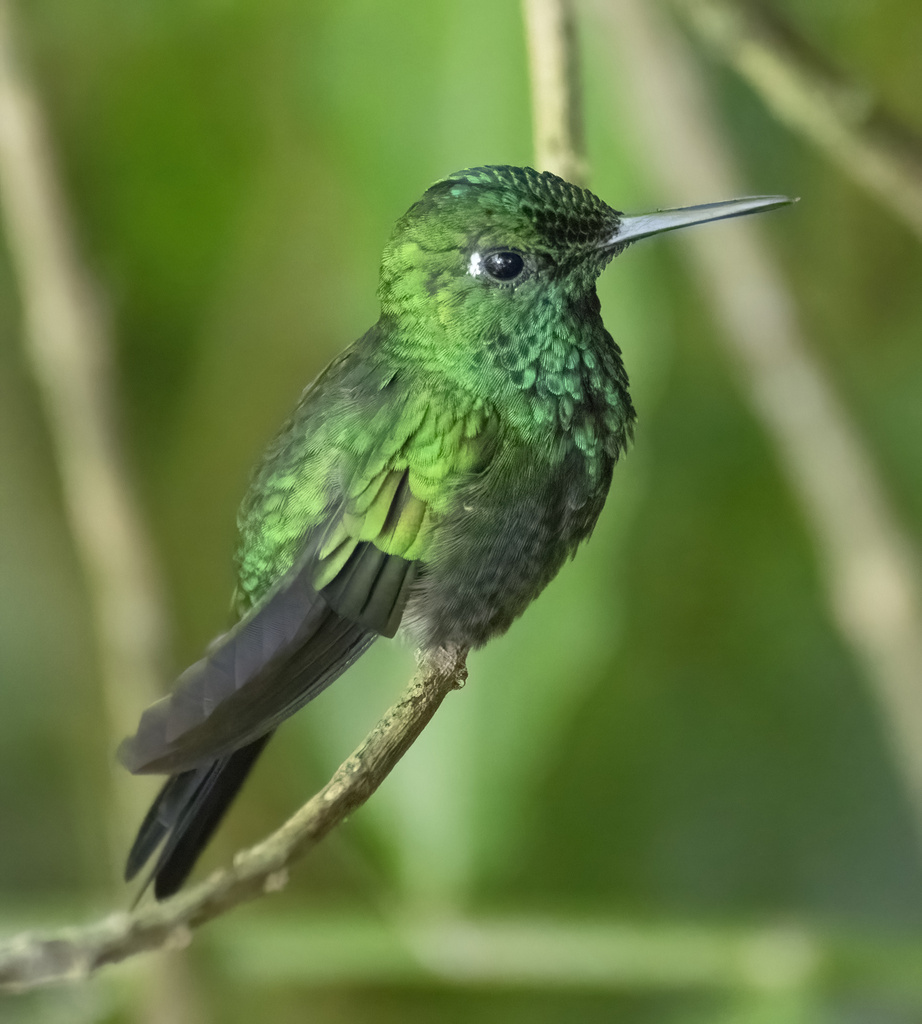
Green-crowned Brilliant
Live sightings near you, the range map, bar charts of when it is seen, and Macaulay Library photos and recordings.
Green-crowned Brilliant
Heliodoxa jacula
The green-crowned brilliant (Heliodoxa jacula) is a large, robust hummingbird that is a resident breeder in the highlands from Costa Rica to western Ecuador. It is also known as the green-fronted brilliant, notably by the Handbook of the Birds of the World.
From the article Green-crowned brilliant on Wikipedia (CC BY-SA), quoted section by section
Description
Male green-crowned brilliants are 12 to 13 cm (4.7 to 5.1 in) long and females 10.5 to 12 g (0.37 to 0.42 oz). One female weighed 7.4 g (0.26 oz). Both sexes of all subspecies have a white spot behind the eye and a forked tail, though that of the female is not as deeply indented as the male's. Adult males of the nominate subspecies have a glittering green to blue-green head and breast with a small metallic violet-blue patch on the throat. The upperparts and belly are bronzy green, the vent area white, and the thighs also white. The tail is blue-black. Adult females' blue-green head is not shiny like the male's. They also have a short white malar stripe. Their underparts are whitish and heavily spotted with green; the spots merge on the flanks. The tail is black and the outer feathers have white tips. Immature males have a dull bronzy green crown and underparts, a bright buff chin and malar, and a shallowly forked tail. Immature females have a bright buff throat and duller green spots on the underparts than the adult. Subspecies H. j. henryi is larger than the nominate. Males' heads have a more brilliant glitter than the nominate's and their plumage is greener with less or no blue. Females have more white on their underparts and the separate green spots extend onto the flanks. Males of H. j. …
Range & habitat
The nominate subspecies of green-crowned brilliant is found from Panamá Province in eastern Panama into Colombia, where it inhabits all three Andean ranges. H. j. henryi is found more northerly, from Costa Rica south and east into Panama as far as Coclé Province. H. j. jamersoni is found from Colombia's Nariño Department (and possibly from further north in Cauca Department) south along the western slope of the Andes of Ecuador at least as far as El Oro Province. The green-crowned brilliant inhabits a variety of landscapes including the interior, edges, and clearings of humid sub-montane and montane forest; mature secondary forest; and gardens. In elevation it generally ranges between 700 and 2,200 m (2,300 and 7,200 ft) in Costa Rica, though sometimes as low as 100 m (330 ft). In Panama it is usually found between 500 and 2,100 m (1,600 and 6,900 ft), in Colombia between 300 and 1,700 m (980 and 5,600 ft), and in Ecuador between 500 and 1,550 m (1,600 and 5,100 ft). There are also records as low as 300 m (980 ft) in Ecuador.
Wikipedia: “Distribution and habitat”
What it does
The green-crowned brilliant usually forages in the middle and upper strata of the forest. A primary source of nectar is Marcgravia vines, and females also feed at small understory plants. Males sometimes defend Marcgravia patches, though they also nectar by trap-lining, visiting a circuit of flowering plants. The species usually clings to flowers to feed rather than hovering.
Wikipedia: “Feeding”
Listen
Looking for field recordings…
Where it lives
Recorded sightings
—
geo-referenced records in GBIF, from museums, herbaria and field observers.
Drag the globe to turn it. Dots are where records exist, not a range map; darker means more records.
In the stacks
Searching the stacks…
Every page naming Heliodoxa jacula in the Biodiversity Heritage Library →
This page is assembled live from iNaturalist, GBIF, Wikipedia, the Source Library and the Internet Archive. It is not yet part of the hand-edited codex. iNaturalist taxon 5914.